
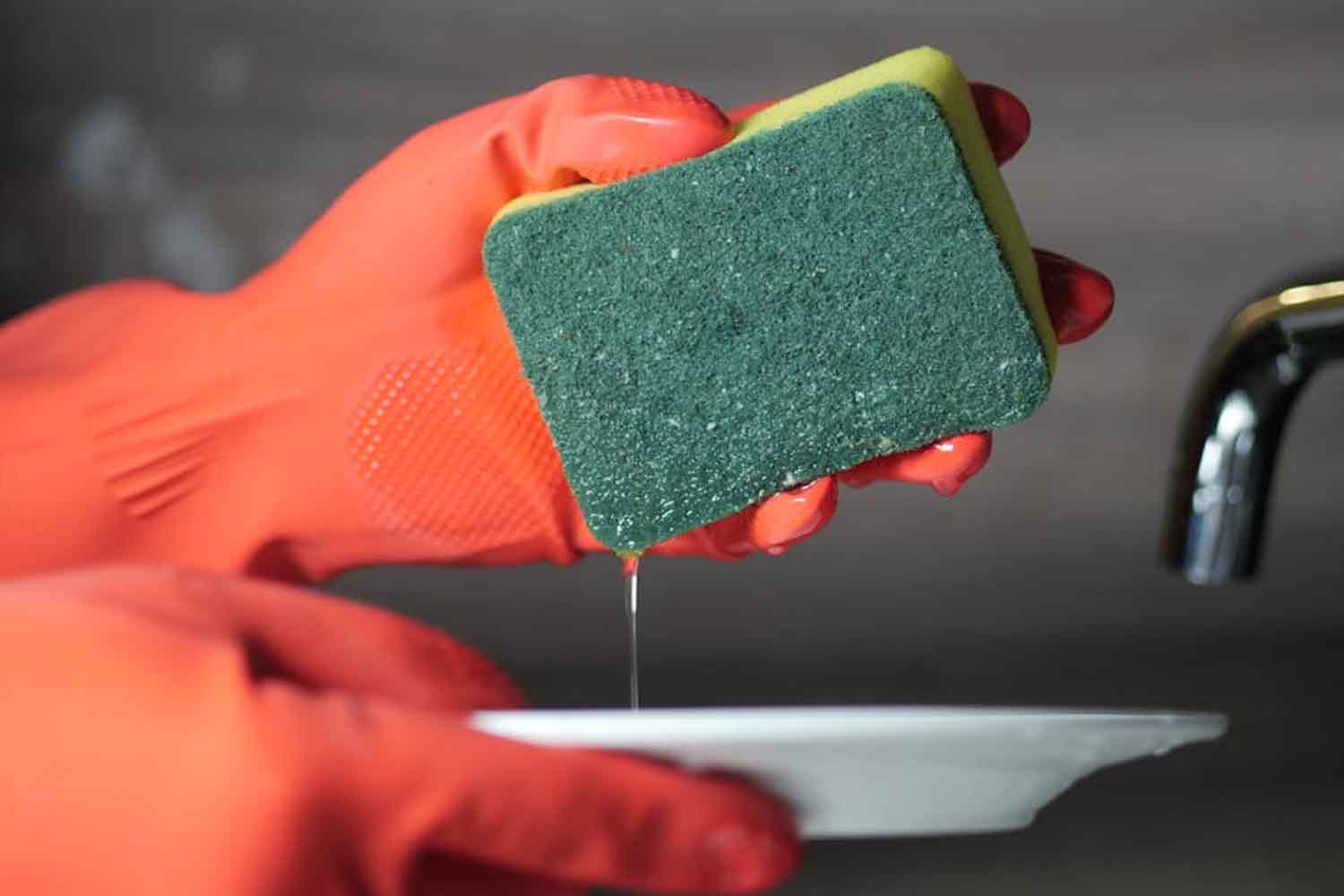
In the sink everything happens without great theater. A greasy plate, a pan left there for “just five minutes” and become an archaeological find, the detergent that foams, the sponge wrung out with that little domestic violence that no one really considers violence. We use it, we rinse it, we leave it on the edge of the sink to take on that sad shape of a tired object. Then we take it back. And she, every time, loses something.
The kitchen sponge seems harmless precisely because it is one of the most normal things we have at home. He stands there next to the tap, more present than many people we say we hang out with. Yet, as she scrapes away sauce, oil, coffee residue, she too is consumed. Tiny fragments of plastic break off from the surface and end up in the wastewater. Microplastics, in fact. Very small, invisible during the gesture, much less invisible when we begin to multiply that gesture by millions of kitchens.
A recent study tried to measure just this: how many plastic particles a sponge releases during daily use and how much this release really weighs on the environment. The result is double-sided, inconvenient enough to avoid the usual sink alarm. Sponges release microplastics, yes. Some models release many more than others. The greatest environmental damage from manual washing, however, comes from the water we let flow.
Plastic in the sink
The work brought together two worlds that usually look at each other from afar: the laboratory and the real kitchen. On the one hand there were controlled tests, on the other families in Germany and North America who used three different types of sponge in their normal washing habits. No perfect advertising scene, no hand soaping an already clean plate under a catalog light. Real dishes, real sinks, real rush.
The sponges were weighed before and after use to understand how much material they had lost. In the laboratory, however, an automatic device was used capable of reproducing the mechanical stress of washing, that repeated pressure that we apply without thinking when we insist on a baking tray or the bottom of a pot. The name of the system almost seems like it came out of a cartoon, SpongeBot, but the task was very serious: simulate daily abrasion and observe what ends up going away.
All the sponges analyzed lost material. The quantity varies greatly depending on the type. Annual estimates range from approximately 0.68 grams to 4.21 grams of microplastics per person. Reading it like that seems like a tiny, almost ridiculous figure. A crumb. The problem, as always with microplastics, comes when the crumb is repeated by millions of hands, millions of sinks, millions of sponges bought, used, squeezed and thrown away.
Sponges with a lower proportion of plastic release fewer particles. Those with more plastic, on the contrary, become a much more generous source of fragments. In a theoretical scenario applied to all German households, the use of a particular type of sponge could lead to up to 355 tons of microplastics per year. An invisible mountain, built one plate at a time.
A significant part of these particles is retained by wastewater treatment plants. This passage matters, because it avoids imagining every single fragment fleeing towards the sea. Several tons, however, can still reach aquatic environments or soil. Rivers, lakes, oceans, land. The kitchen, in this story, stops being a closed room and goes back to being connected to everything else, through pipes that we usually prefer to forget.
The faucet weighs more
The most useful data, however, comes when the research broadens its gaze and calculates the overall environmental impact of hand washing. Here the sponge remains in the dock, with its plastic particles, but the most cumbersome protagonist becomes the tap. According to life cycle analysis, between 85 and 97% of the total impact of manual washing depends on water consumption.
It is less convenient information, because it shifts responsibility from the product to the behavior. Changing sponges is simple, almost reassuring. You buy a different model and you already feel more tidy inside. Changing the way we wash the dishes requires more attention: turn off the water while soaping, avoid leaving the jet open due to inertia, collect the dishes before starting, wash more carefully. Trivial gestures, therefore often ignored.
The kitchen sponge, from this perspective, becomes a much more interesting object than it deserves at first sight. It tells you something that applies to many domestic consumption: the material matters, the way of use matters even more. A sponge with less plastic can reduce the release of microplastics. A sponge used longer can reduce overall resource consumption. A tap left open all the time can erase much of the good intentions accumulated elsewhere.
The research, in fact, suggests three very concrete directions. Using less water when washing remains the choice with the greatest environmental effect. Choosing sponges with a lower plastic content helps limit the release of particles. Keeping the same sponge in use for longer, when it remains clean and usable, reduces the need to produce and buy more. No biolit shelf revolution. Just a sink managed with fewer automations.
A less automatic choice
The delicate point also concerns the way in which we look at “small” objects. The kitchen sponge is cheap, needs to be changed often, and seems to have been created to be consumed without worries. It is precisely this apparent irrelevance that makes it easy to underestimate. Part of the dispersion of microplastics that we struggle to see is hidden in everyday household products, because it occurs in actions that are too familiar to seem polluting.
The kitchen has already been indicated by several studies as an environment in which microplastics can appear from multiple sources: utensils, packaging, fabrics, containers, abrasion of synthetic materials. The sponge enters this list with a particular characteristic: it is rubbed, wet, wrung out and worn precisely to do its job. When it works well, it gets ruined. When it spoils, it lets go of particles.
This doesn’t turn every wash into a miniature environmental catastrophe. However, it transforms the sponge into an object to be chosen more carefully. Alternatives with less plastic, when effective and durable, make sense. Duration also has an impact: throwing away a sponge that can only be used out of habit increases material consumption, while keeping it beyond the hygiene limit becomes another problem. We need that unspectacular measure that we know very well at home: understanding when something is still good and when it’s just pretending.
The work involved different skills, from biology to life cycle analysis, through environmental technologies and evaluation of the effects on ecosystems. This part matters because it avoids reducing everything to particle counting. Microplastics are a piece of history. Water, energy, materials, production and disposal build the rest of the picture.
For those who wash the dishes every day, the practical consequence is less dramatic than the alarmed headlines would like. The kitchen sponge should be chosen better, used wisely and replaced without waste. The tap must be looked after, because the continuous jet weighs more than it seems. The difference begins there, in the sound of the water flowing while we are still looking for the pot to soap.
You might also be interested in:
