
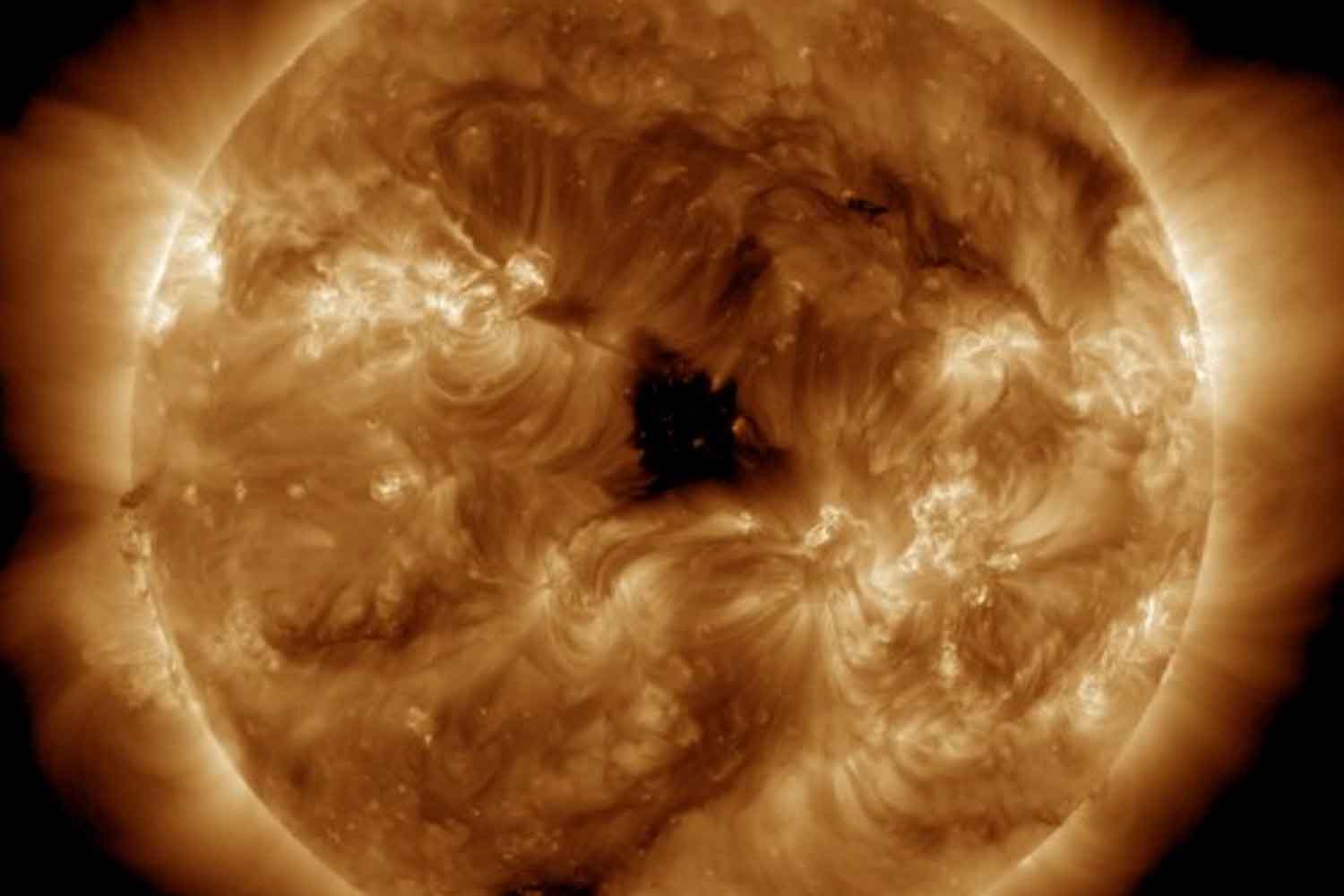
The Sun makes noise even when from here it seems like just a bright ball hanging above our days. A noise that the eyes ignore, because it travels in radio waves, within a language made of charged particles, magnetic fields, plasma and sudden bursts of energy. Usually these signals arrive, turn on, disturb the instruments for a few hours or a few days and then disappear. In August 2025, however, one of these radio bursts decided to behave in a much less polite way: it remained lit for 19 days. An enormous time, out of scale, long enough to force scientists to revisit an apparently simple question: what, in the Sun’s atmosphere, can keep a signal alive for so long?
The previous record for an event of this type stood at around five days. Here the signal almost quadrupled that duration, transforming an already known phenomenon into a case difficult to dismiss as a simple solar oddity. It was a Type IV solar radio bursta category linked to energetic electrons trapped inside large magnetic structures around the Sun. Radio waves, taken alone, travel through space without posing a direct danger to those living on Earth. The magnetic context that produces them, however, belongs to the same family of phenomena that can accompany solar flares capable of disturbing satellites, probes, communications and activities in space.
The signal that rotated with the Sun
The duration of the phenomenon immediately created a practical problem. The Sun rotates, and therefore the area from which the signal came came in and out of the field of vision of individual space observers. No probe could track it alone all the time. The reconstruction came by putting together observations collected by several instruments scattered across the inner Solar System: Parker Solar ProbeWind, STEREO and Solar Orbiter, mission conducted by the European Space Agency together with NASA. Each vehicle saw a piece of history, a few days at a time, as the sun’s rotation moved the source in front of one observer and then in front of another.
This sort of scientific relay provided a precious clue. The signal moved with the rotation of the Sun. It did not appear as a series of different flares born by chance in the same area, one after the other. It seemed like a unique, stable structure, capable of staying lit while being dragged by the movement of the star. A magnetic furnace that continued to hold the electrons prisoner and make them visible to the instruments when the observation angle became favorable.
Identifying the exact point from which a radio signal originates in the solar corona, however, bears little resemblance to indicating a light bulb turned on in a dark room. The corona deforms, broadens and displaces the radio waves as they travel towards the instruments. The result is a bloated and fuzzier image of the actual source. The researchers then developed a correction technique based on STEREO data to trace the area of origin. The signal was traced back to a helmet streamera large magnetic structure in the corona, similar to a pointed bow, visible during total eclipses as a kind of luminous plume stretching outward.
These structures form over regions where magnetic fields of opposite polarity meet and form large closed rings. Inside those rings the plasma can remain confined. The simplest image is of a magnetic trap, only much larger and much more unstable than any trap built on Earth. The electrons stay inside, spin, lose energy, emit radio waves. It all adds up, at least up to a certain point. Because a trap explains the container. Explain 19 days of signal it also requires something to keep charging it.
A trap replenished several times
During those weeks, three coronal mass ejections started from the same region of the Sun, the large eruptions that project plasma and magnetic fields into space. Scientists believe these three explosions may have fueled the phenomenon, injecting new populations of energetic electrons into the magnetic structure. One refill after another, as if the tank was being topped up just as it was starting to run low. The definition used in the study is very technical, corotating electron reservoira reservoir of electrons that rotates together with the Sun. Translated less frigidly, it means a magnetic zone capable of retaining particles for an anomalous period and becoming visible to instruments only when geometry, rotation and observers agree.
The explanation holds up well on a temporal level, but it still leaves the most delicate part open. The precise mechanism that confined electrons for so long remains to be elucidated. The researchers themselves have pointed out the limitations of the current picture: the three eruptions offer a plausible way to keep the signal alive, while the stability of the magnetic trap on a scale of almost three weeks remains the most stubborn point. Science, when it works well, also does this: it illuminates a room and leaves the next door visible while it is still closed.
Then there is a less spectacular and very concrete detail for those who deal with space weather. The corona and solar wind can distort radio waves so much that a compact source appears enormous. In this case the burst appeared approximately 20 degrees in the sky, with a distortion estimated at around a factor of 60 compared to the real size of the source. For those who have to evaluate the size of an active region on the Sun, such an error is serious. It’s one thing to observe a really large area. Another is to look at an image enlarged by wave propagation and mistake it for the true source.
The work also matters for the moment it arrived. The Sun goes through a very intense phase of its cycle of about eleven years, with high magnetic activity, more frequent eruptions and conditions more favorable to the appearance of long-lasting phenomena. In these phases, understanding where the signals originate and how large the regions producing them really are becomes more important. Telecommunications, navigation, Earth observation satellites, interplanetary probes and astronauts depend on more reliable predictions of what is happening in space near our planet.
The radio signal from the Sun of August 2025, therefore, does not just tell of a laboratory oddity. It shows how complex the upper part of the solar atmosphere can be, how long energetic particles can remain trapped, and how easy it is to missee what is happening when the very medium through which we observe distorts the image. The useful point, for those who work on spatial predictions, lies right here: correcting the appearance, reducing the error, understanding if a source is really large or if the Sun is showing it to us through dirty glass.
The study was published on The Astrophysical Journal Letters with the title “Unprecedented 19 Day Type IV Radio Burst as a Corotating Electron Reservoir”. The scientific date matters: the phenomenon dates back to August 2025, the analysis was published in 2026, and its usefulness comes now, while solar activity remains high and each new eruption can become a test bed for tools, models and predictions.
Seen from Earth, this whole story has an almost domestic paradox. The signal that attracted so much attention didn’t burn out our antennas, phones or televisions. It did not change the color of the sky above the cities. He did something more subtle: he showed that above the surface of the Sun there are structures capable of retaining energy for longer than expected, enough to make even a storm seem short. For us it remains a star in the center of the sky. For instruments, on some days, it’s a radio on that no one can turn off.
