
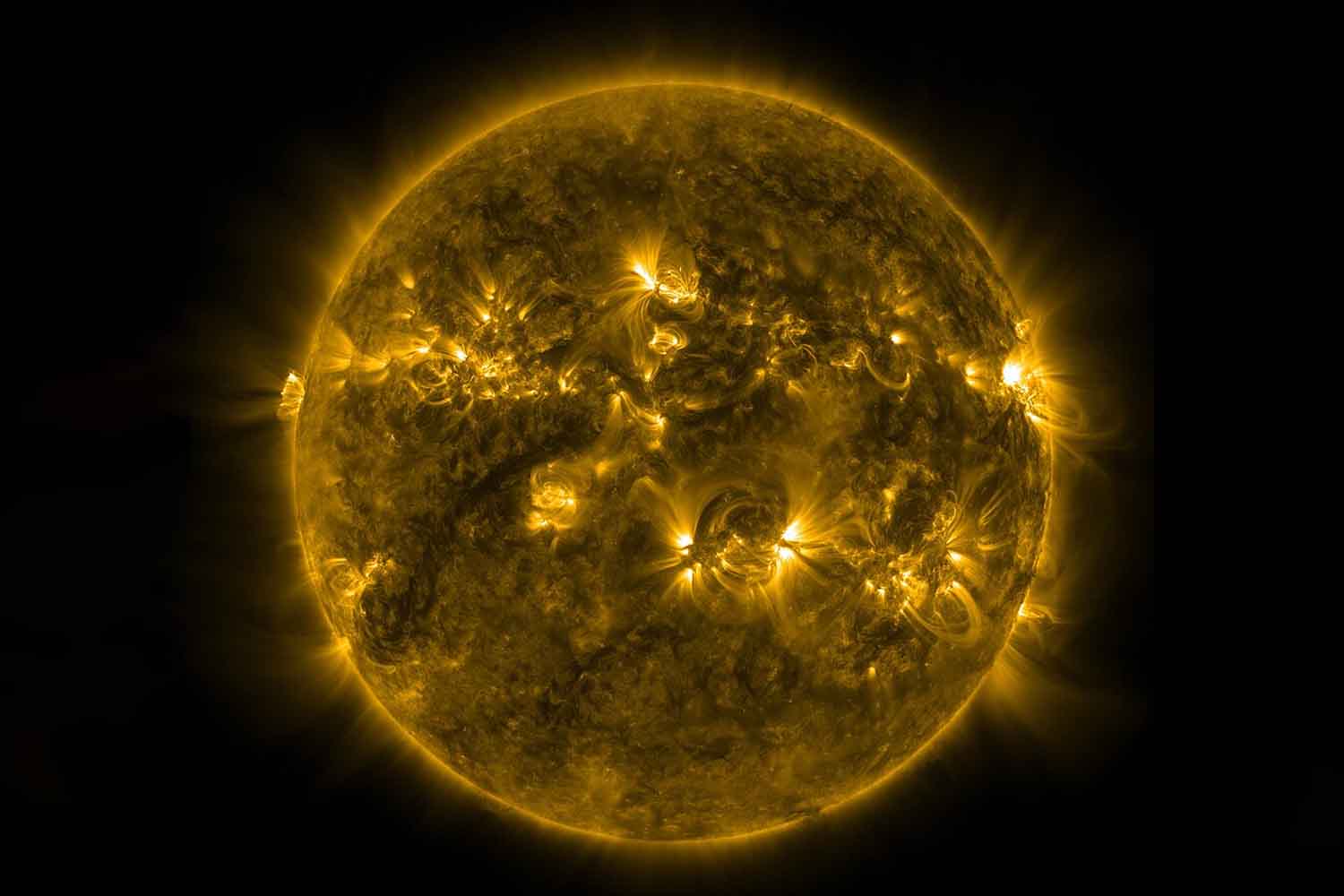
A GPS disturbance, a radio communication that fails, a satellite forced to correct course, an aurora that arrives much further south than expected. On Earth we notice it like this, with scattered effects and often translated into technical news. First, however, everything starts from an object that seems immobile only because we look at it from too far away. The Sun pulsates, vibrates, changes rhythm. And that rhythm, observed for almost forty years, now tells us something less reassuring than the usual alternation between calm and agitated phases.
A new study published in Monthly Notices of the Royal Astronomical Society analyzed the internal oscillations of the Sun, i.e. tiny sound waves that pass through our star and allow us to read its hidden changes. It’s a field called helioseismology, a close relative of asteroseismology: instead of just counting sunspots and flares, try listening to what happens beneath the visible surface, the photosphere. A kind of stethoscope pointed at a mass of plasma large enough to decide, on the worst days, how quiet our power grids, satellites, communications and navigation systems will be.
The noise under the light
The Sun follows a solar cycle of approximately 11 years, moving from a minimum of activity to a new minimum, with a maximum phase in between. During the maximum, sunspots, flares, coronal mass ejections and all those eruptions of particles and magnetic fields increase which, when directed towards the Earth, can generate geomagnetic storms. Cycle 25, the current one, has already gone through its most intense phase or has come very close to it: NASA and NOAA have announced the entry into the solar maximum period in 2024, while identifying the precise peak requires months or years of decreasing data.
The novelty of the study lies in how that cycle appears when observed from the inside. The researchers used data collected between 1987 and 2025 by the network BiSONBirmingham Solar Oscillations Network, made up of six telescopes distributed in different points of the planet. This network measures the Sun as a whole star, following global oscillations called p-modes, acoustic waves that change frequency in response to magnetic activity.
So far it seems like matter for experts, one of those phrases that make you want to close the tab and go and look at the real weather, the one with the clouds above your house. But the substance is simple: if the Sun vibrates differently, something in its internal structure is changing. And if that something concerns solar magnetism, it pays to pay attention.
Thinner magnetic skin
The data shows that, starting from cycle 23the relationship between internal oscillation frequencies and traditional indicators of solar activity has changed behavior. In the past, surface measurements, such as sunspots and other global proxies, told a fairly consistent story with internal vibrations. Now that correspondence has moved on.
Cycle 24 was weak by many classic indicators. Cycle 25, however, appears more ambiguous: looked at from the surface it seems less powerful than the most intense solar cycles of the recent past, however in high-frequency helioseismological data it shows a strength comparable to that of cycles 22 and 23. Translated: the visible face of the Sun says one thing, its internal beating suggests another.
Low-, medium-, and high-frequency oscillations probe different depths beneath the photosphere. Putting them together, a precise picture emerges: the structural changes linked to solar cycle they seem to concentrate closer and closer to the surface. The research speaks of an increasingly superficial layer, within about a thousand kilometers of the photosphere. An enormous distance for us, almost nothing for a star with a radius of about 696 thousand kilometers.
The interesting part, this time, lies precisely in the discretion of the phenomenon. The Sun continues to be the Sun. It rises, sets, illuminates the crooked mornings and the too hot summers. Under that astronomical normality, however, its magnetism may be changing modes of organization. According to the authors of the study, the data is better explained by a reorganization of the way in which magnetic activity is stored under the surface, rather than by a simple variation in the intensity of the magnetic fields.
Space weather
Space weather seems like a movie expression, but instead it concerns very concrete infrastructures. Geomagnetic storms can disturb satellites, GPS signals, radio communications, navigation, power grids. In orbit they can increase the risk for spacecraft and astronauts; in the upper atmosphere they can modify the resistance encountered by satellites, forcing them to make corrections and maneuvers. In the most visible cases they give spectacular auroras. In the most inconvenient cases they enter the operators’ technical bulletins.
In May 2024, a series of flares and coronal mass ejections produced one of the strongest geomagnetic storms of the past two decades. Many people remembered her for the auroras seen at unusual latitudes; for those who manage satellites, radios, networks and warning systems it was also a very practical reminder. The Sun, when it decides to really move its hands, reaches right into our electrical habits.
Understanding where magnetic activity is formed and how it is concentrated serves precisely this: to improve forecasts. Traditional measurements remain fundamental, because sunspots, flares and radio flux give valuable information on visible activity. Helioseismology adds a deeper, less immediate, perhaps decisive level. If solar magnetism is compressing into shallower layers, the models we use to interpret future cycles will need to take this into account.
Cycle 26 will say something more
Prudence is necessary here. The study indicates a trend observed across multiple cycles, with data covering the ascending phase of cycle 22 to the maximum of cycle 25. A long and precious series, rare in solar astronomy, precisely because maintaining consistent observations for almost forty years requires patience, stable instruments and a certain scientific stubbornness. However, more time is needed to understand whether the Sun is truly entering a different and lasting mode, or whether it is going through a phase destined to diminish.
For this reason, the work will continue throughout the remaining part of cycle 25 and then in cycle 26, expected approximately between 2029 and 2032. It will be there that the picture becomes more readable. If the trend continues, the solar “beat” will confirm a profound transformation in the distribution of magnetic activity. If it changes trajectory, we will still have learned something about how our star goes through its seasons.
