
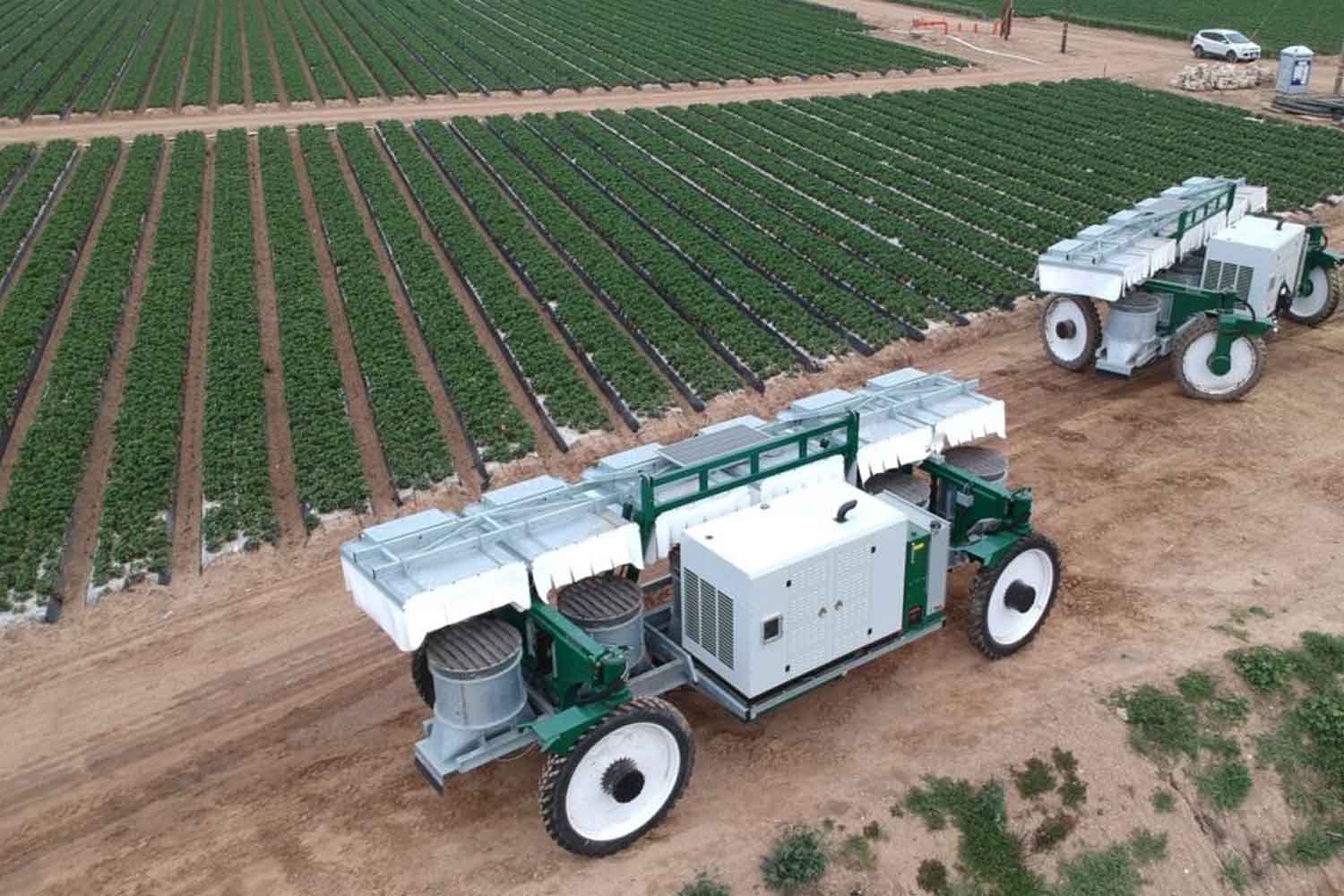
The US company TRIC Robotics has brought autonomous robots the size of tractors to the Californian strawberry fields, capable of covering multiple rows at a time and treating the plants with UV-C light during the night. They come by twice a week, adjust the lamps following the irregularities of the terrain and are monitored remotely by the company. They don’t leave the usual cloud of mist behind: for some fungi and mites, the treatment is brief exposure to ultraviolet light.
The principle is not entirely new. We had already talked about ICARO X4, the Italian robot developed especially for vineyards. TRIC Robotics chose strawberries, a delicate and frequently treated crop, and enlarged the frame considerably.
Twelve meters of lamps above the strawberries
The largest model is called Eden. It is a three-wheeled platform over 40 feet wide, about 12 meters, built in the proportions of normal agricultural sprayers. The side wings and the height of the lamps automatically adjust to maintain the expected dose even when the furrows are anything but smooth, as often happens in real fields and much less in promotional animations.
The Luna robot is more compact, covers six rows and, according to the company, can serve an area of between 50 and 100 acres, i.e. between approximately 20 and 40 hectares. It can carry UV-C lamps, cameras to collect data on plants or vacuum cleaners that physically remove insects. They are different tools: the light acts on some pathogens and mites, the aspirator deals with insects. In videos, everything often ends up in the convenient category of “parasites killed by rays”, but a ray is not a vacuum cleaner.
Farmers don’t have to buy the machine. TRIC offers treatment as a service, prepares the robot on the plot and manages its night-time outings. The company claims that the price is aligned with that of conventional disease and pest control programs; However, it does not publish sufficient economic data to compare in detail the costs, savings and results of individual agricultural companies.
The first platforms ran on batteries. Charging points were often missing in the camps and so current models are powered by an on-board diesel generator. The light is from the future, the generator much less so.
Why robots turn on lamps in the dark
@
The UV-C light used in treatments has a wavelength of approximately 254 nanometers and damages the genetic material of fungi, bacteria, viruses and some arthropods. Shooting it on the plants at any time, however, would be inefficient and could require higher doses.
In fact, several microorganisms possess mechanisms capable of repairing part of the damage caused by ultraviolet when they are exposed to visible light again. Nighttime treatment allows a few hours of darkness to pass and hinders this repair, called photoreactivation. This is the scientific reason for the night shift, more precise than the generic idea that pathogens are simply “weaker when they sleep”.
Researchers from the Agricultural Research Service of the US Department of Agriculture have been working on this technique since 2011. The tests on strawberries involved, among others, the gray mold fungus, the powdery mildew fungus, several species responsible for anthracnose and the red spider mite. The nocturnal application allowed the necessary UV-C doses to be lowered without observing negative effects on the plants in the experimental conditions studied.
The transition from laboratory tests to fields has given interesting results even independently of TRIC’s robots. In a study published in Plant Health Progresstractor-drawn UV-C equipment was tested at night in strawberry plots in California and Florida. Applications around 200 joules per square meter contained powdery mildew as much as, or better than, the weekly fungicide programs used in the trials. In Florida, two treatments per week reduced disease incidence on fruit by approximately 83% compared to untreated plots.
That study tested UV-C treatment with specific doses, strains and environmental conditions. It did not certify the commercial performance of the TRIC robots, but it confirmed that the lamps mounted above the strawberries are based on a rather more solid scientific basis than a reel with epic music.
Which pesticides can be reduced
TRIC Robotics presents the technology as a chemical-free alternative for pest and disease control. The definition must be kept within the radius of the lamps. UV-C can reduce or replace some fungicidal and acaricide interventions, even if they do not eliminate weeds, diseases not susceptible to treatment or all insects that pass through a crop.
For this reason the system is proposed within integrated defence, together with the other available tools. When you need to vacuum up an insect, a different accessory comes into play. When the target is a fungus sensitive to UV-C light, the lamps are turned on. The robot brings both, without pretending that one technology alone can do everything.
Commercial development proceeds alongside research. The National Science Foundation awarded TRIC Robotics $965,770 in a second-phase SBIR grant dedicated to the use of ultraviolet light against strawberry pathogens. The project began in December 2022 and the conclusion indicated by the institution is expected, on an estimated basis, for the end of 2028.
