
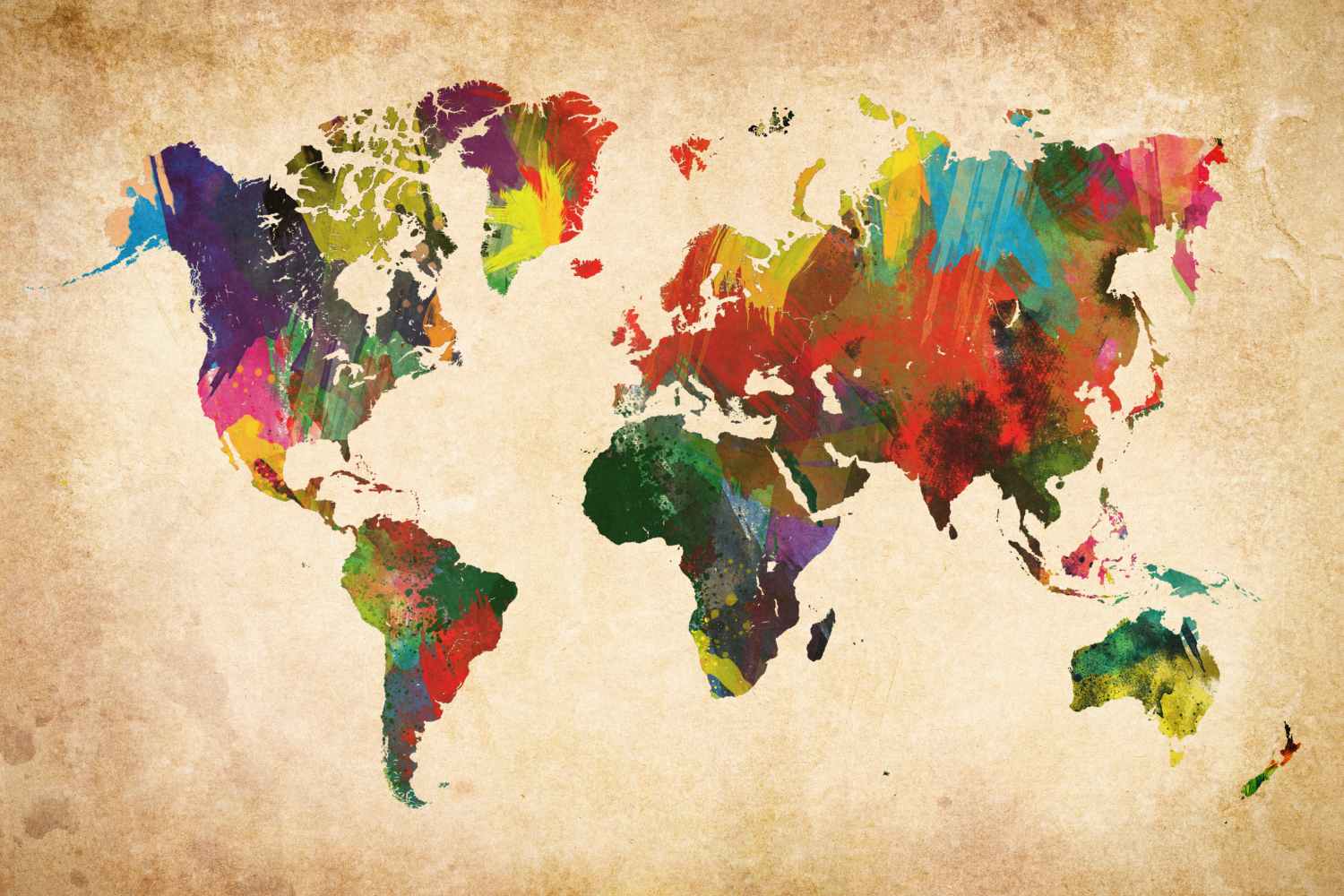
That planisphere hanging on the walls of the classrooms, which we learned to fix as children, with Europe and North America in the center and Africa reduced to a marginal block, is not a faithful photograph of the planet. It is the so -called merchant projection, conceived in 1569 by the Flemish cartographer Gerardo Mercatore. Born to facilitate maritime navigation, however this representation has an evident limit: it enlarges the areas close to the poles and reduces those close to the equator.
Thus, Greenland appears almost as much as Africa, when in reality the African continent is fourteen times more extended. According to calculations spread by researchers and cartographers, the United States, China, India, Japan, Mexico and most of Europe would find space inside Africa.
A distortion that, as historians and scholars observe, does not only have geographical consequences: it has fueled for centuries a unbalanced image of the planet, with Africa perceived as a peripheral.
The position of the African Union
For these reasons, the African Union (UA), which brings together 55 Member States, has officially supported the “Correct The Map” international campaign, promoted by the Africa No Filter and Speak Up Africa organizations. The initiative asks to replace the projection of mercatore with the most recent Equal Earth, developed in 2018 to return real proportions to the continents.
“It might seem only a map, but in reality it is not,” Selma Malika Haddadi, vice -president of the EA commission, told Reuters. According to Haddadi, represent Africa as reduced and marginal “has contributed to consolidating cultural and political stereotypes”, affecting the perception of the continent in the international scene.
From school to collective identity
The theme also concerns the education and formation of the new generations. “The current dimensions of the Africa map are wrong. It is the longest disinformation campaign in the world, and it must simply cease,” explained Moky Makura, director of Africa No Filter.
An analysis shared by Fara Ndiaye, co -founder of Speak Up Africa, according to which “the Mercator’s map has influenced the identity and pride of Africans, especially of the children who meet her since the early years of school”.
To counteract this cultural heritage, several African schools are starting programs that adopt the Equal Earth projection as a new didactic standard. The goal is not only to correct a cartographic error, but to return to the younger generations a more truthful representation of their continent.
A geopolitical question
It is not just about geography. The choice of cartography is also a political and symbolic fact. The Mercatore map observe the promoters of the countryside, is the daughter of a colonial vision of the world, who placed European countries in the center and relegated the global south to the background.
“Equal Earth”, explain from the African Union, represents a refusal of that legacy and a step towards the construction of a more equitable narrative. Not surprisingly, other regions of the world are also joining the African request: Dorbrone O’Marde, vice -president of the Commission for repairs of the Caribbean community (Caricom), has defined the new projection a choice that “refuses the ideology of power and domination inherent in the Mercator map”.
International reactions
The “Correct the Map” campaign has already obtained some openings. The World Bank has confirmed the use of Equal Earth and Winkel-Tripel in its static maps and has announced the gradual abandonment of merchant in digital versions. The United Nations, on the other hand, received the formal request of the African Union: the proposal will be examined by a committee of expert cartographers.
On the technological front, Google Maps has replaced mercatore with the three -dimensional view of the globe in the desktop version since 2018, but on mobile the old projection still remains the default mode.
Because it matters for us too
It may seem like a distant theme, but it is not. Maps are not simple neutral tools: they affect our understanding of the world, on school books, on political and economic choices. Continuing to use a map that artificially reduces the global South means perpetuating an unbalanced imagination.
Correcting the map, support the promoters of the campaign, also means returning dignity and recognition to a continent that has over one billion inhabitants and is at the center of decisive global challenges, from the environment to the economy.
The appeal of the African Union invites to reconsider the way we look at the world. It is not just about replacing a cartographic projection, but of reviewing the language with which we describe the relationships between the continents. Because the geography, after all, is never neutral: it is a mirror of power relationships. And correcting the map can be the first step to correct the gaze with which we face the future.
Don’t you want to lose our news?
