
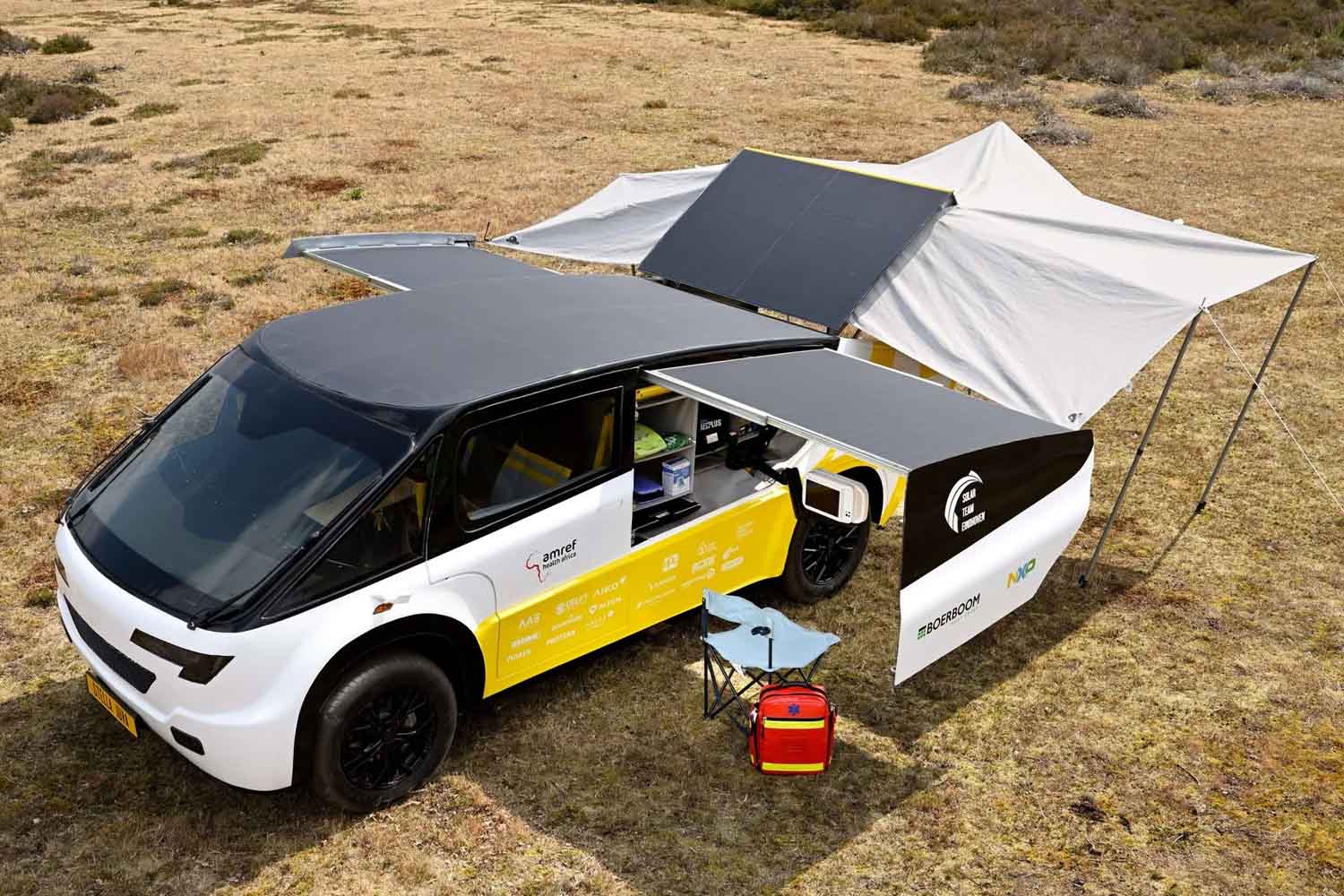
Stella Juva, the solar ambulance designed by 23 students from the Technische Universiteit Eindhoven, was presented on 21 July 2026 in the Netherlands and will leave for Kenya in August, where it will be tested in real conditions together with Amref Health Africa. Last April we reported on the project: then there was a rendering, some technical promises and a debut set for the summer. Now there are four wheels, roof panels and a mission already planned.
The white and yellow vehicle is presented by Solar Team Eindhoven as the first ambulance in the world capable of traveling using only solar energy and powering the medical equipment on board with the same source. The definition will have to pass the most important test: the one far from Dutch roads, official photographs and easily accessible electrical sockets.
Up to 715 kilometers on a sunny day
According to data released by the group, Stella Juva can reach a maximum speed of 120 kilometers per hour and travel up to 715 kilometers on a sunny day. It is designed to tackle even rough terrain and has a panel-charged battery, necessary to continue moving the vehicle and using tools during the night or when the sky becomes overcast.
The 715 kilometers remain a declared autonomy in favorable conditions. Heat, dust, sanitary load, road surface and simultaneous use of equipment can change consumption significantly. Kenya will also serve to understand how long that figure holds up when the process stops resembling a test and begins to get serious.
Photovoltaic cells have been installed on the roof All Back Contactin which the electrical contacts are moved to the back to leave a greater surface exposed to light free. The manufacturer AIKO, which supplied the cells, lists efficiency in small spaces, resistance to high temperatures and more stable production in variable conditions among the objectives of the system. These are valuable characteristics for any solar medium; on an ambulance that also has to power an ultrasound they become slightly less decorative.
More mobile clinic than traditional ambulance
Stella Juva has two seats and was designed above all to bring care to the patient. Healthcare workers can use it to perform blood tests, screen for tuberculosis and malaria, administer vaccines and perform ultrasounds during pregnancy. On board there is also space for a portable x-ray machine, a defibrillator and a refrigerated system for storing medicines and vaccines.
The name “ambulance” recalls the rush to the hospital. Here the movement takes place in the opposite direction: it is a small independent clinic that reaches communities far from health facilities. A practical difference in areas where the nearest medical center requires hours of travel and operators must also travel by bicycle, without being able to count on constant fuel or electricity.
Femke Maurits, partnership manager at Amref Health Africa in the Netherlands, explained that the distance between villages and health facilities represents one of the main obstacles in many African territories. Without electricity, it also becomes complicated to maintain the cold chain of vaccines and use diagnostic tools. The project was developed in consultation with Amref and other international health organizations, so as to avoid building a splendid European solution to a problem imagined from afar.
The first real test will be in Kenya
In August the group will reach Kenya together with Amref Health Africa. Stella Juva will be taken to two field locations, where health activities such as care for people suffering from tuberculosis will be simulated. The program also includes hundreds of kilometers of travel to verify autonomy, behavior on difficult terrain and ability to power the tools while working.
The prototype was designed and built in about a year. Solar Team Eindhoven had already created Stella Vita, a solar camper, and Stella Terra, the off-road vehicle that crossed Morocco and the Sahara for over a thousand kilometers in 2023. The accumulated experience has gone into the lightweight structure, suspension and energy management of the new ambulance.
After the tests, the group aims to involve companies and healthcare organizations capable of taking the project towards possible production. At the moment Stella Juva remains an experimental example: no fleet is ready to leave and an industrial supply chain, maintenance, spare parts and assistance in the areas of use are still missing. Twenty-three students demonstrated they could build the vehicle. Transforming it into a stable health service will require many more people, money and kilometers.
In Kenya, between heat, dust and difficult roads, the 715 kilometers will cease to be a presentation figure. And they will start to become a given.
