
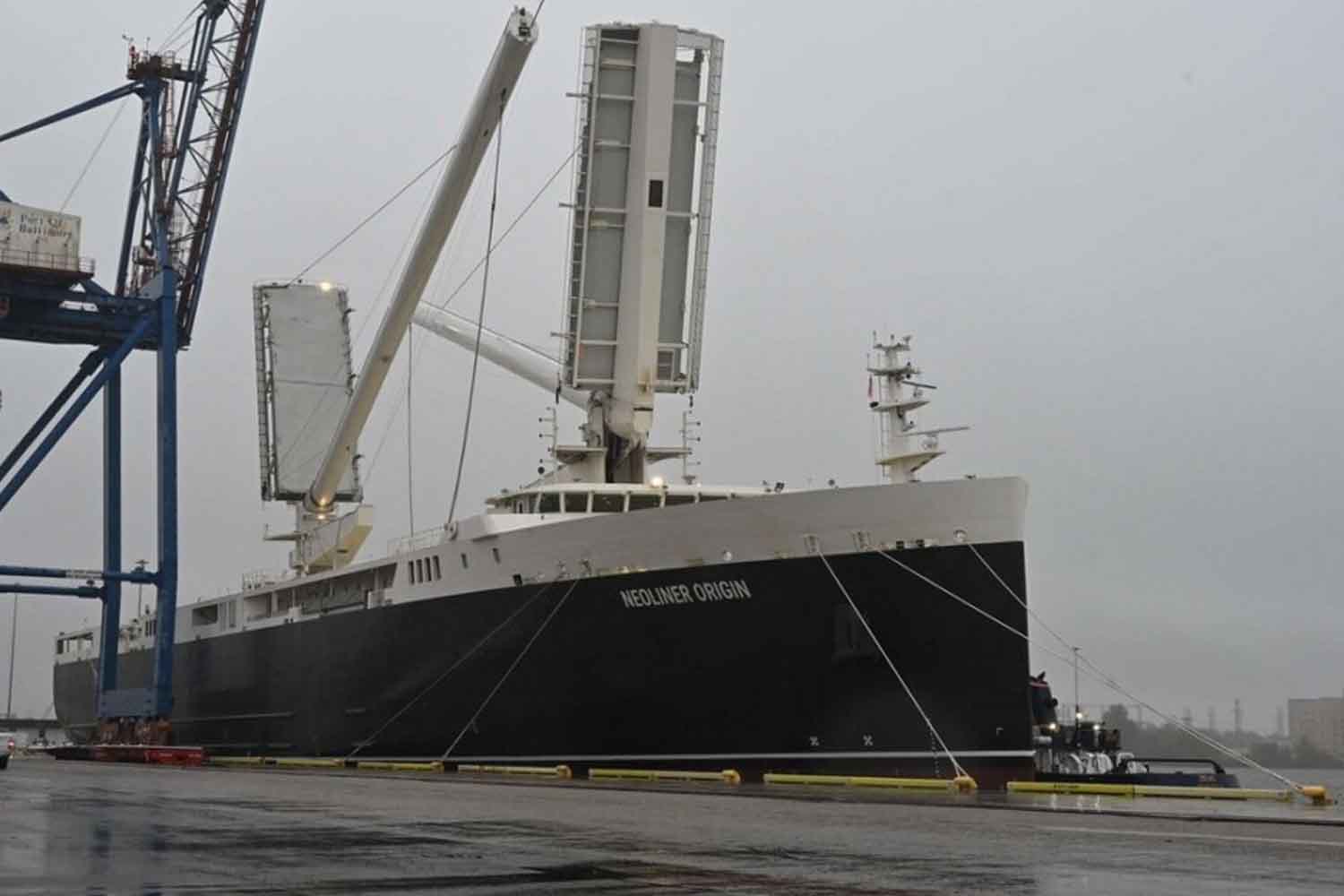
The future of shipping may look to the past. After over two centuries of industrialization and fossil fuel navigation, a French company has rediscovered the power of the wind to drastically reduce the environmental impact of sea logistics.
It’s called Neoliner Origin and is currently the largest sailing cargo ship in the world. 136 meters long, it made its inaugural crossing from Nantes, in Brittany, to the port of Baltimore, in the United States, departing on 13 October 2025. On board, a load of Renault cars and luxury products, transported with an ecological footprint 80% lower than traditional methods.
Neoliner Origin: sailing innovation at the service of sustainable transport
Equipped with 65 meter high retractable carbon fiber masts, the Neoliner Origin has reached top speeds of 11 knots using only the wind. Its modern design combines the simplicity of traditional sails with cutting-edge solutions, allowing you to navigate in “hybrid” mode, i.e. sailing with the support of a secondary engine.
With a 5,300-ton hold capacity, the freighter demonstrates that it is not only possible, but also scalable, to use sailing to transport containers over long distances. It’s an idea that seems to have come out of a nineteenth-century novel, yet has returned to respond to today’s climate challenges.
Among the first to believe in the project is LVMH, the luxury giant, together with the well-known liquor brand Cointreau, both committed to neutralizing their emissions. Jean Zanuttini, president of the French company Neoline, said:
Until now sailing ships were limited to very small loads. Today we can transport entire containers using only the wind.
An ecological, efficient and fuel-independent navigation model
One of the main advantages highlighted by Zanuttini is independence from port infrastructure: captains no longer have to wait to refuel, nor worry about possible fuel shortages. Just spread the sails and take advantage of the trade winds. This solution is also perfectly suited to low- or middle-income countries, where the necessary infrastructure to manage alternative or innovative fuels is often lacking. With Neoliner, all you need is the wind.
Although a storm damaged one of the stern sails during the Atlantic crossing, the cargo continued the route without interruption, using the remaining sail and the auxiliary thruster. It is an approach called “hybrid navigation”, which could reduce emissions from the entire sector by up to 90%.
Shipping is estimated to be responsible for 2% of global greenhouse gas emissions. For this reason, experiments like that of Neoliner represent a fundamental step in the ecological transition of international logistics.
You might also be interested in:
