
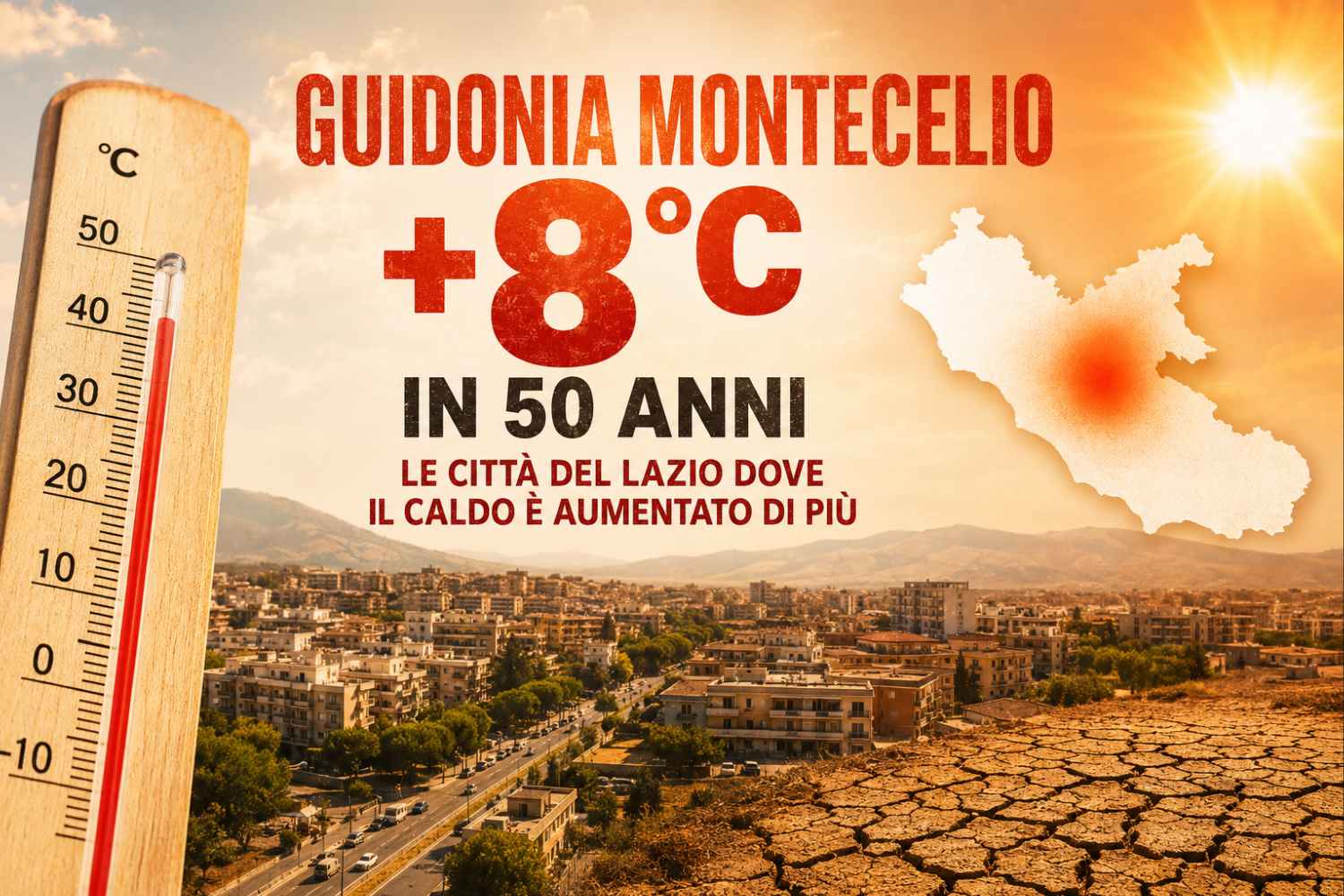
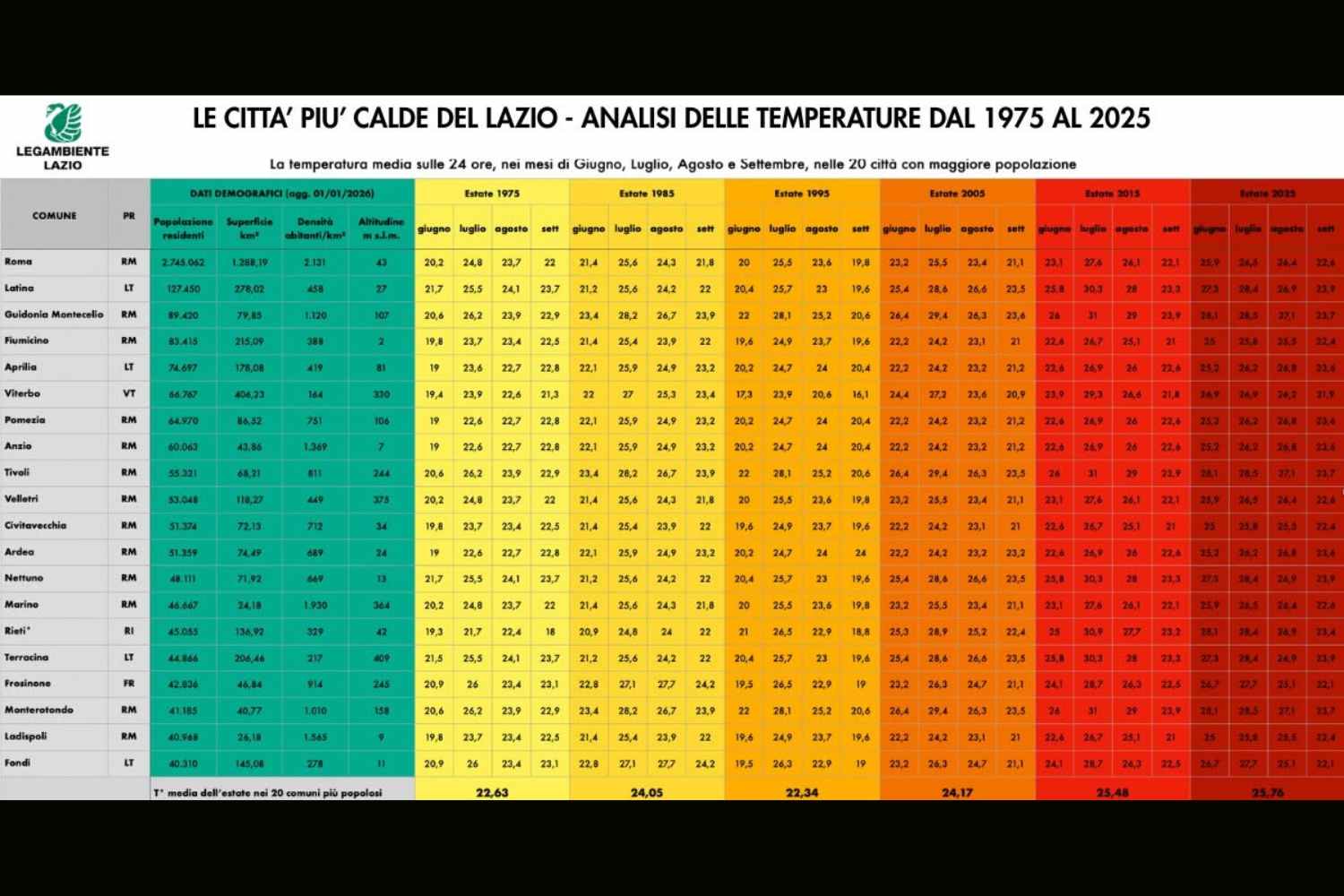
The summers of Lazio are hotter than fifty years ago, according to an analysis by Legambiente which compares the average temperatures in the 24 hours recorded in twenty municipalities of the region, the most populous, between 1975 and 2025, with a second closer reading level over the last ten years, from 2016 to 2026. The data comes from the historical archive of ilMeteo.it, the source on which Legambiente has constructed the ten-year comparison (1975, 1985, 1995, 2005, 2015, 2025) on the four summer months, including June. The result is a report entitled “Hottest cities in Lazio”, created in collaboration with the regional Tgr, which had already anticipated some of the numbers. Two elements emerge clearly: a rise in temperatures which is now difficult to classify as natural variability, and at the same time the emergence of some municipalities where the heat has become, literally, unbearable.
Guidonia in the lead, and not by a little
The municipality that has seen its average temperature increase the most is Guidonia Montecelio, the third largest in Lazio by population, with an increase of close to 8°C in fifty years. It is not an isolated record, given that Guidonia is the hottest city ever even looking only at the last decade, with an average of 25.73°C over 24 hours in the month of June, followed closely by Terracina and Latina, both at 24.66°C. Compared to last year, when the June average in Guidonia reached 28.1°C, the 2026 figure marks a slight respite.
@ Legambiente Lazio / Facebook
The geographical framework helps to explain why this area suffers more than the others. The eastern quadrant of Rome, Guidonia itself, Monterotondo and the flat portion of Tivoli share a position that deprives them of both the sea breeze and the refreshment of the Abruzzo mountains. Added to this are population density, vehicular traffic and the presence of large travertine quarries, which in fact amplify the accumulation of heat in an area already penalized by the conformation of the territory.
Not just the capital
Looking only at the increases of the last decade, other municipalities show increases of a certain size: Rieti rises by 4.6°C, Frosinone by 4.5°C, Nettuno by 4.1°C, Viterbo by 3.9°C. Rome remains one of the muggiest cities in the region, and is the capital where Legambiente calculates the greatest number of days considered at risk for those who work outdoors, even if several municipalities administered by the Region led by Francesco Rocca record averages higher than those of the Capitol. In short, extreme heat is no longer a phenomenon that only concerns large urban centres.
@ Legambiente Lazio / Facebook
Legambiente’s comment
These are the words of Roberto Sacchi, president of Legambiente Lazio:
Our cities are increasingly unlivable during the day and even at night, with hellish temperatures, in progressively longer summers. Analyzing the temperatures of half a century in the cities of Lazio, two elements are very evident: on the one hand an incontrovertible violent rise in temperatures, with an increase in the number of very hot days especially at the end of spring, on the other the existence of now boiling places where the very high temperature is making the cities completely unliveable in summer. To address these very serious critical issues, it is necessary to incessantly combat climate-changing emissions, with collective and sustainable mobility, energy production from solar and photovoltaic, a circular waste economy, and the green reconversion of industry. At the same time, however, we must literally change the characteristics of our cities before the climate crisis does it violently for us: with climate shelters and urban shading, removing thousands of hectares of asphalt from the enormous black and boiling car parks, strengthening parks, agricultural areas, woods, making street trees as suitable as possible to current conditions, stopping concrete, land consumption and the multiplication of new suburbs, with choices to demolish the building forecasts of the master plans and policies for the repopulation of small villages and internal areas.
The investigation stopped at the twenty most populous municipalities in the region, even if the mechanism that made the Guidonia quadrant red-hot has nothing to do with the size of an urban center, because it depends on how far that territory is from the sea and the mountains, on how much asphalt and how much greenery there is. In Lazio there are 378 municipalities, and more than one of those left out of the count shares the same position with Guidonia in the middle of the plain, a reality over which the Legambiente thermometer has not yet passed.
