
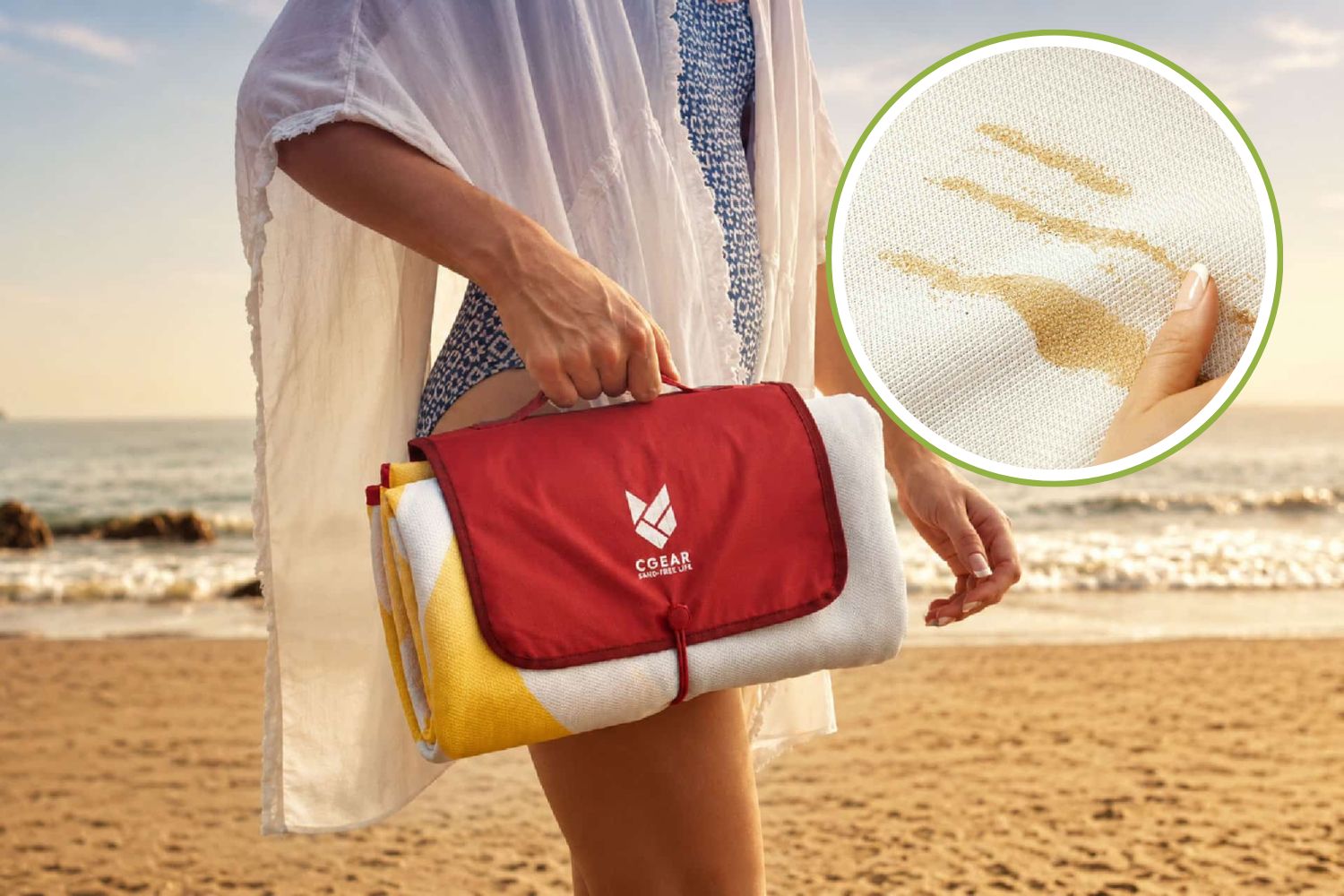
The sand problem begins when you decide to return home. You shake the cloth, close the bag convinced that you have sorted everything out and a few hours later the grains reappear on the floor, in the book taken to the seaside, between the seats of the car. They have a particular talent for slipping into everywhere and staying there for weeks.
A sandproof beach towel try to stop this little invasion with a rather simple solution: let the specks fall through the fabric. It’s called CGEAR Sand-Free Mat and is made up of two overlapping layers of mesh that make the sand slide downwards, preventing it from easily returning to the surface.
Two layers and the sand goes down
©CGEAR
Operation depends on the arrangement of the links. The openings of the two layers are staggered, so the grains that fall onto the sheet pass through the first net and end up in the space below or return directly to the ground.
The patent filed at the beginning of the 2000s describes precisely this path. The same structure prevents the sand present under the sheet from rising, which remains trapped between the two layers.
A swipe of the hand, the movement of the feet or a gust of wind helps the remaining grains above find an opening. With dry sand, a few simple steps are enough. The one that is wet and stuck to the skin may require a little more movement, while crumbs, leaves and larger residues must be removed like on any other cloth.
Water also runs through the plot. Drops that fall from the swimsuit and spilled drinks filter towards the ground instead of forming a puddle, while the passage of air speeds up drying. To dry your skin, you still need a towel: this towel works above all as a base on which to sit, lie down or place bags and toys.
First the helicopters, then the umbrellas
The most curious part concerns the origin of the technology. According to the reconstruction of the Australian companythe system was developed to create large surfaces to be laid in helicopter landing areas.
The air pushed down by the rotors raises dust, sand and small debris, creating clouds that reduce visibility and can reach people and equipment. Military carpets let particles pass through the weave and helped keep the surface more stable.
In 2010 the idea was scaled down and brought to the leisure accessories market. The problem, moreover, remained similar: to prevent sand and dust from accumulating over an area intended for people or equipment. From here the transition to beaches, campsites, picnics and spaces in front of campers and caravans.
A tarp for one person or for the whole campsite
The smallest sizes measure approx 102 × 198 centimeters and they are meant for one person. We then move on to 155 × 198 centimeters and the 198 × 198 centimeter square model, large enough for a couple or a family.
The camping versions grow quite a lot and reach up to 366 × 366 centimeters. They can be placed under an awning, in front of the tent or in the area occupied by the table and chairs. The smaller models roll up and are secured with a band; some also include a handle or carrying bag.
The manufacturer indicates good resistance to water, mold and UV rays. The open construction allows the cover to dry quickly, while the reinforced stitching helps to withstand frequent outdoor use.
How far it really goes
The sand “disappears” only from the visible surface. The grains pass through the net and remain under the sheet, ready to return to the beach when it is lifted. Those attached to our feet, swimsuit and slippers continue to follow us to the car. Even the performances should be read with a minimum of caution. The patent explains the construction of the weave, while the comparison with a common beach towel, in the different conditions of sand and humidity, is based above all on the manufacturer’s indications.
Furthermore, the material remains plastic. The current versions are mainly made of polyethylene and in the data sheets available on the company website there is no reference to the use of recycled plastic. UV resistance can extend its lifespan, as long as the cover is used for many summers and stored carefully. The sheet makes the sand go down. For those inside the costume, military technology still gives up.
