
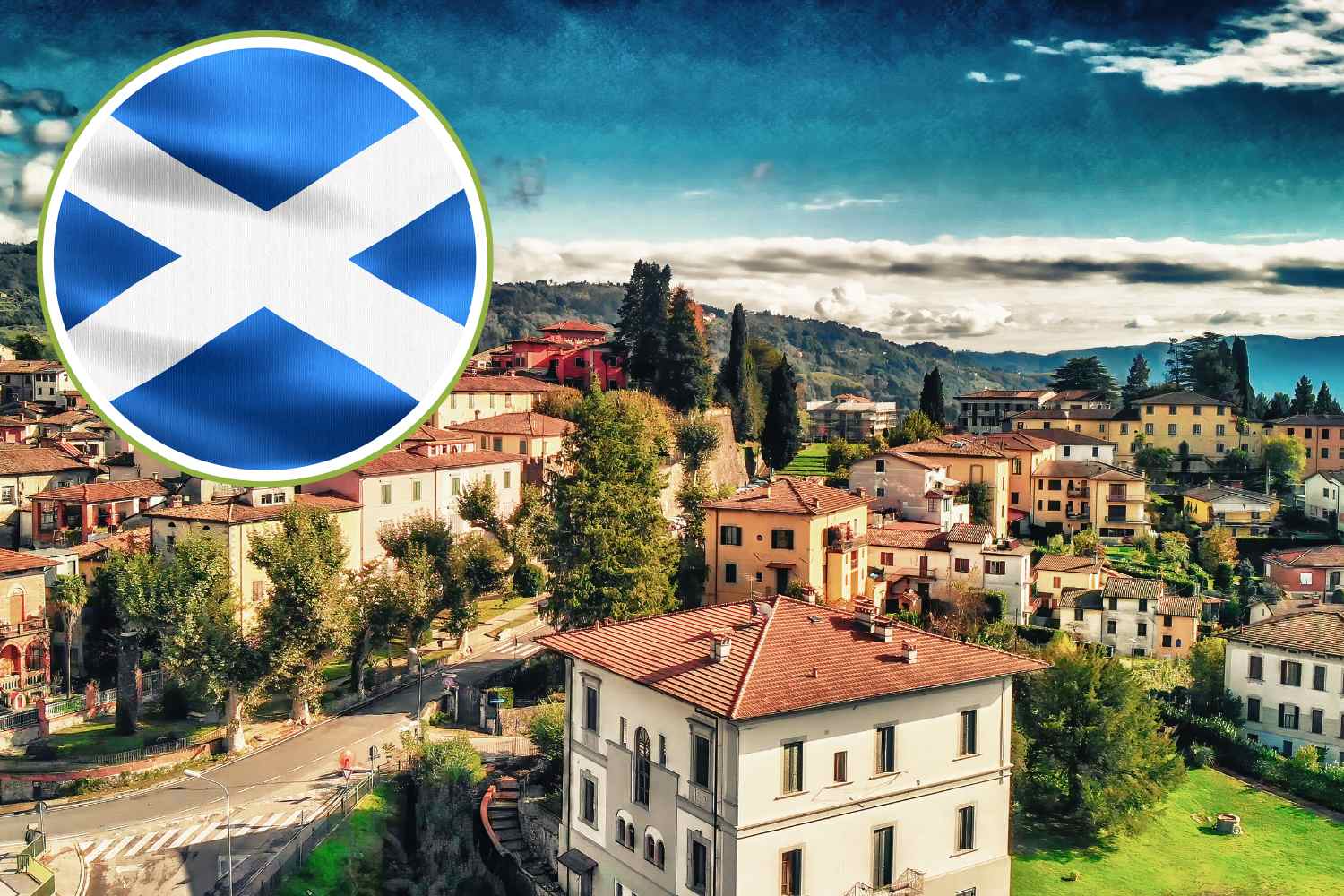
A Tuscan village with a Glasgow accent
Walking through the streets of Barga is like leafing through a book where each page tells two different stories. On the one hand there is classic Tuscany, that of the Alberese stones and the medieval alleys that climb towards the Duomo. On the other hand comes Scotland, with its red telephone booths, the scent of fish & chips coming out of the restaurants and the bagpipes that every now and then break the silence of summer evenings.
It’s not a coincidence, it’s not folklore put there for tourists. It’s a true story, the one that was written between the end of the 19th century and the beginning of the 20th century, when many people from Barga picked up their suitcases and left. Only instead of ending up in New York or Boston like almost all Italians of the time did, they went to Scotland.
In the Glasgow shipyards they needed hands, in the woods of Ardrossan too, and also in the kiosks where they fried fish and chips. The people of Barga went there, they worked, some made a fortune and many returned. But they didn’t return alone, they brought with them their savings, of course, but also something else: a taste for whisky, the melodies of bagpipes, Scottish recipes and even a few wives with red hair.
Today around 60% of Barga’s population has Scottish roots. It’s not a small percentage, it’s an identity that you can see, feel, breathe. The BBC noticed this and made a documentary about it, calling Barga an “Italian Brigadoon”, like that magical village of Scottish legend that appears once every hundred years. Except that Barga doesn’t disappear, it remains there, halfway between Chianti and whisky.
What happens when two cultures mix
In January we celebrate Burns Night, complete with haggis brought to the table while someone recites the poems of Robert Burns. In summer there is the Fish and Potato Festival, where the fish & chips are fried according to Scottish tradition but you wash it down with a good glass of Tuscan wine. And it works, it works great.
The local football team plays in the colors of Glasgow Celtic, the shop signs are bilingual and they even invented Barga Tartan, a Scottish fabric in the colors of the Italian flag. There are restaurants run by Italian-Scottish couples where on the menu you find Sicilian octopus alongside the most British of dishes.
What to see in Barga
Barga is perched on a hill in Garfagnana and the first thing you see when you arrive is the Cathedral of San Cristoforo, built in local stone which takes on a particular color when the sun hits it. It is Romanesque, has three naves and a thirteenth-century pulpit which is worth the visit alone. From up there the view of the valley makes you understand why Giovanni Pascoli called this area “the nest”.
The poet lived there for almost twenty years in Castelvecchio di Barga, in the hamlet just outside the town, and his house is still there, with the original furnishings, papers and books. It seems that he went out for a walk for a moment and should return at any moment.
The alleys and postcard views
The historic center of Barga is made of those things that always work: narrow alleys that suddenly open onto small squares, arches that frame views of the mountains, gray stone houses that smell of burnt wood in winter and offer blessed shade in summer.
There is the church of the Santissima Annunziata, all baroque decorations and fourteenth-century wooden statues. There is the Conservatory of Santa Elisabetta, a former fifteenth-century monastery that became a girls’ school in the eighteenth century, with its silent cloister and Della Robbia works. And then there are the noble palaces, the medieval walls still standing, the castle gates that once defended the village.
An identity that is not just tourism
Talking to the locals you understand that this double soul is not a gimmick to attract visitors. That’s just how they live, and it’s normal for them. Mayor Caterina Campani says that many descendants of emigrants return for holidays, buy houses, open art galleries or clubs. And they feel at home, even if they were perhaps born in Glasgow and speak Italian with a Scottish accent.
Even art has played its part. Scottish painter John Bellany chose Barga as a creative retreat and his luminous paintings are now on display in a local gallery. He didn’t come by chance, he came because there was something familiar here despite being on the other side of Europe.
How to get to Barga
The country is well connected. You can take the train to Barga-Gallicano station on the Lucca-Aulla line, or the bus from Lucca. By car you pass from Borgo a Mozzano, where among other things there is the famous Ponte del Diavolo which is worth a stop, and then follow towards Fornaci di Barga on the SS445.
Because it’s worth going there
Barga is not for those looking for the Tuscany of glossy postcards. It is for those who want to find a place where history is still alive, where traditions have not died in a museum but continue to evolve, where you can drink a good wine while listening to the bagpipes and it seems like the most normal thing in the world.
It is a village that has transformed distance into a bridge, emigration into cultural wealth. And if you spend a few days here, between a glass of Chianti and a taste of haggis, between the Romanesque Cathedral and the Scottish murals, you understand that there is no need to choose between two identities when you can have both.
