
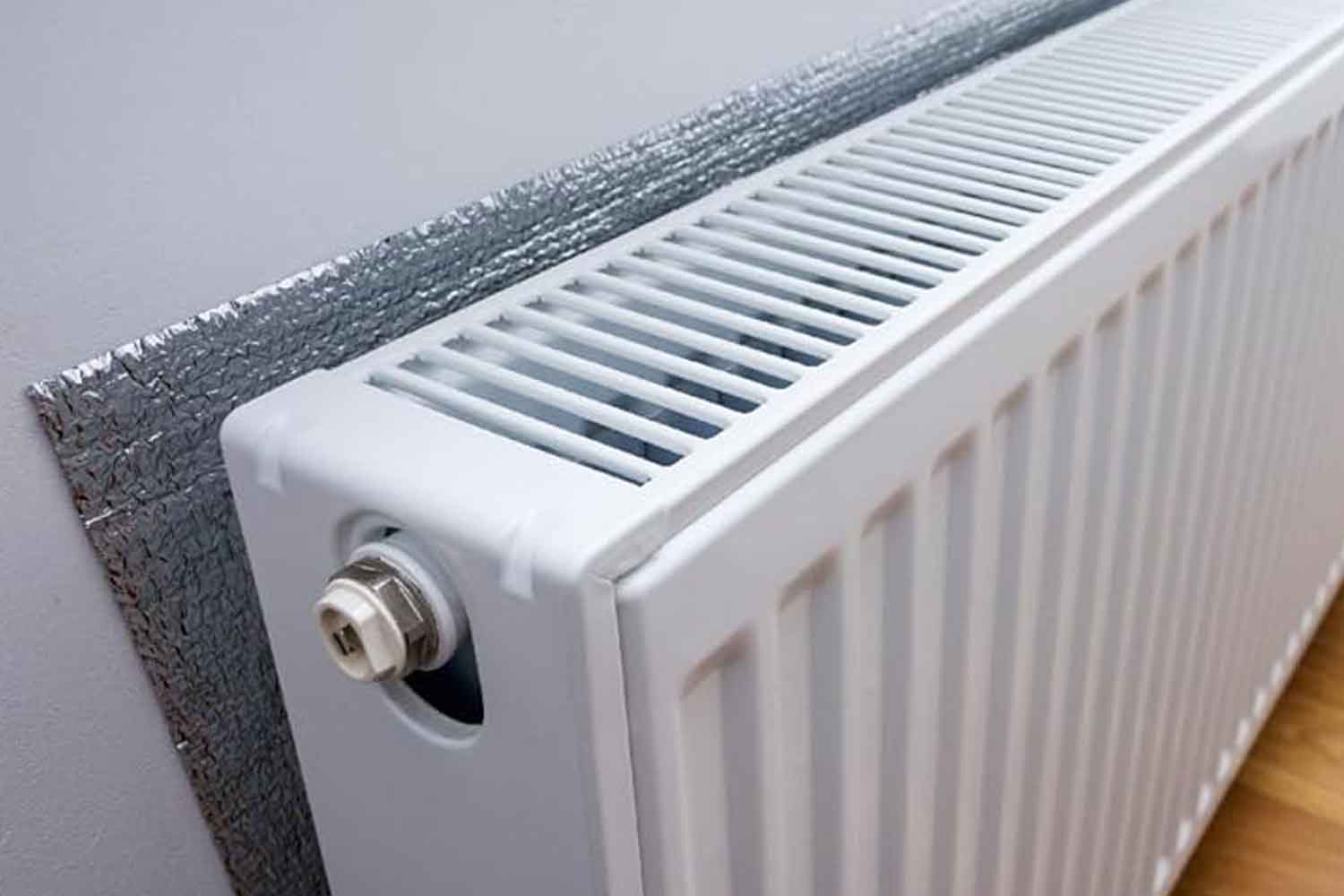
Spending less on heating without invasive interventions is possible, but only if you know the right tools well. Heat-reflecting panels for radiators are among the cheapest and quickest solutions for limiting heat dispersion, especially in less insulated homes. However, their effectiveness depends entirely on how and where they are installed.
Heat-reflecting panels are thin sheets, often made of plastic or multilayer material with an aluminized surface, designed to reflect the heat produced by the radiator towards the inside of the room. When a radiator is fixed to an external or poorly insulated wall, a significant part of the heat is absorbed by the wall and lost outside. In practice, the structure of the building is heated instead of the internal air.
The panel intervenes right here: it creates a reflective barrier that sends the heat back towards the environment, improving the performance of the radiator and the feeling of comfort. The benefit is particularly evident in dated houses, in apartments with cold perimeter walls, in rooms facing north or with cast iron radiators.
How much you can save with heat-reflecting panels for radiators
The low cost is one of the main strengths of these panels. In most cases they can be found for less than 15 euros, making them accessible to anyone who wants to try to reduce consumption without incurring major expenses. The savings cannot be immediately quantified in fixed euros, but translates into better heat distribution, slightly faster heating times and, in the medium term, a reduction in losses.
This is not a miracle solution, but a small intelligent intervention which, added to other measures, can have a concrete impact on your gas or energy bill.
The most common mistake that makes heat-reflective panels useless
Many make a mistake that is as common as it is penalizing: fixing the panel directly on the radiator or inserting it between the fins. In this way, however, the panel does not reflect the heat correctly and ends up compromising normal air circulation.
When the panel is positioned incorrectly, the radiator performs less, air convection is hindered, the reflective material deteriorates more quickly and the energy benefit is cancelled.
The heat-reflecting panel must be installed on the wall, behind the radiator, and not on the radiator itself. It is essential to leave an air space of approximately 1 or 2 centimeters between the panel and the wall to allow correct heat reflection.
How to correctly install heat-reflecting panels for radiators
Installation is simple and takes very little time. The panels are often supplied with ready-made adhesives, while in other cases all you need is scissors, a cutter and a ruler to adapt them to the dimensions of the radiator. The panel must be cut to size and fixed only on the cold wall, avoiding covering electrical sockets or cable passages.
A useful trick before proceeding is a quick test: bring a candle or an incense stick close to the lower part of the radiator. If the flame or smoke visibly moves, it means there is air leakage and that the area is perfect for installing the panel.
When heat-reflective panels are really needed
In cast iron radiators mounted on external walls the effectiveness is clear and perceivable in a short time. In modern, well-insulated homes with efficient fixtures, the benefit is more limited, because heat dispersion occurs mainly from windows, the roof or ventilation systems. In these cases, the panel does not solve the problem at its root, but can still offer an additional contribution for a negligible expense.
For this reason, even when the impact is small, it is almost always worth trying them, considering that installation takes less than five minutes.
BLOSTM Radiator Reflective Panel Roll – 10m x 60cm Radiator Heat Insulation, 2.4mm Thickness, Reflective Heat Insulation, Save Energy and Money, Thermal Insulation Panels
You might also be interested in:
