
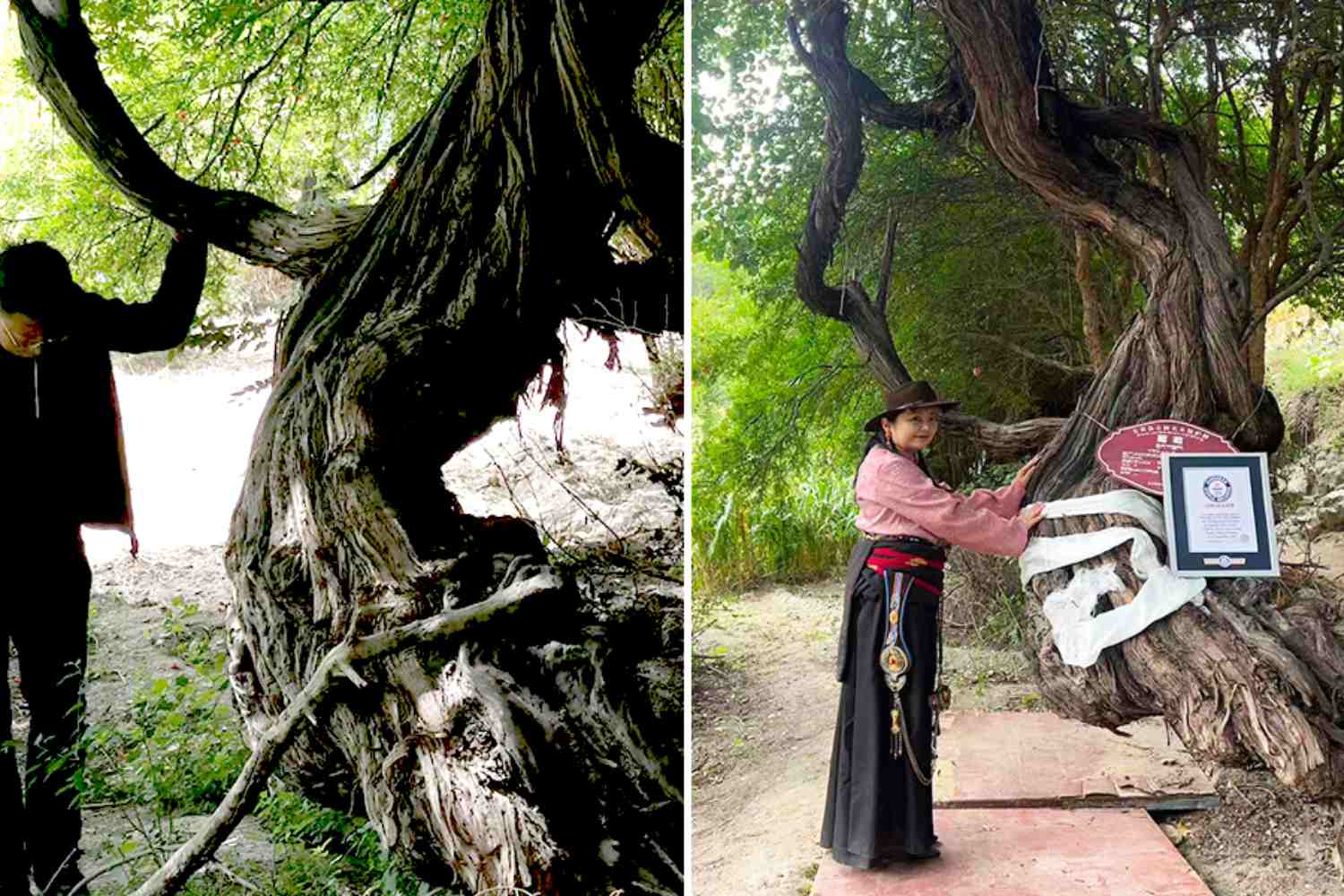
In the eastern mountains of Tibet, among the rocks of Zuoba Village, the oldest vine in the world was found, a wild specimen that has survived over four centuries of frost, wind and silence. The feat was certified by Guinness World Records, which recognized his official age: 416 years.
The plant stands majestically, reaching eight meters in height, with a circumference of 209 centimeters and a trunk diameter of 67 centimetres. It was discovered almost by chance, during a census of centuries-old plants in the city of Changdu, and subsequently studied by experts from the Southwest Forestry University of Kunming, who confirmed its age by analyzing the rings of the wood.
A vine that defies time and altitude
Finding a living wild vine at 2,400 meters above sea level is not only a rare event, but also a sign of nature’s extraordinary resilience. According to Wang Haibo, of the Chinese Academy of Agricultural Sciences, this plant represents a true living archive of the climate, capable of telling the changes in temperature, humidity and seasons through its centuries-old rings.
The Zogang vine is not an isolated case: in the same county, 64 centuries-old plants have been identified, a sign of a unique and perfectly balanced ecosystem. The area’s winemaking tradition dates back over a thousand years, even mentioned in the Tibetan epic poem The Epic of King Gesar.
From Maribor to Tibet: a new world record
Until today the title of oldest vine belonged to the famous one Old Vine of Maribor, Slovenia, dated between 350 and 400 years old. However, the absence of its rotten central core had prevented its age from being accurately calculated. With the Tibetan discovery, the primacy thus passes from the banks of the Danube to the highlands of the Himalayas.
This thousand-year-old vine is not only a botanical record, but also a metaphor for resistance: in a rapidly changing world, it continues to grow slowly and silently, rooted in time and stone. Perhaps, among the mists of the plateau, other ancient vines are still waiting to be discovered.
You might also be interested in:
