
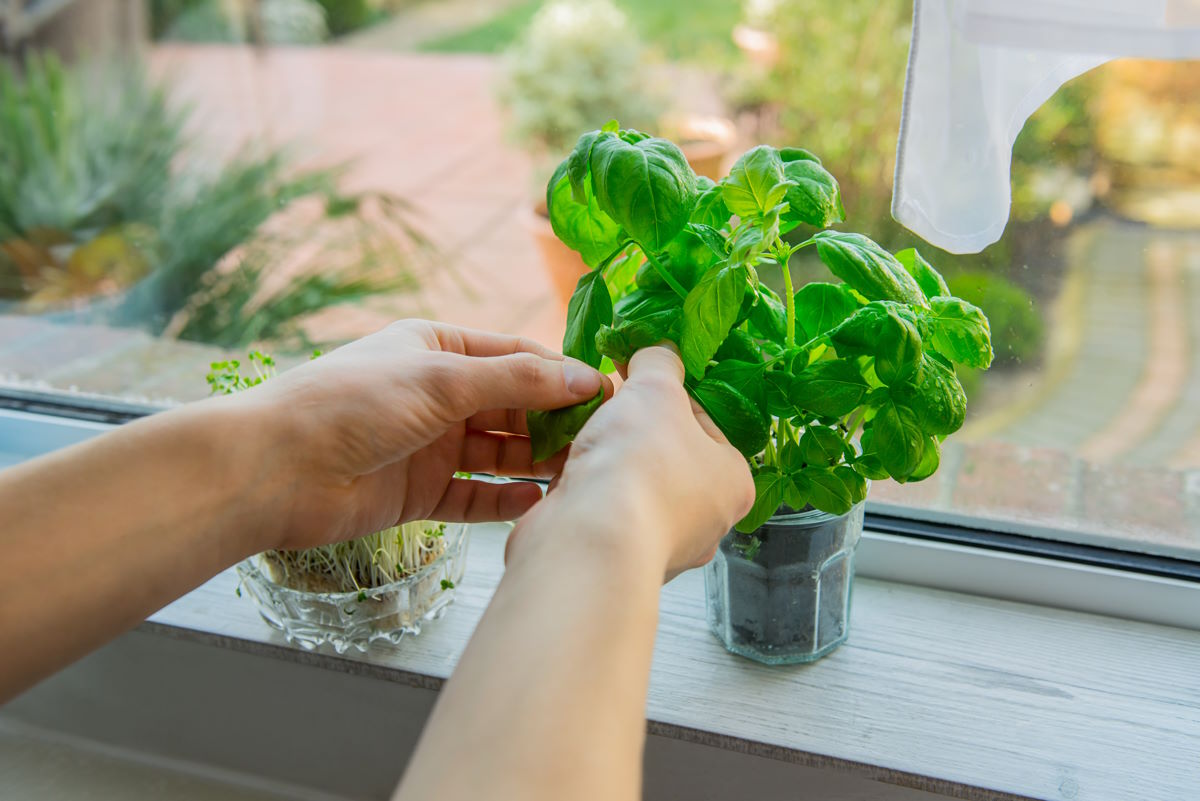
In this article we show you how to potentially reproduce it infinite times!
How does basil reproduce?
Reproducing basil is actually very simple: to ensure that this plant lives forever you need to rely on the stick method, taking small cuttings from the mother plant. These are portions of the branch that are perfect for rooting, but be careful: not all of them are made to take root and experts recommend using only the axillary shoots, i.e. the shoots that tend to form between the main stem and the branch of the seedling.
When is the best time to take basil cuttings?
The best time to reproduce basil is spring and summer, when the plant grows more vigorously and the stems are rich in energy. Cuttings take root more easily at temperatures between 20 and 25 °C. In autumn and winter, however, growth slows down and it will take longer for new roots to develop.
What is needed
To reproduce basil you need a few simple elements:
The method
It’s true: to reproduce basil it takes a little patience, but the method is very simple and the result is great. First of all, as a first step, it is advisable to prepare the cuttings. It is therefore necessary to obtain an axillary shoot of at least fifteen centimeters from the mother plant. How to do it? Starting from the top, count four basil leaves and remove the others, so that the cutting focuses on rooting, rather than caring for and nourishing the leaves. At this point, therefore, prepare a plastic tray and pierce it on the longer sides. Then, pass the skewers through the holes so as to recreate a sort of grid and place the resulting cuttings between one stick and another. Finally, add the water.
At this point you’re done: your basil will reproduce independently; the important thing is to wait at least 15 days for the cuttings to start growing roots. When they grow up to two centimeters, you can then put them in pots. The latter must be small, about 10 cm in diameter and covered by spongy and soft soil. Once this step has been done, transfer the cutting into the vase and let it rest in a well-lit area, but not directly hit by the sun’s rays, which are too aggressive for basil. The important thing is to ensure that the soil is always moist so that the roots take root in the soil.
Mistakes to avoid when taking basil cuttings
Although this is a simple method, there are some errors that can compromise the success of reproduction. It is important to always choose young and healthy shoots, avoiding branches that are too old or already weakened. It is also necessary not to leave too many leaves on the cutting: the plant must concentrate its energy on producing roots and not on maintaining an excessive number of leaves.
Another fundamental aspect concerns the water: if you use the rooting method in water, it is advisable to change it regularly to avoid the formation of mold or bad odors. The tools used for cutting must also be well cleaned and disinfected, so as to reduce the risk of transmitting diseases to the new plant.
How long does it take for a basil cutting to grow roots?
Usually the first roots begin to appear after about 10-15 days, but times can vary depending on the temperature, the amount of light received and the conditions of the mother plant. When the roots reach a length of about 2-3 centimeters, the cutting is ready to be transferred to a pot with soil.
How to care for basil after moving it to the pot
After transferring the cutting to the pot, it is important to give it time to adapt to the new environment. In the first few days the soil must be kept slightly moist, taking care to avoid water stagnation which could cause the young roots to rot.
The new plant should be placed in a bright area, but protected from direct sun during the hottest hours, especially during the initial phase. When the basil has grown, it will be possible to stimulate a greater production of leaves by periodically eliminating the tips and collecting the leaves correctly: this will encourage the birth of new lateral shoots and will make the plant more lush.
Can basil be reproduced infinitely?
Basil is not a perennial plant, but thanks to the cutting technique it is possible to continuously obtain new seedlings starting from a healthy mother plant. By periodically taking new shoots and letting them root, you can therefore always have new basil available without having to resort to sowing every time.
