
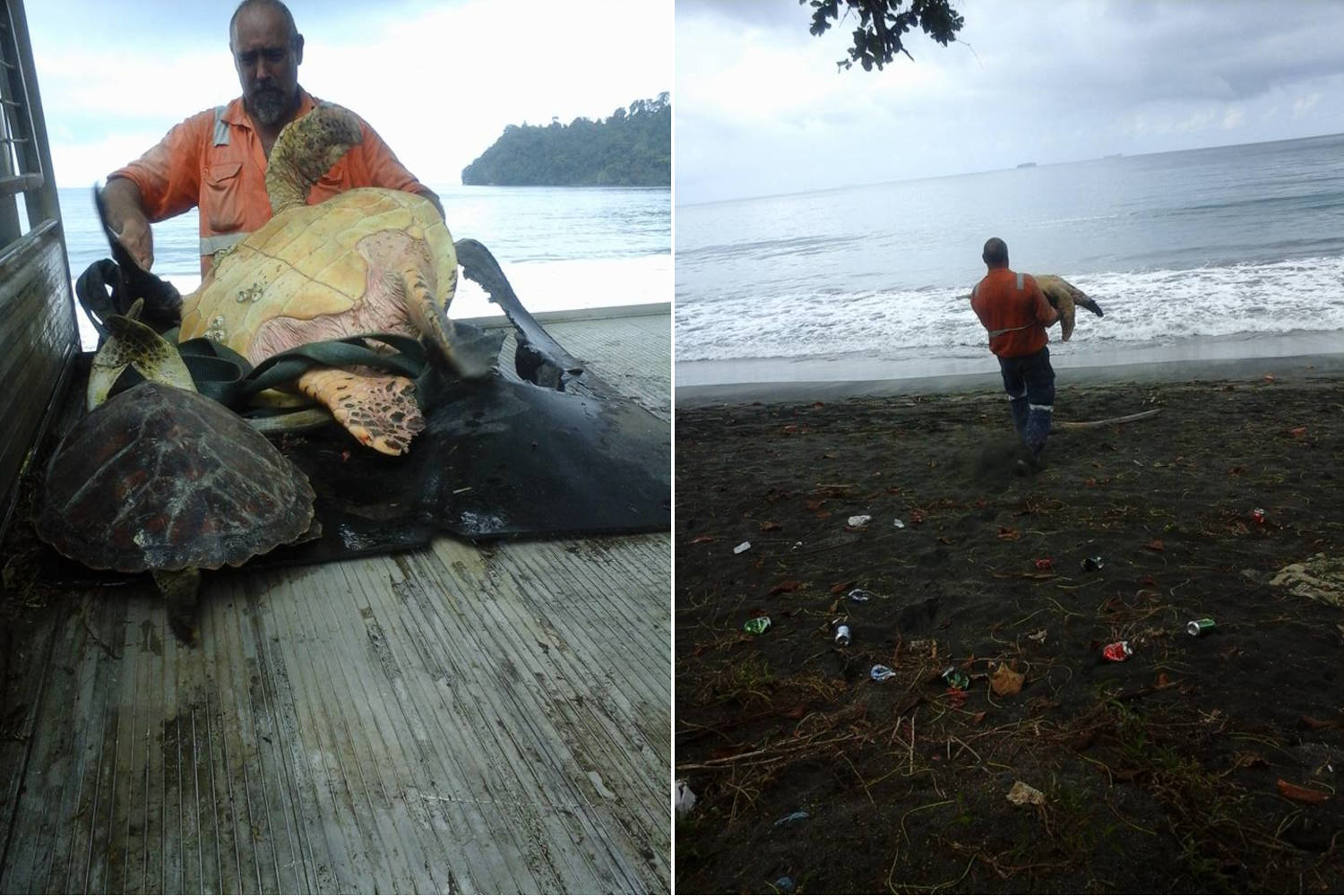
Arron Culling, originally from New Zealand, has attracted the world’s attention for his extraordinary dedication to sea turtle conservation. During a visit to a food market in Papua New Guinea, Arron noticed two live turtles for sale as food. Without hesitation, he spent around 50 local dollars to purchase them, loaded them into his vehicle and drove them just 5 kilometers away to release them into their natural habitat.
But it was not an isolated action, but rather a commitment that has lasted for years. According to his Facebook profile, Arron and his friends repeated similar rescues at least nine times, saving dozens of turtles. His determination pushed him to found an organization dedicated to the protection of turtles in Papua New Guinea.
The protection of sea turtles
Sea turtles are among the most threatened species in the world, with seven recognized species, including green, loggerhead, leatherback, hawksbill, kemp’s ridley, olive ridley and flatback. Most of them are protected by international laws such as CITES and by national regulations such as the Endangered Species Act in the United States. However, the capture and sale of turtles for profit continues to be a problem in many countries, making gestures like Arron’s vital to raising public awareness.
Controversies and real impact
Despite good intentions, experts like Moby Solangi have highlighted a possible negative effect: buying turtles from markets can create an economic incentive to catch more of them, generating a parallel market. On the other hand, many believe that even if Arron’s action does not solve the problem in the long term, it still has the merit of drawing attention to conservation and giving the rescued turtles a chance of survival.
We can all contribute by adopting simple behaviors: reduce the use of plastic, avoid disturbing turtles during nesting, turn off artificial lights near beaches, and respect the marine ecosystem. Every small gesture can become an important step towards safeguarding these critically threatened species.
You might also be interested in:
