
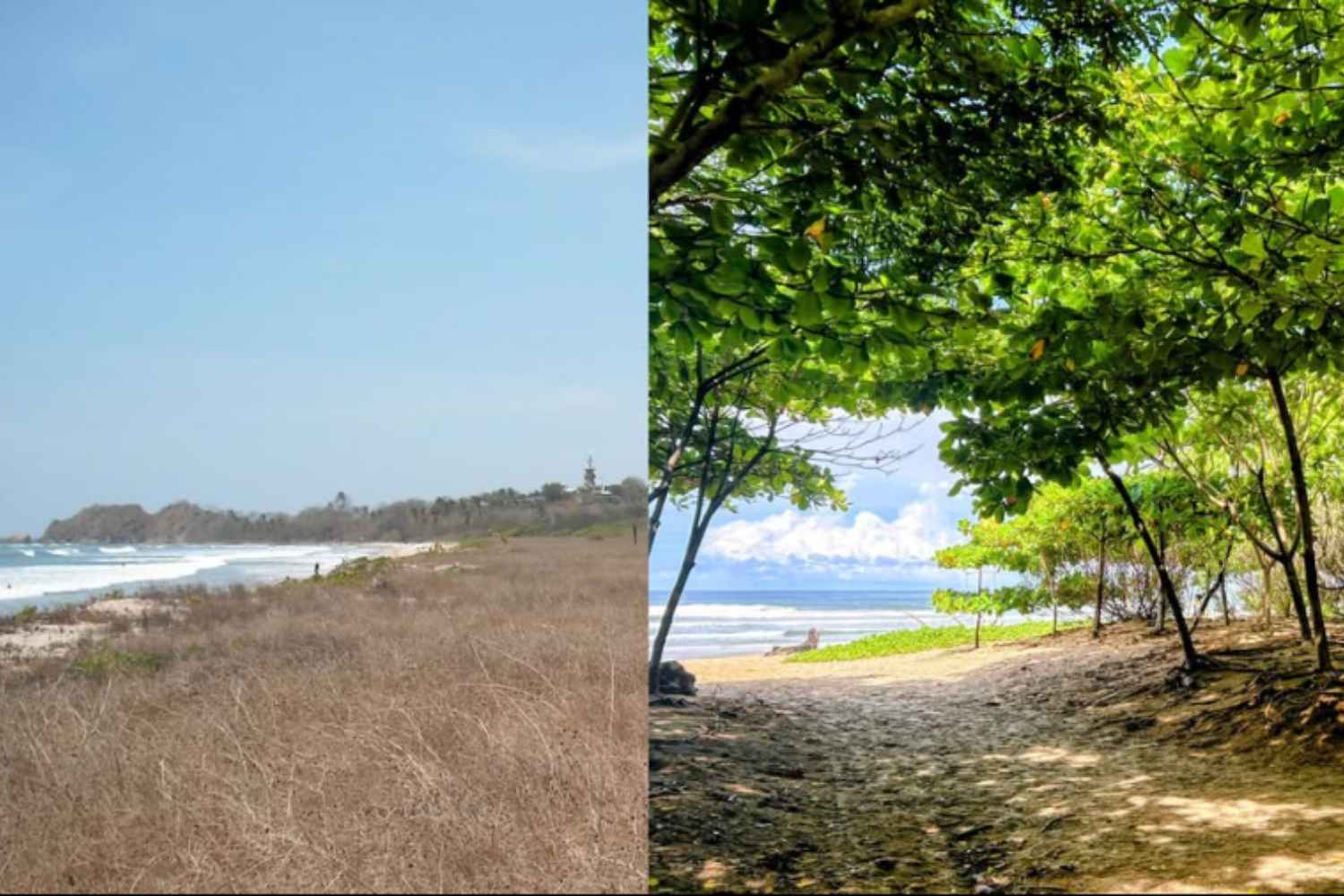
Over 100 thousand trees planted, 34 beaches involved, more than 13 thousand volunteers mobilized and dozens of native species reintroduced. The numbers of Costas Verdes, an environmental organization founded in 2009 along the Costa Rican Pacific, tell one of the most interesting coastal reforestation projects in Latin America. In the space of fifteen years, the association has transformed deeply degraded areas into ecosystems once again capable of hosting wildlife, providing shade and rebuilding lost ecological connections.
View this post on Instagram
The story, told by Guardianhowever, offers a broader reflection: it shows how limiting it is to consider conservation as simple protection of what remains. In many cases, compromised ecosystems need to be rebuilt from scratch.
The price of intensive farming
To understand the significance of the project we need to go back a few decades. According to Gerardo Bolaños, executive director of Costas Verdes, between the 1940s and 1970s Costa Rica lost approximately 70% of its forest cover. One of the main causes was the expansion of cattle ranching on the Pacific Coast.
“Farmers burned ecosystems and grew grass to feed livestock. It was an aggressive and poorly planned approach,” Bolaños said. Bernal Herrera-Fernández, a researcher at the National University of Costa Rica, calls this dynamic the “hamburger connection”: the link between the growth of the cattle industry and deforestation in Central America. The repeated use of fire has accelerated soil degradation, hindering natural regeneration for decades.
When forests don’t return on their own
Since the 1970s, Costa Rica has built an advanced protection system. The 1977 Maritime-Land Zone Act protected a 200-metre coastal strip, while the biodiversity and forestry laws of the 1990s tightened constraints. Fundamental rules, explains Gerardo Avalos, professor of tropical ecology, which however were not enough.
Many lands abandoned after the decline of livestock farming have failed to recover spontaneously. “Soils lost their fertility and their resilience was compromised by intensive practices on very poor soils,” underlines Bolaños. This disproves the idea that it is enough to interrupt human pressure for nature to recover: when degradation reaches high levels, targeted interventions, time and investments are needed.
From a beach without shade to the return of fauna
The idea came from Max Tattenbach, founder of Costas Verdes. As a college student and surfer he frequented Playa Hermosa, a four-mile beach that had only one shaded area. From that observation was born a program that today manages four nurseries, collects local seeds, produces the necessary plants and involves 35 schools and dozens of companies.
View this post on Instagram
The results are tangible today: species that hadn’t been seen for a long time have returned to the reforested areas, such as howler monkeys in Playa Guiones and variegated squirrels. For Herrera-Fernández, these interventions recreate vital ecological corridors for animal movement. The path remains complex: in Guiones approximately 40% of the trees planted have survived, a quota that reminds us that restoration is a process subject to many environmental variables.
A global lesson
Costas Verdes now aims for 300,000 trees on 100 beaches. But the real value goes beyond the numbers. If conserving means avoiding new losses, restoring means reconstructing what has been erased. The beaches of Playa Hermosa and Playa Guiones demonstrate that this work is possible, but requires continuity, science and involvement of local communities. Decisive elements when the goal is not just to plant a tree, but to bring an entire ecosystem back to life.
