
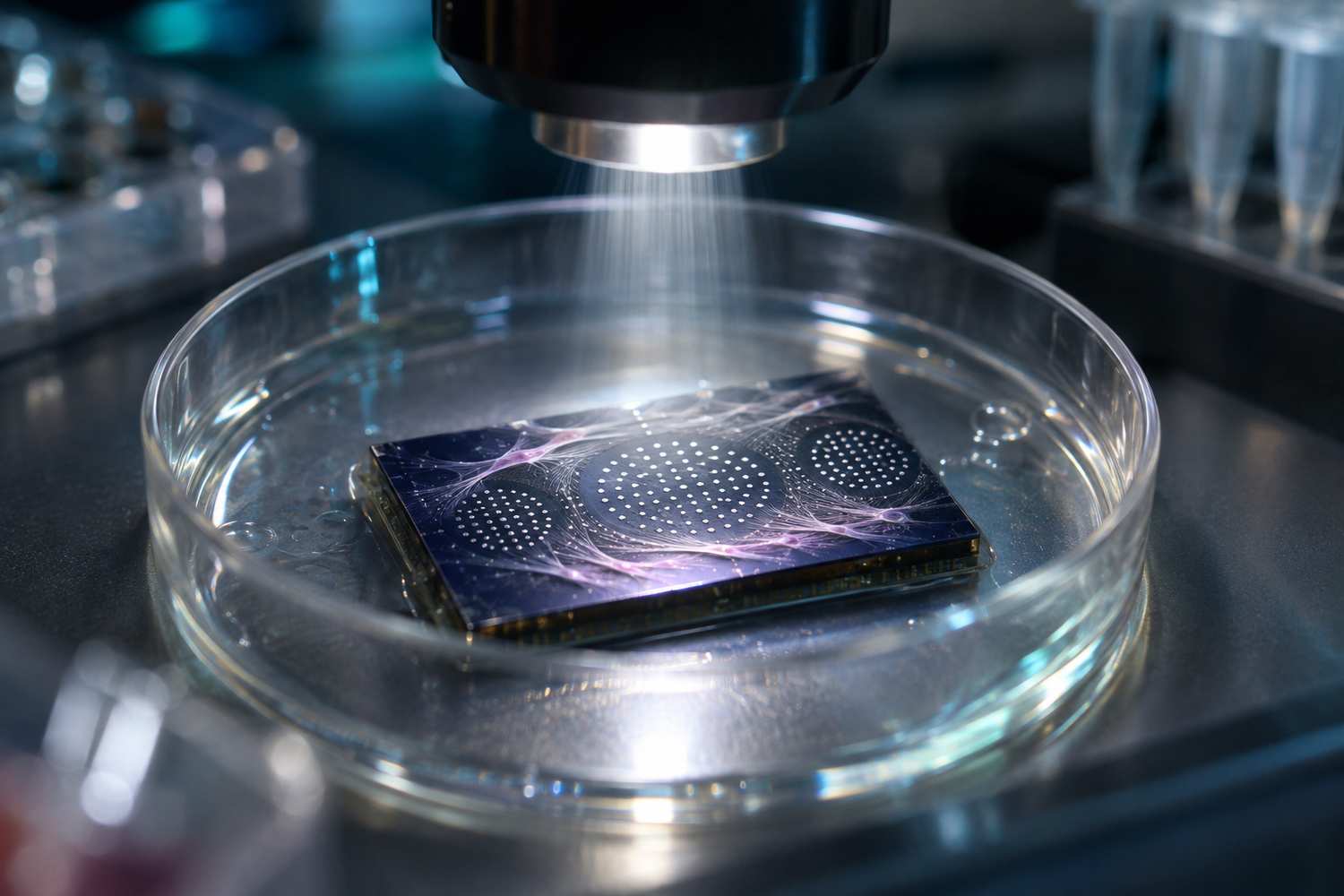
On a silicon chip, some human cells began to arrange themselves following precise patterns: arcs, curves and ring structures. They were guided by tiny illuminated photovoltaic cells, capable of transforming light into weak electrical stimuli. On devices left in the dark, however, the cells grew in a much less orderly orientation. Thus photovoltaics, which we are used to associating with roof panels, has found a rather unusual use: influence the arrangement of living cells.
The result comes from Pennsylvania State University, in the United States, where a group of engineers is studying how to use light to control the growth of biological tissues. The research, published on 8 October 2026 in the scientific journal Advanced Functional Materialscould contribute to the development of 3D bioprintinga technology that allows you to build biological structures by depositing living cells and biocompatible materials layer by layer.
How these tiny solar panels work
When printing biological tissue, cells are placed in precise positions through a mixture called bioink. The work, however, continues even after printing: the cells continue to move, multiply and interact with each other. And this can change the organization of the structure that researchers are trying to build. For some tissues, such as muscle ones, the direction in which the cells are arranged is fundamental for their functioning.
Scientists have long known that weak electric fields can influence cell orientation. Usually, however, to generate them you need electrodes and physical connections which complicate crop management. Ibrahim T. Ozbolat, professor of biomedical engineering at Penn State and leader of the research, explained that his group sought a system capable of obtaining a similar effect simply by using light.
The solution came from photovoltaic microcellsmade on silicon using microfabrication techniques. They work on the same principle as traditional solar panels: they capture light energy and convert it into electricity. In this case, however, the generated current serves to create electrical stimuli localized near the cells. Simply change the lighting to intervene on the device’s activity, without having to connect external electrodes to the culture.
The group experimented with photovoltaic cells with diameters ranging from 80 and 800 micrometers. A micrometer is equal to one thousandth of a millimeter, so the smallest devices measured less than the thickness of a human hair. Tiny dimensions, in short, but sufficient to influence the behavior of cells grown on their surface.
The cells follow the design of photovoltaic microcells
The researchers arranged the microcells on different chips, changing their sizes, distances and geometries. On these surfaces they cultivated lung and skin fibroblasts, cells present in connective tissues and involved in the production of substances that help support and organize the tissues of our body, for seven days.
During the experiments, the chips were exposed to different light intensities. The comparison with cultures kept in the dark showed a clear difference: with illumination, the fibroblasts tended to align themselves according to the arrangement of the photovoltaic microcells. By modifying the design on the silicon, the researchers were able to obtain different orientations, from curved configurations to those organized around ring structures.
Size also made a difference. Among the five configurations examined, the one with microcells from 320 micrometers achieved the best alignment accuracy of 45.5%. The larger cells, therefore, did not necessarily produce the best results. The combination of size, mutual distance and distribution of electrical stimuli influenced the behavior of the fibroblasts.
Yifan Tao, an engineering doctoral candidate and first author of the study, said that the team expected to gain some control over the direction of the cells, but that the effect of the arrangement of the microcells on their shape and orientation turned out to be surprisingly strong. The results also showed that the intensity of the light can be used to modulate the response of the deviceadding another possibility of control.
The research also observed responses linked to calcium signaling, one of the mechanisms through which cells regulate numerous biological activities. Approximately 44% of fibroblasts cultured on the photovoltaic devices showed calcium responses following illumination, versus 1-2% observed in silicon and glass controls. An interesting result because it suggests that these stimuli can also influence some cellular processes, in addition to the arrangement visible under the microscope.
From light to 3D printed biological fabrics
The possibility of orienting cells without using external electrical connections is of particular interest to regenerative medicine. In the construction of artificial fabrics, in fact, obtaining a recognizable shape represents only part of the work. It is also necessary for cells to organize themselves correctly and develop the characteristics necessary to carry out their functions.
A light-based system could offer researchers an additional tool to intervene on the arrangement of cells even after printing. Possible applications concern tissue engineering, the study of wound repair and some research on fibrosis processes, in which the organization of connective tissue plays an important role.
As also explained by Pennsylvania State University, the next objective will be to test the method on cells more sensitive to electrical stimuli, such as cardiac and muscle cells. In these cases it will also be necessary to verify how the stimuli influence their biological functions, in addition to the simple arrangement in space.
Then there is the most challenging step: transfer the system from flat surfaces to three-dimensional structures. The experiments conducted so far concern cells grown on two-dimensional chips. In a three-dimensional space, researchers would like to be able to control electric fields along different directions, accompanying the organization of cells even within the tissue.
The road to producing functional biological tissues will therefore require further experiments. Meanwhile, on a small silicon chip, light has already managed to influence the direction in which cells grow. To get to 3D bioprinting there is still a rather important step missing: adding the third dimension.
