
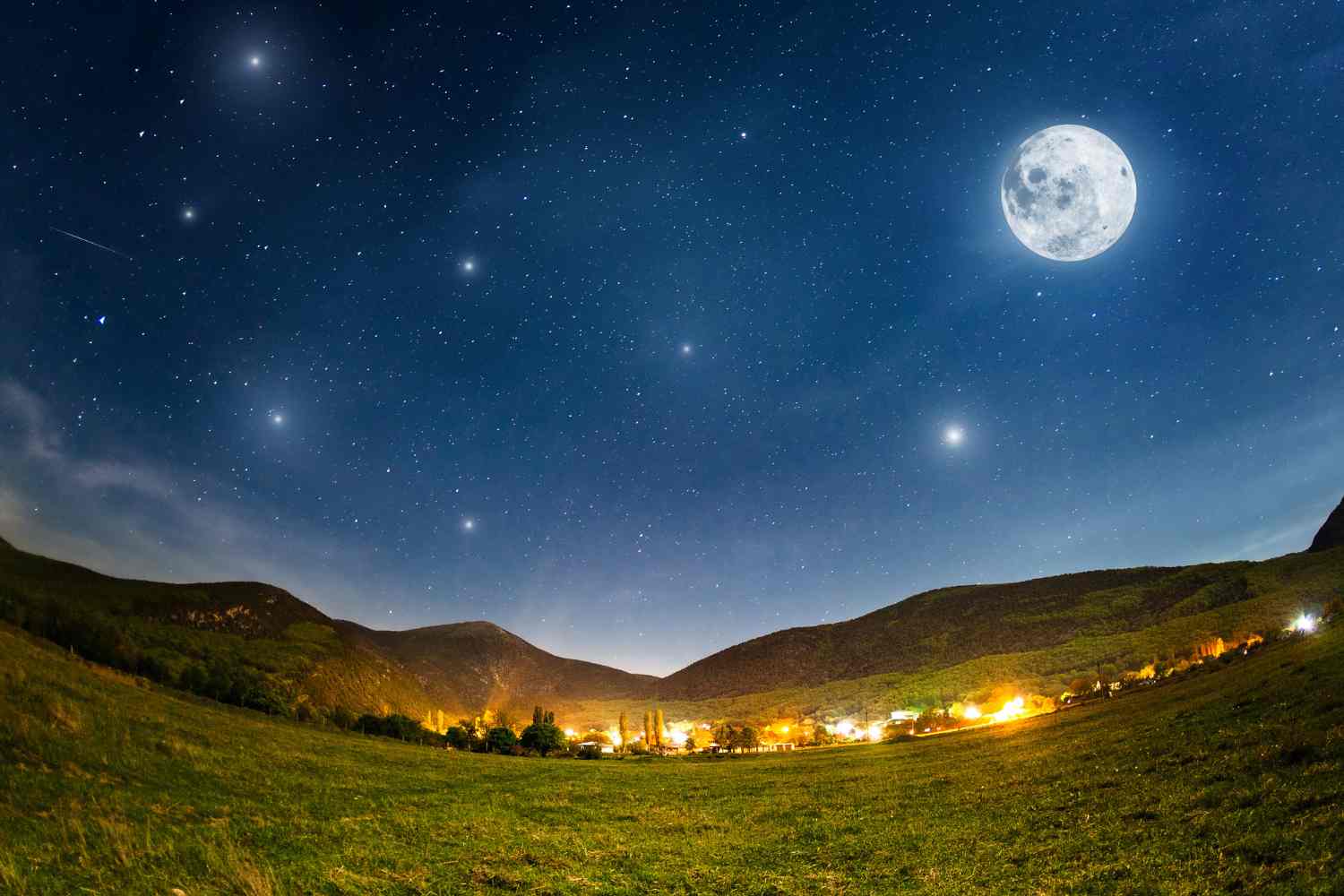
On June 21st at 10.24am we welcomed thesummer 2026 and the first full moon of the hottest season of the year is expected tomorrow, on the night between the 29th and 30th. It will look smaller than usual and we will call it Strawberry micromoonwe don’t miss it!
Summer Solstice: This is the site of one of the most exciting light rites in the world, it’s not Stonehenge and it’s in Italy
Why micromoon
It will return on the night between 29 and 30 June micromoonthat perhaps less spectacular event than Supermoon but always fascinating, in which the full moon (actually also the New Moononly you can’t see it) is at apogee (i.e. the point of the lunar orbit furthest from Earth). We always point out, however, that, how Supermooneven the term micromoon is not an official definition, because it was never confirmed byInternational Astronomical Union.
In this case the full moon will be at a distance from the Earth of approximately 405,254 kmagainst an average distance of 382,500 km. As he explains Timeanddateunder these conditions our satellite can appear between 12.5% and 14.1% smaller than a Supermoon And between 5.9% and 6.9% of an average full moon.
Lunar calendar 2026, let’s prepare for another year of wonderful (and free) shows offered by the sky
©Timeanddate
Why Strawberry Moon
The first full moon of summer will be there Strawberry Moonnamed so by Native Americans because this moon marked the beginning of the strawberry picking season in North America. In Europe, however, it was exactly there Honeymoonbut also Hot moonor Hay moon.
There Honeymoonwhich we still refer to today honeymoonrecalls mead, an alcoholic drink produced by the fermentation of honey and sipped since the Neolithic but of which we also find traces in Ancient Egypt.
In fact, in many regions of Europe, newly married couples were traditionally given a quantity of mead sufficient for an entire month’s consumption. In this way, it was believed that this drink helped in procreation. And, given that in ancient times time was not marked by the current Gregorian calendar but by the phases of the moon, the “honeymoon” was referred to as the period of time in which the couple would sip the drink to procreate.
When and how to admire the Strawberry microMoon of June 30, 2026

©Stellarium
The moon will technically be full on June 30, 2026 at 1.56 am Italian timebut throughout the night between the 29th and 30th we will be able to admire the show (weather permitting). Let’s raise our eyes to the sky and look above the South – South-East horizon, towards the constellation of Sagittarius: we will admire a splendid moon (in the map the sky of June 29, 2026 at 11.30 pm).
How to photograph the Strawberry micromoon
Those who want to immortalize the show do not need professional equipment. The best time to shoot is immediately after moonrise, when the satellite is still low on the horizon: in this phase it can take on golden or orange tones, which are particularly suggestive in photographs. To obtain sharper results, even a smartphone with night mode or an amateur telephoto lens can make the difference, perhaps framing the Moon with landscape elements such as trees, mountain profiles or monuments, to give a sense of scale to the scene.
A full Moon “low” in the sky
There is another reason that makes this full moon special: being the first full Moon after the summer solsticein the Northern Hemisphere it will tend to remain particularly low on the horizon throughout the night. This phenomenon is linked to celestial mechanics: in summer the Sun travels a high arc in the daytime sky, while the full Moon, always being in a position opposite to the Sun, is forced to follow a lower path. A detail which, combined with the micromoon effect, will give avery special atmosphere.
Anyone who wants to witness the phenomenon will just have to arm themselves with a little patience and, if possible, move away from sources of light pollution to enjoy the sky to the fullest. For those who are on holiday or travelling, the night between 29 and 30 June could be the perfect opportunity for a moment of shared observation, perhaps on the beach or in the mountains.
Don’t miss it!
Sources: Moongiant / Timeanddate
