
There is always a certain charm in art auctions, but when the protagonist is Banksy, the mystery thickens and the price rises dizzyingly. The last twist comes from London, where Sotheby’s beaten a work of the street artist for the record figure of 5 million euros. The painting in question, known as “Crude Oil (Vettriano)” or “Toxic Beach”, reinterprets the most famous canvas of the Scottish painter Jack Vettriano, “The Singing Butler”. A work, that of Vetraino, who in 2004 had been sold for “just” 744,800 pounds, marking a record for a Scottish artist at the time.
What makes this “new” so special (dating back to 2005) version? Banksy has transformed the romantic dance scene on the beach, populated by an impeccable butler with an umbrella, into a disturbing scenario of environmental degradation.
The couple continues to dance, but the idyllic background has been replaced by a toxic landscape, with two operators – who wear anti -radiator suits and antigas masks – committed to transporting what appears as a stem of toxic waste.
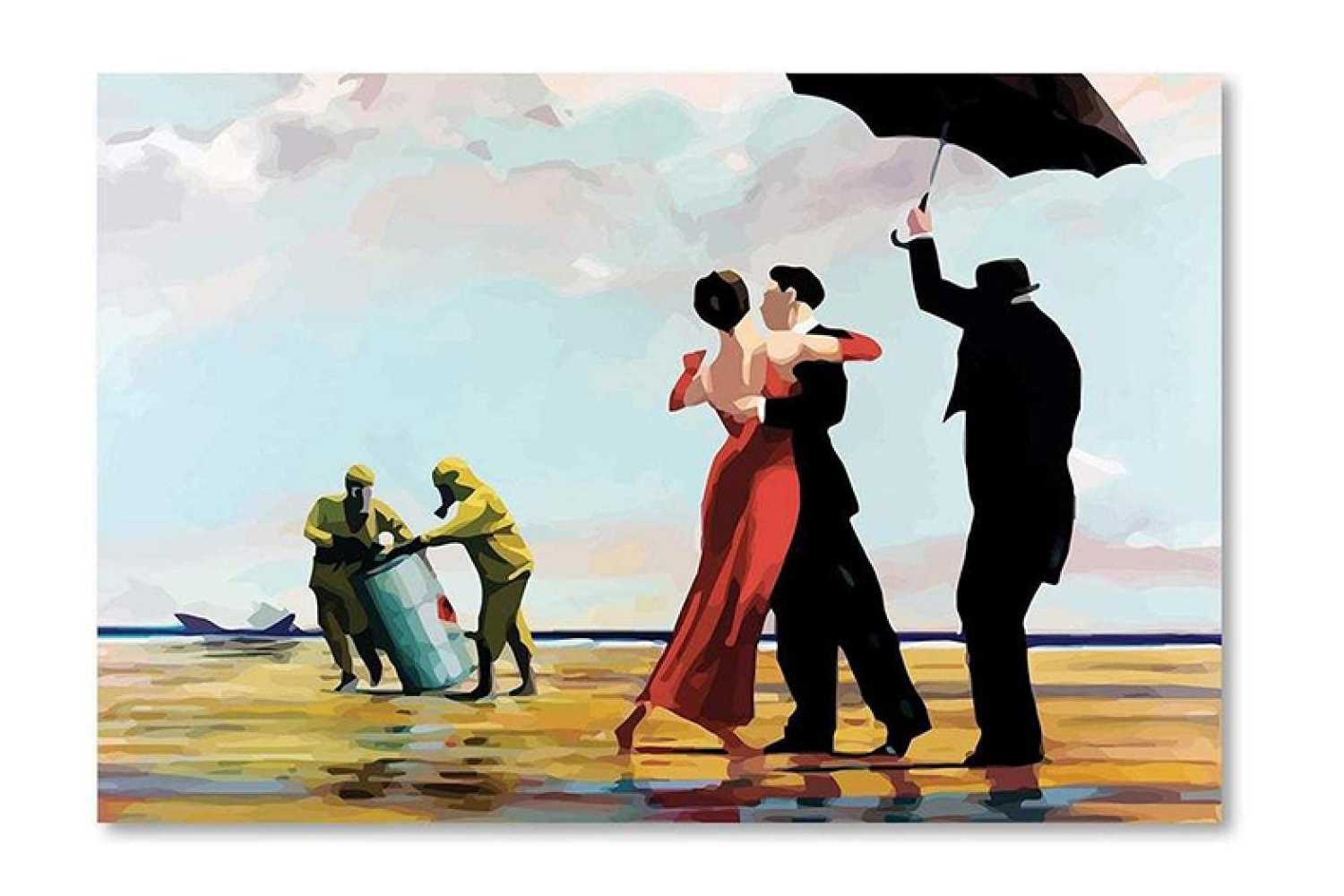
A touch of satire and denunciation, trademark of the Bristol artist.
A mysterious buyer for a controversial work
It is not only the price that makes us speak, but also the new owner, whose identity remains wrapped in mystery. Someone with 4.3 million pounds available and a passion for protest art decided to take home a piece of contemporary art history. The first appearance of “Crude Oil (Vettriano)” dates back to 2005, when he was exhibited in an exhibition that collected Banksy’s provocations. Now, the work will enter a private collection, subtracting from the view of the public, at least until the next auction.
The timing of this sale is not accidental. On March 1, 2025, the world of art lost Jack Vettriano, found lifeless in his apartment in Nice at the age of 73. The news of his disappearance reported his work in the spotlight and, inevitably, has rekindled great interest for each piece linked to his figure.
Jack Vettriano: the painter loved by the public, less by criticism
Jack Vettriano, born Jack Hoggan in 1951 in Methil, Scotland, had an atypical artistic journey. On the contrary, he did not come from a family of art: at ten he already worked to contribute to home finances and sixteen left the school to become a mining technical apprentice. The painting came by chance, with a set of watercolors given for its twenty -first birthday. Self -taught, he began by copying the impressionists to find a personal style that mixed noir atmospheres, vintage elegance and a cinematic romanticism.
The official debut took place in 1988 at the Royal Scottish Academy, where he sold his first paintings in a single day. From then on, his career took off, leading him to exhibit in London, New York, Hong Kong and Johannesburg.
In the face of an unquestionable commercial success, Vettriano remained a very divisive artist: the public loved him, criticism less. His works were often liquidated as “art of poster”, without innovation. Still, one thing is certain: they sold. Every year, “The Singing Butler” ended up on thousands of greeting cards, guaranteeing the artist an annual gain of 500,000 pounds only in Royalties.
The legacy of Vettriano and the desecrating touch of Banksy
Banksy’s reinterpretation of “The Singing Butler” represents a real breakage. While the original evokes an elegance with a nostalgic flavor, the version of the street artist reveals the dark side of the dream. Banksy plays with perception: it transforms a symbol of beauty and romanticism into a social complaint, forcing the viewer to question the world in which we live.
What would you think of Vettriano about this reinterpretation? Difficult to say. He was not new to disputes and had always defended his style without healing too much critics. What is certain is that seeing your own disassembled and reassembled work with an opposite meaning must not be a simple experience for an artist.
In the meantime, the art market has spoken clearly: Banksy’s art continues to make the head spin (and the wallets). Sotheby’s auction has once again shown how powerful his message is.
The question is now: where will “raw oil (vetriano) end?”? Will it be exposed in some luxurious residence, or will it be kept away from prying eyes, confined, perhaps, within a caveau? Whatever the fate of the work, one thing is certain: Banksy’s mystery and value continue to increase.
