
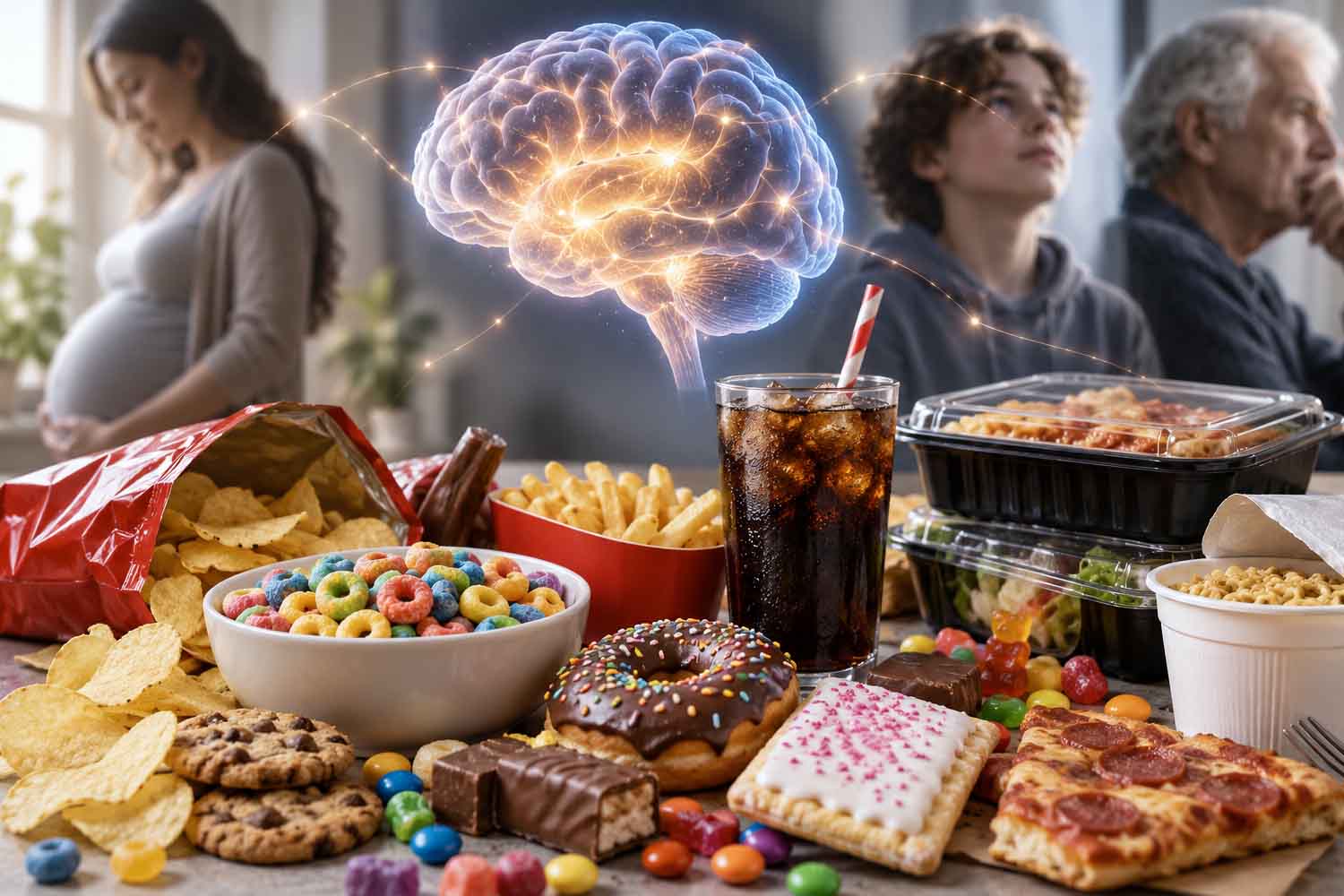
The brain of a fetus, during the last trimester of pregnancy, is doing a lot of work: building new connections, proceeding with myelination and developing structures involved in memory, emotions and reward. It’s also one of the first moments in which the consumption of ultra-processed foods could make history.
A review published on Frontiers in Public Health by Gaia Mottis, Pratheba Kandasamey and Daria Peleg-Raibstein of ETH Zurich brought together the available research to follow this relationship throughout almost the entire lifespan: pregnancy, childhood, adolescence, adulthood and old age.
The result is a much more interesting story than the poor snack put in the dock. What matters above all is how much space these products occupy in the diet and for how long, while the mechanisms involved range from the nutritional quality of the diet to inflammation, passing through the microbiota and brain reward circuits.
And the evidence doesn’t all carry the same weight. Some come directly from human studies, others from animals or cells; many show associations that still need to be better explained.
The first sign appears already during pregnancy
One of the most interesting studies cited in the review followed 2,377 mother-child pairs from the Spanish INMA cohort. The researchers reconstructed the women’s diet during the third trimester of pregnancy and subsequently evaluated the children’s cognitive development.
At 4-5 years of age, the children of women who consumed more ultra-processed products had on average lower scores in verbal ability tests. In the group with the highest consumption these foods represented at least 28.9% of the diet; in the one with the lowest consumption they did not exceed 7.2%.
The difference was approximately 2.3 points on the scale used. On the other cognitive domains analysed, however, no significant associations emerged, nor in the assessments carried out when the children were one year old. It is an important detail because it significantly undermines the image of a generic “damaged brain”.
The study published on Clinical Nutrition it was also observational: it sees a relationship between maternal nutrition and a subsequent outcome in children, without being able to attribute the difference with certainty to the ultra-processed.
The biological plausibility, however, is there. During fetal development, proteins, iron, zinc, choline and polyunsaturated fatty acids are needed. A diet very rich in ultra-processed products can provide many calories while leaving less space for the foods that provide these nutrients. The question, therefore, also concerns what ends up off the plate.
The adolescent brain is a near-perfect customer
Then comes adolescence, when the reward circuits are particularly reactive while the prefrontal cortex, the one that helps control impulses and evaluate consequences, has yet to complete maturation.
Ultra-processed foods enter into this mechanism with some rather convenient characteristics: they often combine fats and refined carbohydrates, they are easy to eat, require little chewing, and have very constant flavors and textures. The brain quickly learns that that package promises predictable gratification. In this regard, at least, we are very efficient animals.
One of the most cited experiments on the topic comes from the US National Institutes of Health. Twenty adults followed an ultra-processed diet for two weeks and a diet consisting of minimally processed foods for another two weeks. They could eat as much as they wanted.
With the ultra-processed diet, they spontaneously ate about 500 more kilocalories per day and gained weight. The experiment didn’t directly study brain development, but it showed something very concrete: given the same number of nutrients offered in meals, the way food is constructed can change how much of it we eat.
Signs regarding attention and behavior then appear among children and adolescents. A Brazilian study of 173 boys associated higher consumption of ultra-processed foods at 3-4 years of age with more symptoms of hyperactivity and inattention at 12-13 years of age.
We are talking about symptoms detected through assessment tools, not diagnoses of ADHD. Furthermore, nutrition, sleep, family conditions, physical activity and individual characteristics can all move together. The review also brings to the table possible links with other neurodevelopmental disorders, including autism, but we are still a long way from being able to attribute a dietary cause to them.
Microbiota and inflammation act as a bridge
In the meantime, a lot of traffic travels between the intestine and the brain. Intestinal bacteria transform dietary fibers by producing molecules, including short-chain fatty acids, involved in the functioning of the intestinal barrier and in the regulation of the immune system. A diet low in fiber and very high in refined sugars, salt and saturated fats can change this balance.
Hence one of the most studied hypotheses arises: alterations in the microbiota, greater intestinal permeability and inflammation could contribute to creating less favorable conditions for the brain too. The review also takes into consideration oxidative stress, insulin resistance and possible epigenetic modifications, especially during pregnancy. However, some steps in the chain are still reconstructed mainly thanks to experiments on animals and cells.
This also applies to additives, bisphenols or nanoparticles coming from packaging: there are experimental signals that deserve study, but dose, substance and exposure change things a lot. Putting any industrial food in the same huge black bag would do little.
The link with dementia appears in adults
As the years increase, the problem becomes cumulative. A diet very rich in ultra-processed foods is associated with obesity, diabetes, hypertension and cardiovascular disease, conditions which alone increase the risk of cognitive decline. Then there is the hippocampus, a fundamental structure for learning and memory, particularly sensitive to metabolic disorders and inflammation.
A meta-analysis published in Journal of Neurology brought together ten observational studies with over 867 thousand participants. In people with the highest consumption of ultra-processed foods, the relative risk of dementia was higher than that observed in groups with the lowest consumption.
Here, however, the studies were very different from each other: the statistical heterogeneity was very high. It means that the overall association exists, while quantifying it precisely is decidedly more complicated.
Those who eat a lot of ultra-processed foods may simultaneously have a less varied diet, do less physical activity, sleep worse or have different economic and metabolic conditions. The studies try to take this into account, with all the limitations of the case.
Ultra-processed foods are not simply “packaged foods”
The NOVA 4 category includes industrial formulations often composed of refined or recombined ingredients, isolated proteins, modified starches, syrups, flavourings, emulsifiers, colorings or sweeteners.
The packaging alone says little. Jarred legumes, frozen vegetables, natural yogurt or bread prepared with just a few ingredients have undergone industrial processing, but this does not mean they automatically end up in the same group as a sugary drink or a reconstituted snack.
And this is probably also why research on ultra-processed foods remains difficult: very different products can coexist within a single category and those who eat many of them also tend to have an overall different diet.
The ETH revision therefore leaves a fairly clear trace without the need to turn it into a simple process. The more ultra-processed foods permanently occupy space in the diet, the more signals regarding metabolism, behavior and brain health appear. Some start before birth, others become visible decades later. The brain, after all, has a long memory. Even when we talk about what we put on our plate.
