
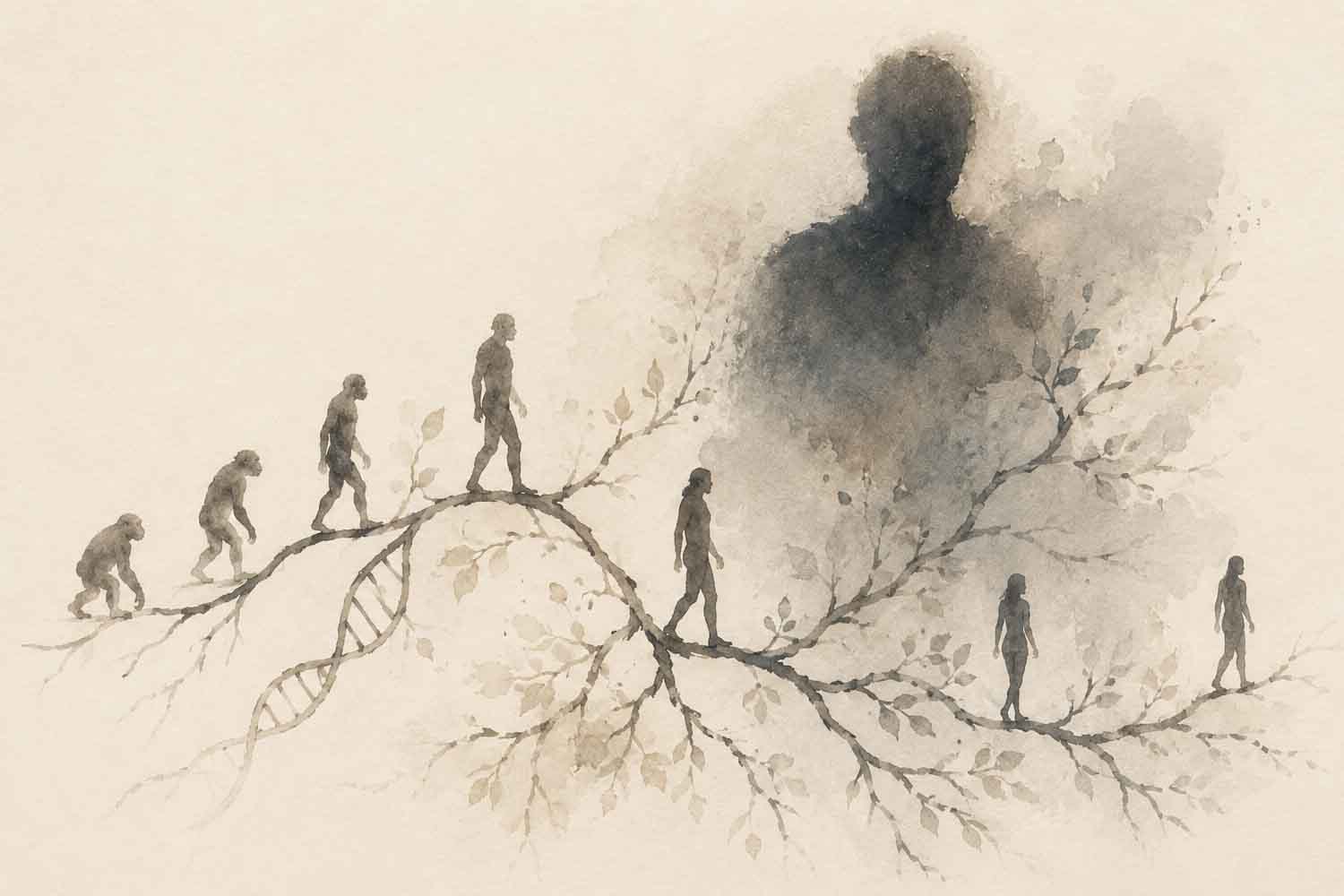
In the 503 genomes analyzed, some segments do not lead back to either Neanderthals or Denisovans. They seem to come from a still unnamed human population, of which we do not possess an ancient genome and to which no fossil has been attributed with certainty. Yet a small part of his DNA may have remained: on average, between the 0.49% and 1.1% in the five groups examined.
The track appears in the British, Han Chinese, Indian Telugu, West African Yoruba and East African Luhya samples. According to the authors of the study published on Sciencethis archaic population would have met and had children with the ancestors of Homo sapiens in Africa, before the expansion that took part of our species out of the continent.
An ancestor without a genome
Finding Neanderthal DNA is relatively simple, at least on paper: Scientists can compare modern genomes with those gleaned from their bones. The same goes for the Denisovans, although the available material is much scarcer. With a population that lacks any reference sequence, direct comparison fails.
Researchers at the University of California at Berkeley then developed TRACEshort for Tracking Archaic Contributions via ARG Estimation. The method reconstructs genealogical relationships along the genome and looks for segments that go back much further than the surrounding ones.
Our DNA, in fact, does not preserve a single ordered family tree. With each generation, chromosomes exchange pieces through recombination, leaving a succession of slightly different family histories along the genome. TRACE puts them together in the ancestral recombination graphs and identifies unusually ancient branches, extensive enough to be compatible with interbreeding between long-separated populations.
Before chasing invisible ancestors, the group checked that the system found those already known. TRACE reconstructed the expected distribution of Neanderthal DNA in Europe and Asia and that of Denisovan ancestry, more present in the genomes of Asia and Oceania. Then there were some segments left that didn’t coincide with either of them.
These sequences show similar genetic affinity with Neanderthals and Denisovans. For the authors they would therefore have come from a distinct lineage, separated from the ancestors of modern humans approximately 800 thousand years agoin the same long period in which the Neanderthal and Denisovan lines also split. The number is an estimate from the model, not a species’ identity card.
The meeting would have taken place in Africa
Most of the segments found in the non-African groups also appear in the Yoruba and Luhya samples. The two sub-Saharan African groups also preserve a greater variety of exclusive sequences, while only a part has arrived outside the continent.
This distribution places the probable interbreeding in Africa, before the last major expansion of Homo sapiens towards Europe and Asia, which occurred about 50 thousand years ago. The population that left the continent brought with it only a portion of the genetic diversity present in Africa, including some fragments inherited from this unknown lineage.
The study therefore expands a story that has already become much less linear in recent years. Neanderthals and Denisovans were not simply replaced by modern humans: they met our ancestors and left descendants. Now DNA suggests that interbreeding also involved groups of which we have no recognizable genetic remains.
The result, however, is concerning five populations and 503 individuals. Their distribution crosses three continents and allows us to recognize a shared signal, without representing all current human diversity. Priya Moorjani herself, coordinator of the study, indicates the expansion of genomic databases as one of the necessary ways to search for other lines and verify how widespread these traces are.
A second ghost passes through the Denisovans
An older signal has also emerged within Oceania’s genomes. In this case the DNA would have arrived at Homo sapiens through the Denisovans, who had inherited it in turn from a population that separated from approximately other human lines 1.8 million years ago.
The meeting between this “super-archaic” population and the Denisovans occurred in Eurasia more than 200 thousand years ago. Much later, crosses between Denisovans and Homo sapiens they would have made a small part of that genetic material travel to the modern populations of Oceania. Denisovans would have retained between 3% and 5% of this ancestry; only a fraction of that would have reached modern humans.
The chronology overlaps with the presence of Homo erectus in Eurasia, but this is only enough to indicate a possible candidate. Without a genome to compare, associating the signal with that species would be premature.
Some of the archaeal segments are more present in regions of the genome involved in immune and metabolic functions. They may have been preserved because they offered some advantage in the face of new pathogens or foods, as has already happened with variants inherited from Neanderthals and Denisovans. The study finds enrichment in those areas; does not yet allow us to assign specific health effects.
To give a name to the two populations, ancient DNA, fossil proteins or other evidence capable of linking the segments to recognizable remains would be needed. For now, that’s enough to reconstruct the meetings. Not yet to see who was on the other side.
