
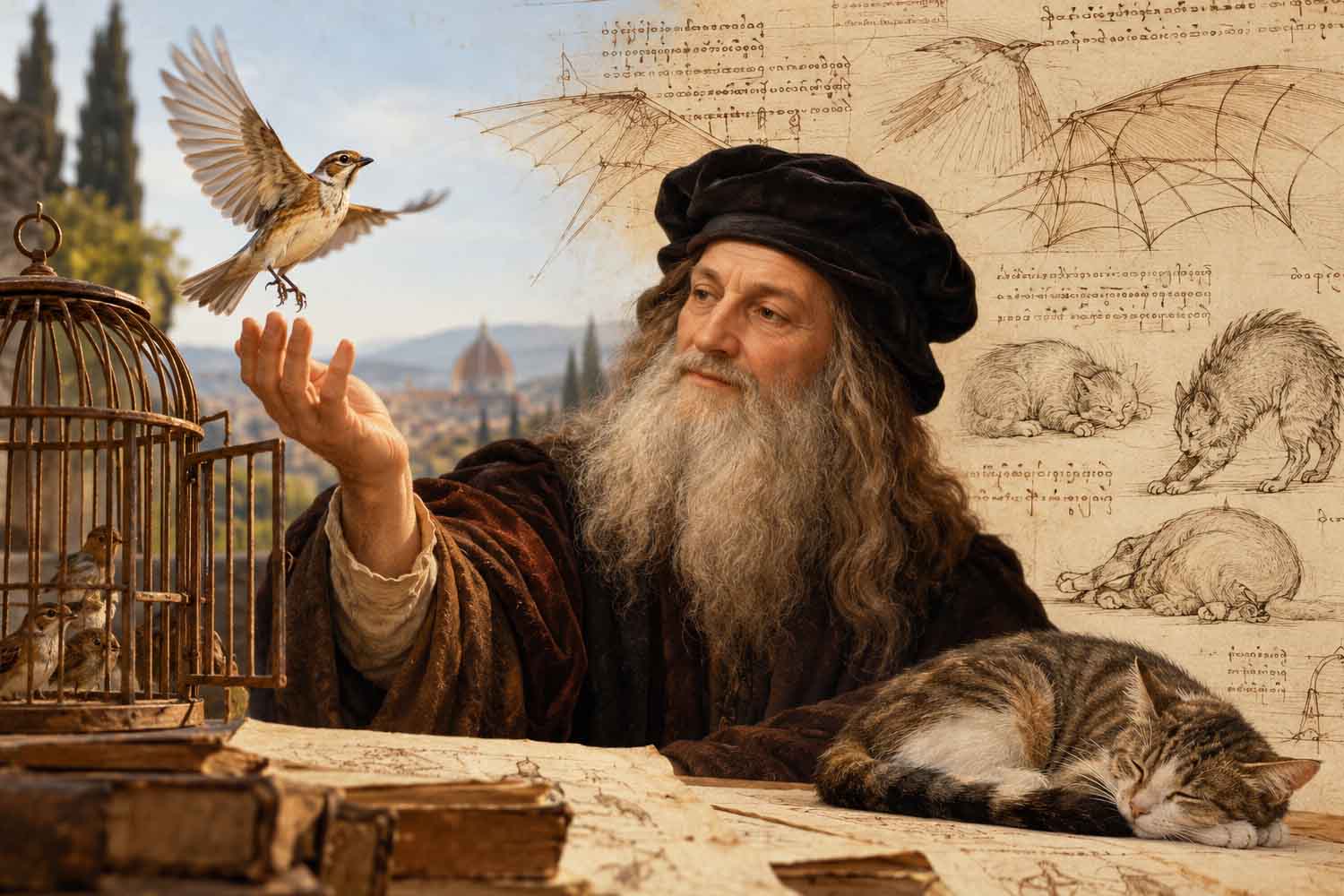
Leonardo da Vinci bought caged birds, paid the sellers’ asking price and then let them fly away. The merchant cashed in, the birds were freed again and Leonardo left empty-handed. This unusual habit is described by Giorgio Vasari, who in his Screw describes a man who is particularly fond of animals, to the point of spending money to restore their freedom.
April 15, the anniversary of Leonardo da Vinci’s birth in 1452, is an opportunity to learn about a less talked about aspect of the great Tuscan artist. Alongside the painter of the Mona Lisa, the inventor of flying machines and the scholar of the human body, we find a man who observed animals with almost inexhaustible attention. He drew them while they slept, studied their movements and wondered about the cruelty of human beings towards them. According to a testimony from 1516, he may have even given up eating its meat.
The birds bought at the market and returned to the sky
In Lives of the most excellent painters, sculptors and architectsGiorgio Vasari says that Leonardo particularly loved horses and other animals, which he took care of with “great love and patience”. Then he focuses on that singular habit. Leonardo, passing in front of the places where birds were sold, bought them and personally took them out of the cages, letting them go:
He left them flying in the air, giving them back their lost freedom.
A simple phrase, which conveys an image rather distant from that of the artist bent over his projects. Yet, that gesture seems to accord well with the curiosity that Leonardo dedicated to living beings throughout his life. Birds, for example, were among his favorite subjects. He observed them to understand how they managed to move in the air, to change direction, to exploit the wind without falling.
Vasari’s story, published several decades after the artist’s death, remains a biographical testimony that we cannot verify in individual episodes. But Leonardo’s relationship with birds is also documented by his papers.
In 1505 he began working on the famous Code on the flight of birdsnow preserved in the Royal Library of Turin. He studied the function of the wings, the balance of the body during flight, air resistance and how birds were able to exploit currents. All knowledge that he hoped to apply to the construction of machines capable of lifting man off the ground. Leonardo wanted to learn to fly. To achieve this, he understood that it was necessary to start with those who had already been doing it for millions of years.
Was Leonardo a vegetarian? The testimony arrived from India
Attention to animals may also have influenced Leonardo’s eating habits. This is suggested by a letter written in January 1516 by the Florentine navigator Andrea Corsali, during a trip to the East. Corsali told Giuliano de’ Medici about the customs of some Indian populations, the “Guzaratti”, who avoided eating living beings and refrained from harming them. When describing this behavior, he added a rather interesting comparison: “like our Leonardo da Vinci”.
Over the centuries, Andrea Corsali’s testimony has fueled the idea of a vegetarian Leonardo, perhaps even against killing animals for food. However, there is a small complication. Corsali does not explain whether Leonardo always avoided meat or whether he was known above all for his opposition to violence against animals. And purchases of meat and fish also appear in the artist’s papers, destined for a house in which other people lived. We therefore do not know what he usually ate.
We know, however, that Leonardo had rather harsh words for human cruelty. In one of his thoughts on morality he addresses the man who claims to consider himself the king of animals, reminding him that he kills countless animals to satisfy his gluttony. She goes so far as to accuse him of trying to transform it into a “burial of all the animals”.
An image very close to the famous phrase, often attributed to Leonardo, according to which his body would never have been a tomb for other creatures. This latter first-person formulation is not documented in the manuscripts. Authentic words are already severe enough, without needing to improve them.
His relationship with nature was complex, made up of observation, study and reflections on human behavior. Leonardo also knew well the violence of animals and the mechanisms of predation. Yet, in his writings addressed to men, he seems to ask for one thing above all: to stop considering every other creature at his disposal.
From horses to sleeping cats, the animals in Leonardo’s drawings
Among the most curious studies he left us is a sheet preserved in the British Royal Collection, probably made between 1513 and 1518. It contains over twenty drawings of cats and lions, even accompanied by a dragon. The cats are portrayed in the most disparate positions. Some sleep curled up, others play, chase each other, fight. One arches his back and raises his fur, evidently unwilling to make friends with anyone.
Leonardo observed the flexibility of the spine, the position of the legs, the movements of the body. The sleeping cats offered him the opportunity to study them calmly. Those engaged in arguing, however, moved too quickly to be reproduced with the same precision, so much so that in some sketches it is difficult to even distinguish which animal the legs belong to.
A problem that anyone who has seen two cats fighting can understand perfectly. Alongside the domestic felines, seven studies of a lioness also appear, observed in different body positions. The dragon, of course, belongs to the imagination, but still follows those sinuous shapes and movements that Leonardo had studied in real animals.
The paper testifies first of all to his interest in anatomy and movement. There is an almost dogged precision in trying to capture every posture, every joint, even the way an animal settles down to sleep.
And this is perhaps one of the most beautiful aspects of Leonardo’s relationship with animals. A man capable of designing extraordinary machines and studying the mysteries of the human body still found time to stop and observe a sleeping cat. Who, knowing cats, probably had no intention of cooperating.
