
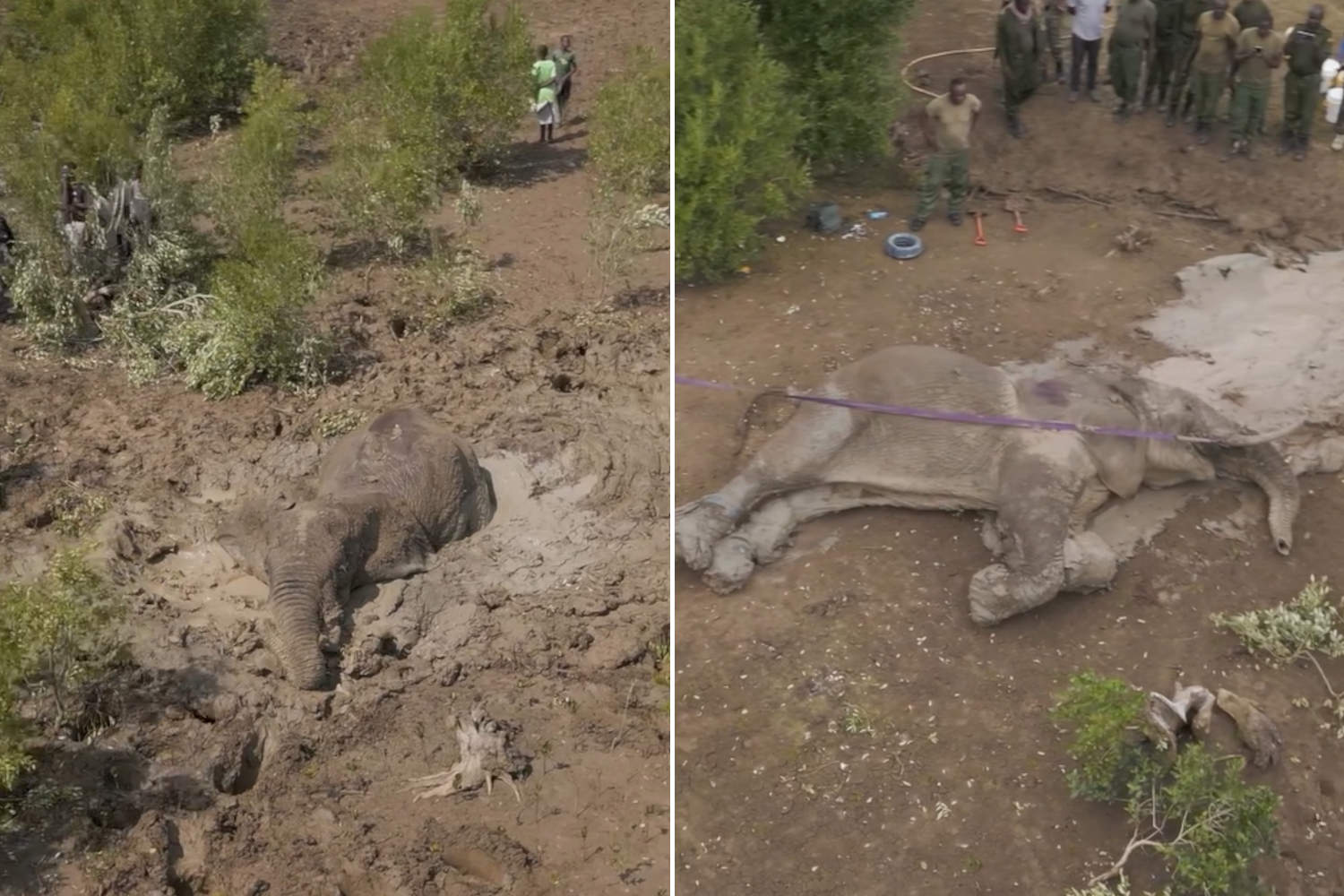
Last August the Sheldrick Wildlife Trust completed one of the most complex rescue operations ever conducted, celebrated through a post that recently went viral. Two elephants had been trapped in the mud and tides of Kilifi Creek, hundreds of meters from land. The situation was critical: with the tide coming in, every minute of delay could have proved fatal. The teams, in collaboration with the Kenya Wildlife Service, had to plan every move with extreme precision to save the animal.
The first two days of relief
On the first day, the teams reached the site with light equipment, carefully observing the mud conditions and the elephant’s position. As darkness fell, the priority was to assess the risks and prepare an action plan to implement the next morning. The goal was to stabilize the animal and figure out how to safely remove it without worsening its condition.
The next day, the extraction turned out to be more complex than expected. The elephant was immersed up to its chest in mud and the cables and straps used initially broke under the weight of the giant pachyderm. A bulldozer was brought to the site as crews dug around the animal to create a safe lifting area. Unfortunately, the first elephant involved in the operation did not make it and died, a hard blow for the rescuers, who nevertheless continued undeterred to save his companion.
The first liberation and definitive salvation
With new tools and reinforced straps, the bulldozer was able to pull the other elephant out of the mud. The animal, exhausted and in shock, refused to leave the place where its companion had died. After accompanying him to a safer area and providing him with water and support, the teams found that the elephant had once again become stuck in the canal.
On the fourth day, the elephant was tracked to a tidal channel. With the help of veterinary therapies and intravenous fluids, the pachyderm was dragged 170 meters to a completely safe area. The release occurred a few minutes before the tide invaded the canal, thus avoiding a risk of drowning. Subsequently, the teams monitored the animal for tens of kilometers, ensuring that it was finally safe.
View this post on Instagram
You might also be interested in:
