
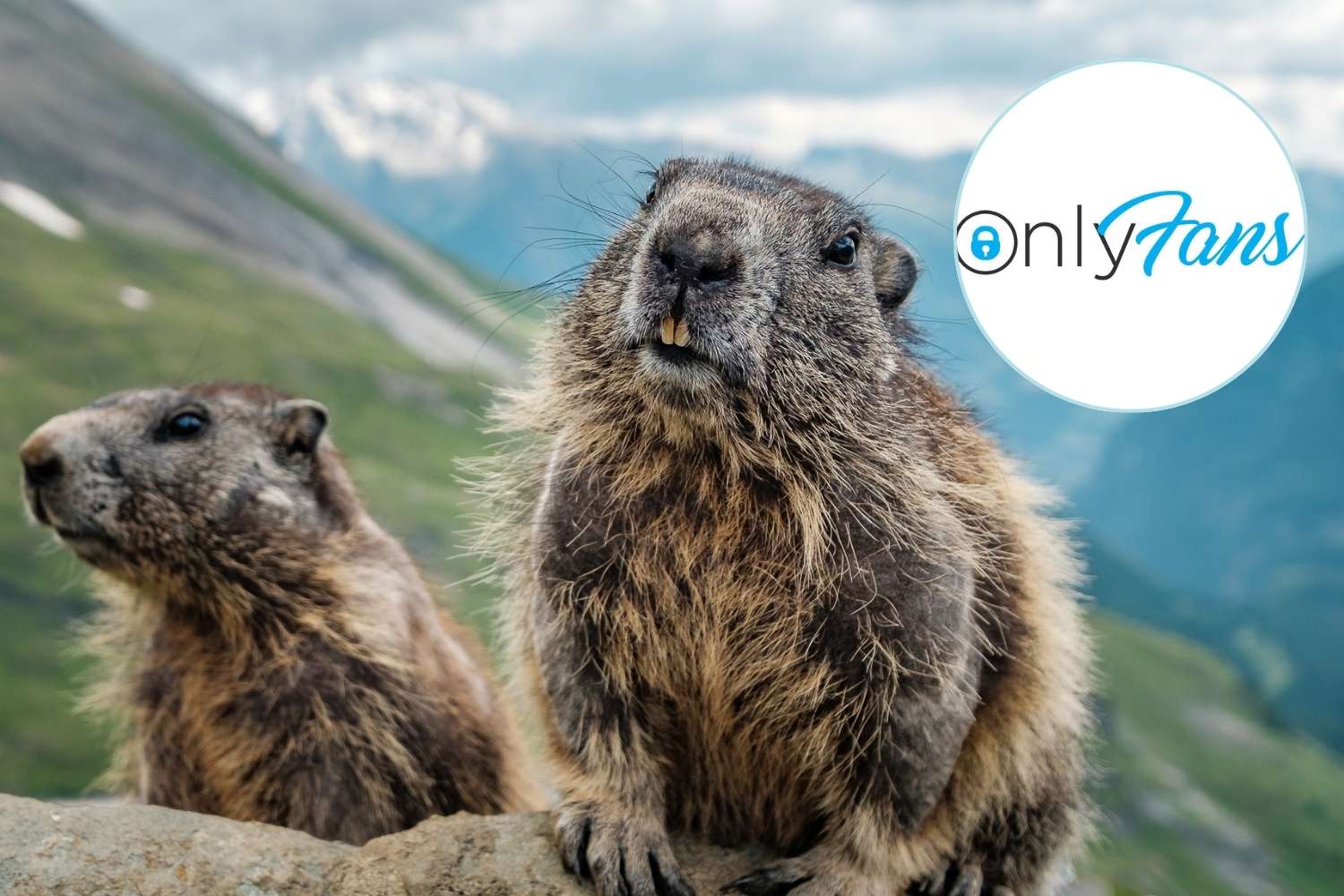
A marmot comes out of its den, another calls out an alarm, someone fights with their neighbor. Then the video ends up on OnlyFans. No career change for the Rocky Mountain rodents: since the end of May 2026 the research group that studies them has been publishing the videos on an account called OnlyMarms to raise money and prevent the interruption of a study that began in 1962. Yes, we are at the point where one of the longest ecological series in the world has to hope for online tips.
The account is free and strictly suitable for all ages. The protagonists are the yellow-bellied marmots, Marmota flavienterfollow at the Rocky Mountain Biological Laboratory, a nonprofit research station near Crested Butte, Colorado.
©Daniel Blumstein – UCLA
Users can leave a tip under photographs and videos collected in the field. At the beginning of August UCLA was already talking about thousands of visitors and about 6,000 dollars raised, before the 20% retained by the platform.
Those marmots have been followed since 1962
The funny part lasts about as long as it takes to say “marmotte on OnlyFans”. Then come the numbers.
The project was started in 1962 by ecologist Kenneth Armitage of the University of Kansas, who led it until 2001. Since then, day-to-day management has passed to Daniel Blumstein, professor of ecology and evolutionary biology at UCLA, now supported by Julien Martin of the University of Ottawa. According to UCLA, this is the second longest study of individually identified mammals in the world.
Each animal can be recognized and followed over time. Researchers observe behavior, social relationships, survival, reproduction, health, and response to environmental conditions. It is precisely this continuity that makes the project valuable: the Marmot Project reminds us that a normal ecological study often lasts two or three years, while a wild marmot can live up to 16 years. To understand what happens to a population over the course of generations, three summers of notes are useful up to a certain point.
In over six decades that sequence of data has made it possible to study changes in population size, effects of environmental conditions, evolutionary dynamics, longevity, consequences of difficulties experienced in the first years of life and even the relationship between sociality and survival. The advantage of such a series is also its most brutal flaw: a lost year remains lost. In 2027 you can’t go back and ask the marmots what they were up to during the previous summer.
NSF did not continue to fund the project
OnlyMarms was born at the end of May, when the National Science Foundation, the main US federal agency for funding basic scientific research, decided not to continue supporting the project. UCLA explicitly presents the account opening as a response to the loss of those funds.
Here, however, we need to avoid a rather tempting shortcut. The case comes during a very difficult period for US university research under the second Trump administration, but the failure to continue this specific funding is not enough, in itself, to demonstrate that the Marmot Project was canceled directly due to a political decision by the White House. The general context, however, is very well documented.
In 2025 UCLA went through a massive suspension of federal funding. In August, Chancellor Julio Frenk estimated extramural funds suspended or at risk at approximately $584 million. The federal government cited accusations of anti-Semitism and discrimination among the reasons; the university contested the choice and argued that the research freeze did not address those challenges. A major portion of those funds, including those NSF funds suspended at UCLA, were later restored after court interventions. Mixing everything into one “cuts” entry would make the story simpler. Even a lot less precise.
The tension over American science funding, however, has been anything but imaginary. In April 2025, UCLA’s research administration itself recorded over a thousand NSF grants terminated in two successive waves and, a few months later, around 300 grants from UCLA alone were temporarily suspended.
OnlyMarms brings money, especially it brings eyes on search
OnlyMarms is actually managed by Emily Renkey, a doctoral student in Blumstein’s laboratory. The videos collected during field work are accompanied by explanations on the animals’ behavior: social interactions, alarm calls, strategies used to avoid predators. Fundraising has thus also turned into a rather effective form of dissemination. Maybe because a graph of animal demographics competes poorly with a groundhog named Jamba Juice.
The money raised helps, but UCLA is very clear about one limitation: crowdfunding cannot support field work of this scale on its own. We need people, equipment, observation and capture campaigns, data collection and management. In fact, on its website the group continues to ask for donations through the official university fund.
And this is the interesting part of OnlyMarms, much more than the pun. Long-term research works exactly because someone keeps showing up in the same place, year after year, when the news isn’t there yet. It collects information that seems tiny until, placed next to each other for decades, it begins to tell how a population, an environment, a species changes.
Since 1962 someone has been coming to the Rocky Mountains, observing the marmots and taking note. In 2026, to try to continue doing so, he must publish them on OnlyFans. The marmots seem to have adapted well to the situation. The research funding model is a little less so.
