
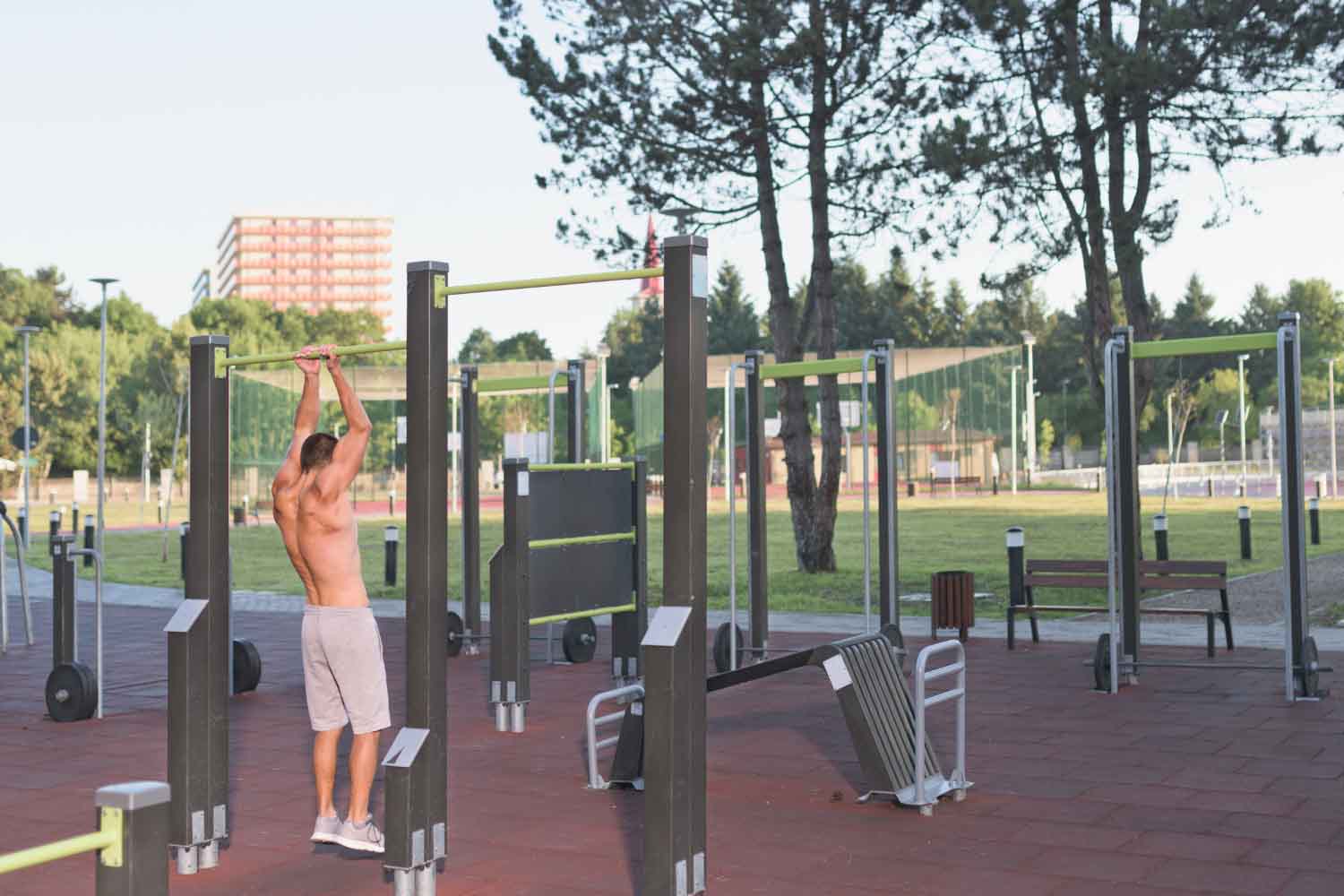
A bar, a bench and a backpack which, for an hour, stops carrying water bottles and starts acting as ballast. This summer the watchword is calisthenics: Bodyweight training can increase mass and strength even away from the gym, as long as the exercises become more difficult as the body learns to perform them.
The lawn offers open air and free admission. However, you have to provide the stimulus needed to make your muscles grow on your own.
The muscle responds to effort
The new indications from the American College of Sports Medicine, published in 2026, come after the analysis of 137 systematic reviews including over 30 thousand participants. The conclusion is rather convenient for those who have already stopped going to the gym since June: elastic bands, free body exercises and programs done at home can improve strength, muscle mass and physical functionality.
For muscle growth, the overall volume counts above all, with a reference of approximately ten weekly sets for each muscle group. ACSM also encourages major district training at least twice a week. The brand of the machinery, surprisingly, does not appear among the requirements.
The calisthenics it can therefore work when push-ups, pull-ups, dips, squats and lunges are treated as strength exercises. You need fairly challenging sets, adequate recoveries and progression over time. Performing the same ten push-ups every morning, with the air of someone who is dealing with a paperwork at the Municipality, soon offers very little to adapt to.
When the push-ups end on the bench
In 2017 a small study published on Journal of Exercise Science & Fitness he placed the common push-ups in front of the flat bench. Eighteen young men between the ages of 19 and 22 were divided into two groups: nine performed the bench press with a load equal to 40% of their maximum, the others adjusted to produce a similar resistance.
After eight weeks, with two training sessions per week, the thickness of the pectoralis major had increased by 18.3% in the push-up group and 19.4% in the bench press group. For the triceps the increases were 9.5% and 10.3% respectively. Strength also improved in both groups.
The comparison is interesting and tiny: just 18 young men, only one upper body movement and two months of observation. The results suggest that well-calibrated bodyweight exercise can produce a stimulus comparable to that of an external weight. From here, a fair amount of sweat goes into promoting any circuit in the park to the level of a complete program.
A meta-analysis of 21 studies found similar increases in muscle mass with low and high loads, while heavier weights retained an advantage in developing maximal strength. To become very good at lifting heavy loads you need to lift them. There are multiple ways to stimulate hypertrophy, as long as the work is truly training.
When the weight of the body begins to weigh little
Difficulty comes with progress. A push-up can be very hard during the first few weeks and transform, a few months later, into a movement that must be repeated dozens of times. The body has adapted. Excellent news for those who train, terrible for a program that has remained identical since June.
In the calisthenics Progressive overload is built by changing leverage, travel, weight distribution, or stability. Push-ups with your hands resting on a bench can move to the ground, then to your feet raised; squats become lunges, Bulgarian squats and single-leg variations. A more controlled descent, a pause in the difficult spot, rings or a band add work without carrying around a rack of dumbbells.
Even a well-secured backpack can become additional resistance. It must be loaded gradually and without objects rolling on your back with each repetition: the two-liter bottle left free inside is not progressive overload, it’s a small revenge.
The program must then cover the entire body. Push-ups and dips mainly train the chest, shoulders and triceps; squats and lunges involve the legs. For the back and biceps you need chin-ups, rows with a low bar, rings or elastic bands. Glutes and posterior chain require bridges, hip extensions and unilateral variations. In improvised circuits the back tends to disappear with considerable ease, perhaps because a bar is really needed to train it.
Reaching complete failure in each series, however, is not essential. The ACSM found that consistently training to the point of failing to perform another repetition does not consistently change the average adult’s performance. The last repetitions should feel tiring and slow down, while the technique should still retain a recognizable form. The muscle may protest. Shoulders and lower back have the right not to participate in the riot.
The heat is not worth as ballast
Training outside can make the session more enjoyable. A meta-analysis published in 2024 brought together 38 studies and 1,168 participants, finding greater enjoyment of outdoor activity compared to indoor sessions of similar intensity. The additional physiological benefits were much less clear. A more pleasant session can help with recurrence; the study alone does not ensure that enthusiasm will survive into September.
In August the park then presents an additional tool that no one ordered: the heat. Fatigue increases, performance may worsen and the risk of illness increases. Sweating more doesn’t make a set more effective for hypertrophy.
The Ministry of Health recommends avoiding direct exposure and intense activity during the hottest hours, particularly between 11am and 6pm during heat waves. Better to choose early morning or evening, look for shaded areas, drink regularly and reduce intensity and duration when the temperature becomes difficult to manage.
Dizziness, nausea, unusual weakness, headache, persistent cramps or confusion require you to stop exercising and get to a cool place. Those who resume after a long break, live with pathologies or experience joint pain should choose suitable progressions and contact a qualified professional when necessary.
The calisthenics it can seriously build muscles, especially for those who are starting out or already have an intermediate preparation. You need consistency, recovery and a difficulty that grows together with strength. The view can help you get back there. Muscles grow when, week after week, the last few repetitions continue to weigh.
