
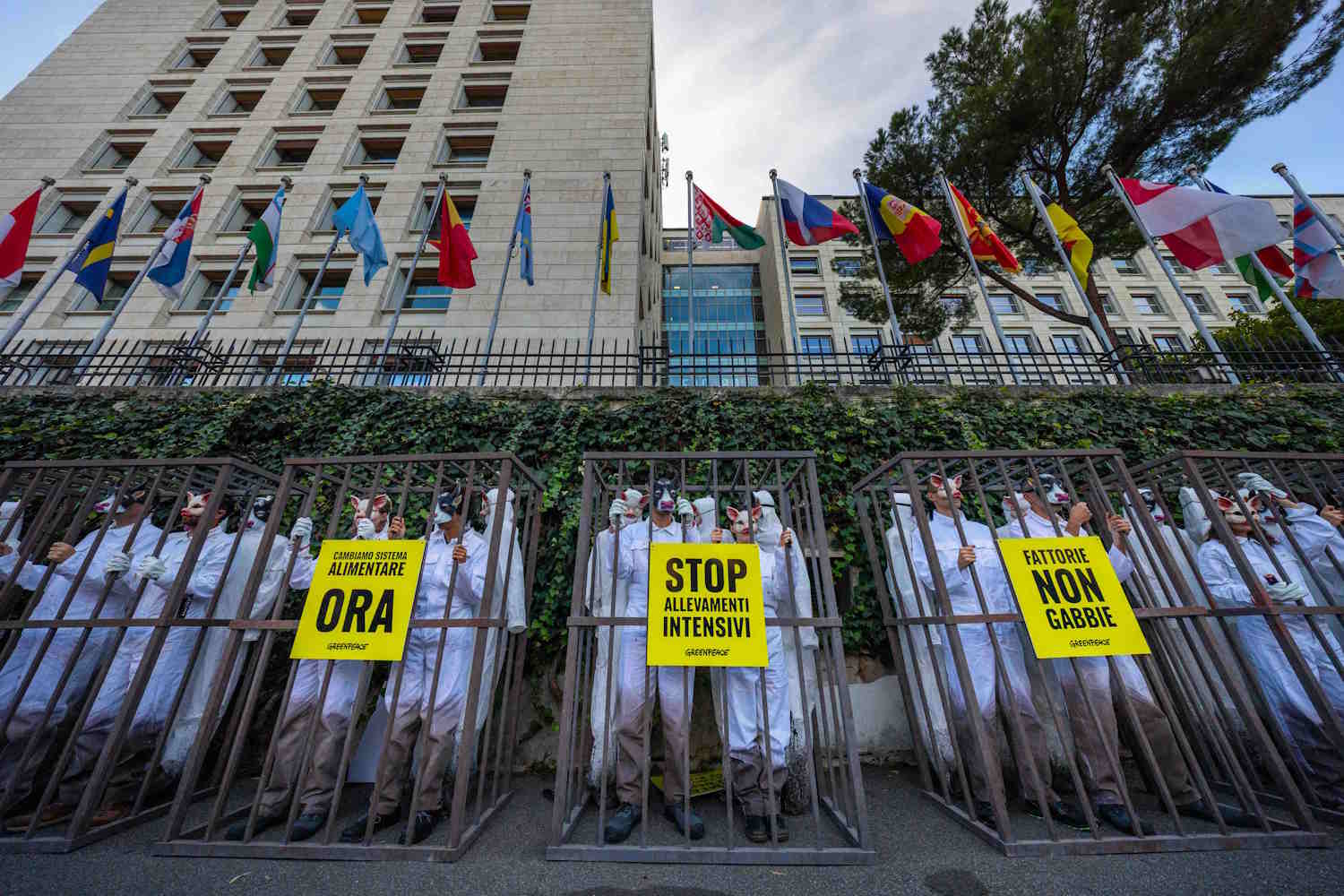
There were no real animals in front of the FAO headquarters this morning, but the scene was no less shocking. Large cages, dense clouds of pink smoke and activists masked by cows and pigs have welcomed the delegates of the second world conference on the sustainable transformation of the breeding organized by the United Nations.
It is Greenpeace who has chosen a raw and direct image to denounce what too often remains hidden behind the walls of industrial farms: suffering, pollution and environmental destruction. The environmental association has in fact recreated an intensive breeding in the center of Rome, wrapped in a pink smoke to symbolize the growing methane emissions produced by the livestock sector.
And those signs spoke clearly:
“Farms, not cages” – “Stop intensive farms” – “We change the food system, now!”.
A direct message to governments gathered to discuss the future of world agriculture: the production of meat and dairy products as it is today is not sustainable, neither for the climate, nor for health, nor for animal life.
Intensive farms are an environmental disaster
The numbers speak for themselves. According to IPCC (Intergovernmental Group on UN climate change), food systems generate up to 42% of global greenhouse gase emissions and zootechny is among the main managers. The methane produced by intensive farms – especially cattle – is a very powerful greenhouse gas, responsible for about a third of the global warming.
But it’s not just about emissions:
Industrial livestock is polluting the water, impoverishing the land and accelerating global warming – explains Simona Savini, head of the agriculture campaign of Greenpeace Italy. Yet the giants of meat and dairy products continue to sell false solutions, blocking the true transformation of the agri -food system.
A global appeal: 90 organizations against the industrial model
During the opening of the conference, Greenpeace has released an open letter signed by over 90 environmental organizations and for development, including Oxfam International, Actionaid and the alliance for food sovereignty in Africa.
The appeal asks the governments of:
The goal is to contain the increase in global temperature within 1.5 ° C and protect vital ecosystems such as Amazon. All this a few weeks after Cop30, which will be held in Belém (Brazil), where a strong presence of the agricultural lobbies is awaited.
Africa in the sights of agro -industry
The complaint does not only concern Europe or South America. As Million Belay, general coordinator of the alliance for food sovereignty in Africa explained:
There is a strong push to intensify and industrialize farms also in Africa. This model of the global North Porta Deforestation, pollution and antibiotic-resistance. Instead, it is necessary to strengthen local systems based on agroecology.
In practice, multinationals are trying to export a bankruptcy model to countries where family and pastoral agriculture still represent the backbone of food safety.
Remove the false myth: “We need intensive farms to feed the world”
Teresa Anderson, responsible for the climatic justice of Actionaid International, put his finger in the plague:
To say that we need agrochemicals and intensive farms to feed the world is a false myth. It is precisely this system that destroy the climate and biodiversity. Agroecology is the most obvious and intelligent answer.
It is not just a matter of idealism. Intensive farms are among the main engines of deforestation and loss of biodiversity. And the idea that they are necessary to guarantee global food supply does not hold up: most of the cereals produced worldwide serves as animal feed, not to directly feed people.
The threat of “No additional warming targets“
Another bomb denounces activists, is that of methane reduction objectives reformulated by exporting countries such as New Zealand and Ireland. These are the so -called “No additional warming targets“, Which in essence, would allow to continue with the same levels of emissions and the same number of bred garments.
A low blow against the Paris agreement and the principles of climatic equity, which instead require greater efforts from the richest countries.
Italy stops at the pole
Greenpeace Italia recalled that the bill “has been filed in Parliament”Beyond intensive farms“, A text that would trace the way for a sustainable transformation of the livestock sector.
The law, however, is still stopped pending discussion. In the meantime, intensive farms continue to operate without real restrictions, helping to worsen the climatic crisis and environmental degradation.
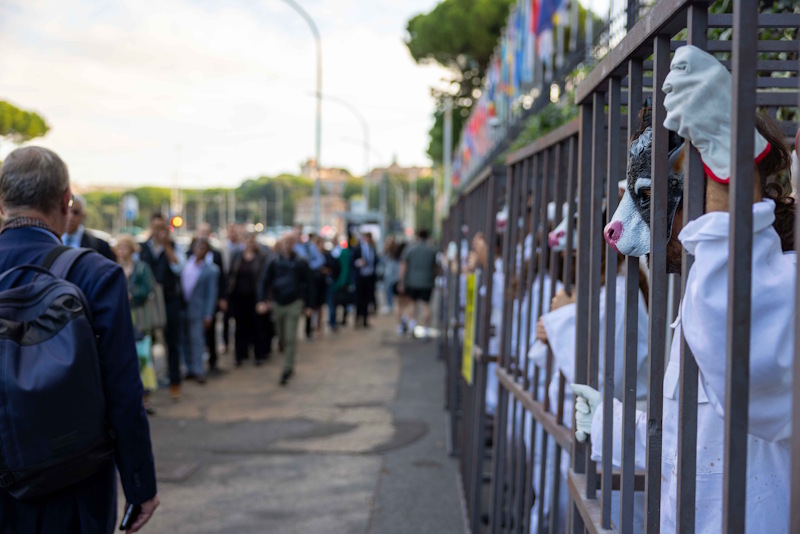
Greenpeace’s protest in front of FAO was not a symbolic gesture, but a clear warning: intensive farms are incompatible with a sustainable future. It is not enough to speak of “technological innovation” or “compensation”. A radical change of paradigm is needed: less meat, less industrial farms, more agroecology, more climatic justice.
With the Cop30 now around the corner, governments must decide which side to stay on.
