
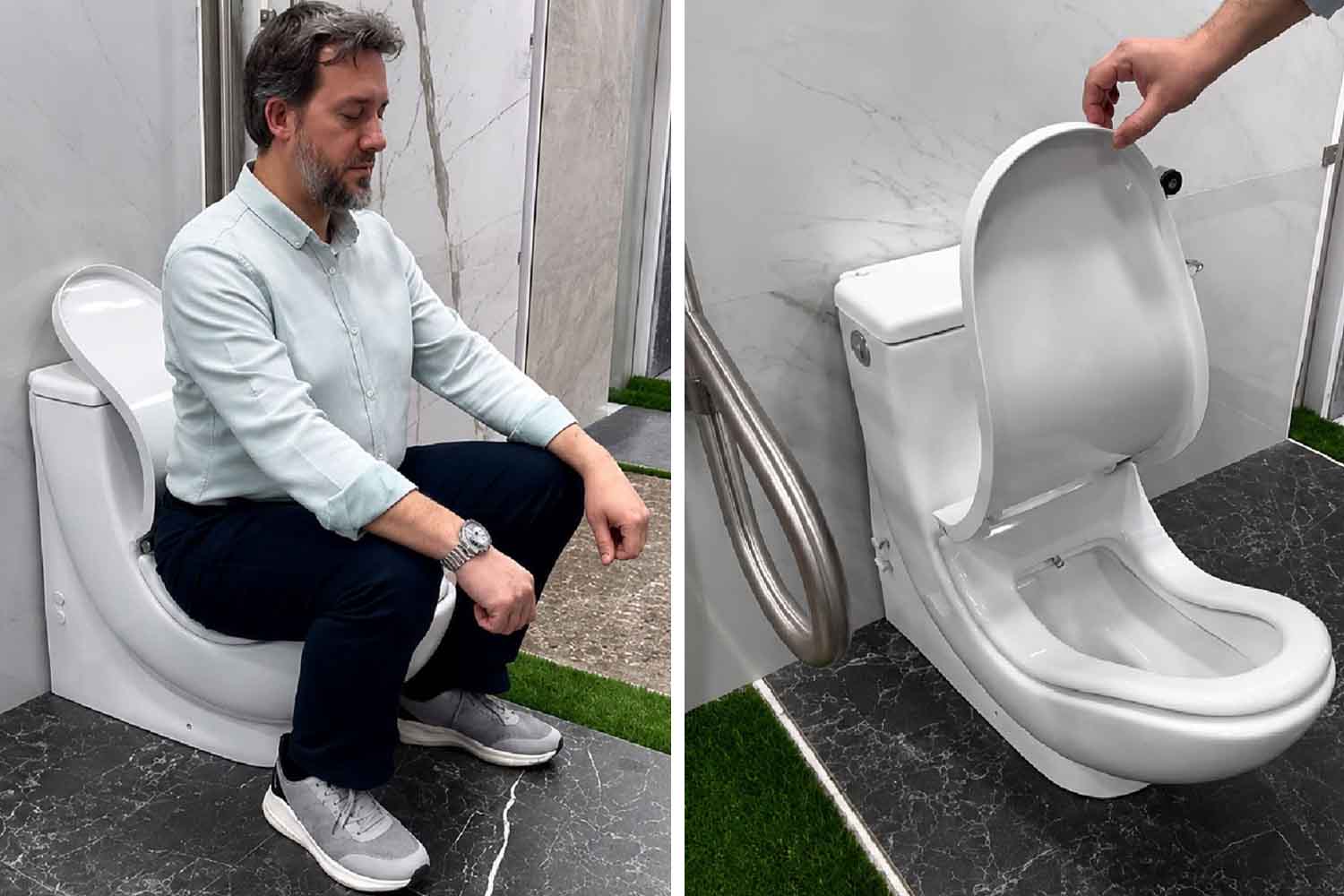
The toilet is one of those objects that we use every day without really looking at it. It sits there, it does its job, it enters the bathroom decor as something already solved. Yet its shape says a lot about how we sit, how much effort we make and how a banal gesture can become uncomfortable when the body is placed in the wrong position.
From this idea was born Ergo Curve, an ergonomic toilet developed in Mexico by the Kisson company. The difference can be seen immediately: the cup has a more curved, hollowed out and inclined shape than a traditional sanitary ware. Whoever sits is naturally brought into a posture closer to squatting, with the pelvis slightly backwards, the knees higher and the torso less rigid. In practice, the toilet tries to do itself what many people achieve by placing a stool under their feet.
A cup that changes your posture
The interesting part of the Ergo Curve lies in its shape. The edge and the internal cavity accompany the body towards a more collected position, different from the classic ninety-degree seat. In this way the pelvis tilts, the hips flex more and the rectal area can work with less resistance.
Simply put: the toilet is not just a place to sit, it tries to guide the body. The crouching posture, or in any case closer to crouching, is the one that human beings used for centuries before the arrival of modern sanitary ware. With higher knees, stool passage may be smoother and pushing effort may be reduced. Kisson’s model tries to reproduce this logic without forcing you to completely change habits.
For those who often suffer from difficulty in the bathroom, this can be the most useful part: a more favorable posture can help reduce pushing, shorten the time spent on the toilet and give a greater sensation of emptying. It’s not a cure for constipation, of course. However, it is a different way of thinking about an object that, until now, has been designed above all to be comfortable, clean and pleasant to look at.
Less effort, more comfort
The principle is the same as the bath footrests that have become popular in recent years: raising your knees and tilting your torso can make toileting more natural. The difference is that here the gesture is integrated directly into the cup. No accessories to move, no stool to hold in front of the toilet, no solution added later. The posture is already foreseen by the healthcare professional.
For this reason, the ergonomic toilet can be interesting especially in homes where the bathroom is redone from scratch, or in structures that pay attention to daily comfort. A mug of this type can speak to those who spend too much time sitting in the bathroom, to those who tend to push a lot, to those who are looking for a more comfortable position without turning the bathroom into an improvised gym.
There is also the theme of water. According to information released on the Mexican market, Ergo Curve consumes 4.8 liters per flush, a smaller quantity compared to many older models: the toilet remains one of the places in the house where drinking water is used most often and with greater automaticity. A more efficient sanitary ware, if it works well over time, can help reduce waste without requiring major changes in habits.
Useful, without miracles
The point to keep in mind is this: a better made toilet can help, but intestinal problems cannot be solved by just changing the bowl. Constipation, irritable bowel syndrome, bloating and evacuation difficulties depend on nutrition, hydration, movement, medications, stress, pelvic floor and clinical conditions. The Milan Polyclinic reminds us that irritable bowel syndrome affects approximately 5% of the Italian population and often requires attention to daily habits, not isolated solutions.
Some scientific basis on posture exists. A study published in PubMed noted that the squatting position can reduce time and effort during defecation compared to traditional sitting. Research on toilet footrests has also indicated possible benefits on comfort and emptying. This is enough to say that the theme is credible. It’s also enough to avoid teleshopping enthusiasm.
Those who want to experiment with the same principle without changing the toilet can start from a stable stool under their feet, keeping their knees slightly higher than their hips and their torso inclined forward. Anyone who has persistent symptoms, pain, blood in the stool, sudden changes in bowel movements or weight loss should talk to their doctor. Posture can help the gesture. The rest are worth a visit, not an online cart. Meanwhile, this curved toilet leaves a very simple question: how many things have we accepted just because they have always been done this way?
You might also be interested in:
