
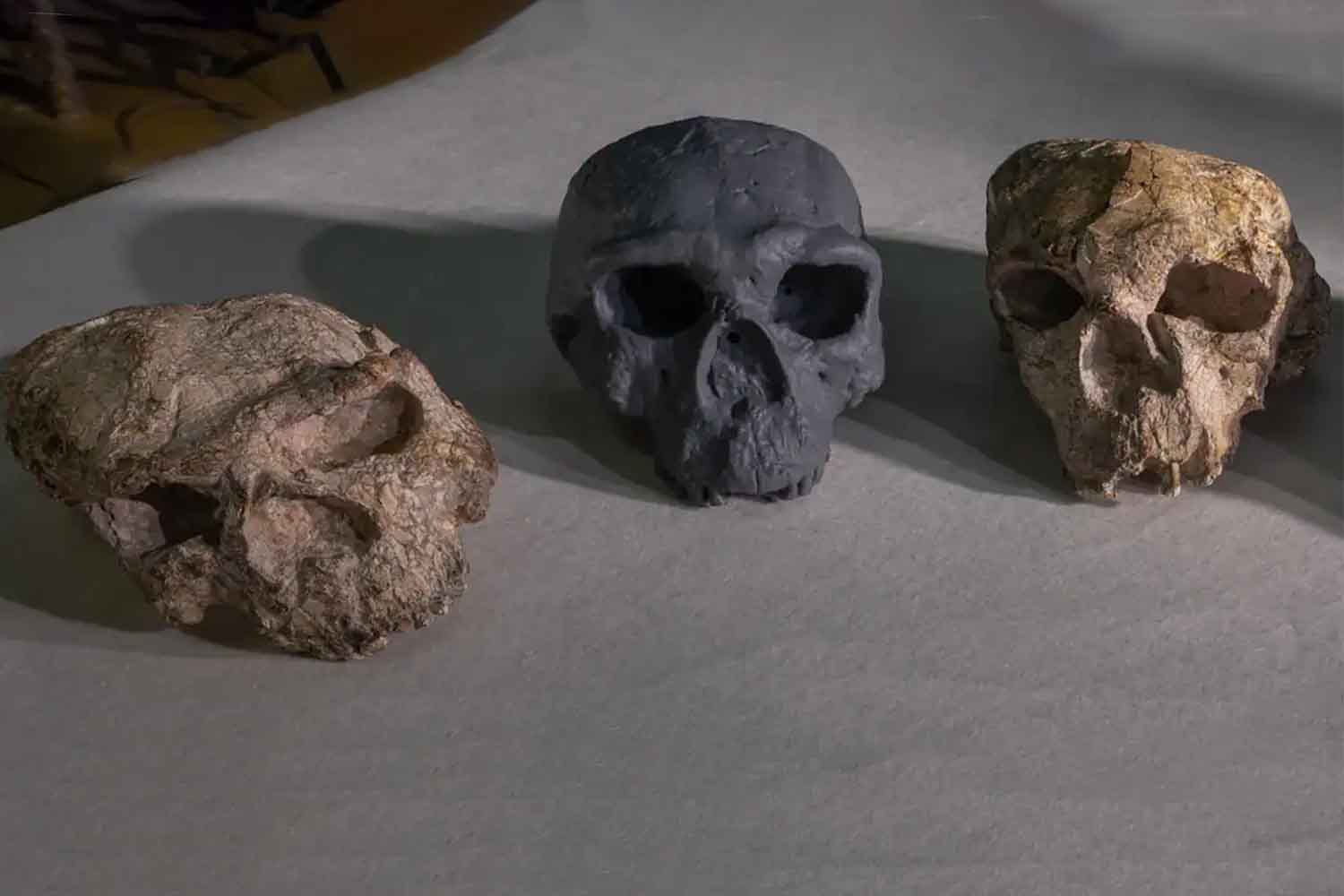
In 1990, a farmer in central China found a fossilized skull so crushed as to look like a pancake. He was called Yunxian 2 and, for years, it was attributed to our distant relative Homo erectus. But today, thanks to advanced digital technologies, that fossil tells a very different story – a story that could rewrite the origins of Homo Sapiens.
An international scientist team used High resolution 3D scans To “unroll” the Yunxian 2 skull, reduced almost in a pulp for millennia of pressure. With techniques of Forensic digital reconstructionseparated the bones from the sediments and put the fragments back together, taking inspiration also from another more damaged skull found in the same area: Yunxian 1.
But the most interesting part came later: scholars have compared over 500 anatomical points by Yunxian 2 with those of numerous other known human fossils. The analyzes, based on evolutionary and genetic models, indicate that This skull belongs to an Asian human linelinked to Homo Longi (nicknamed Dragon Man) and the mysterious Denisovian.
In simple words: We may have separated from Neanderthal and Denisovian long before expectedand Yunxian 2 could be the fossil that shows us that moment.
An ancient face, but a modern brain
The reconstructed skull has mixed traits: one long and low cranial boxvery marked eyebrow arches, but also an unusually large brain for the time – approximately 1.143 cm³similar to that of the former Homo sapiens.
The face is wide, with flat cheekbones and a high nosehowever, without the typical central swelling of the Neanderthalian face. According to experts, these characteristics They bring him closer to Homo Longianother Asian hominide recently discovered. And the most surprising aspect comes into play here: The Denisovians – our lost “cousins” – seem to descend from the same line as Homo Longi.
In this picture, The Denisovians would be closer to us than the Neanderthalsand our evolutionary history could be much more intricate than imagined.
Homo Sapiens’ origin may not be in Africa
If these data are confirmed, The line that led to modern human beings would have separated from that of the Neanderthals about 1.38 million years agoWhile Homo sapiens and Denisovians would have continued to share the same evolutionary branch up to about 1.32 million years ago. Our species, however, would have appeared around 1.02 million years ago.
Numbers that deny the most popular genetic models, according to which these events would have occurred only 600,000 years ago.
Chris StringerPaleoAnthropologist of the Natural History Museum in London and co -author of the study, explains:
This fossil is probably the closest we have to the common antense of all these human groups.
And that’s not all. If really Homo sapiens thus separated from others so early, Perhaps its “birthplace” is not Africaas it has always believed, but Western Asia. From there, archaic populations could have returned to Africa, where modern man then evolved.
A hypothesis still to be confirmed, but which opens completely new scenarios.
Scientists are divided
Not everyone agrees. Some experts, such as the geneticist Aylwyn Scally, remember that the genetics is often more reliable than morphologyespecially when working with partial remains. Frido Welkerof the University of Copenhagen, is more cautious:
If these dates are confirmed by other fossils and genetic data, they would be truly surprising.
Also paleoanthropologist Sheela Athreya it’s skeptical:
Evolution in the middle Pleistocene is still an unsolved mystery.
But on one thing everyone agrees: Yunxian 2 is a very important discoverybecause it could represent one of the rare fossils capable of making us understand how, when and where our kind has evolved.
For now, the history of the human being seems less a straight line and more one complex network of ancient populationswho have crossed and separated several times over time.
