
The electric car spends most of its life at a standstill. In the garage, under the house, in the office parking lot. Meanwhile, inside it carries a battery which, at least on paper, could do something more useful than waiting for the next journey. It could accumulate energy when there is too much of it, return it when needed, lighten the grid in the most complicated moments or lend a hand to domestic consumption, if the system, vehicle and connection rules allow it.
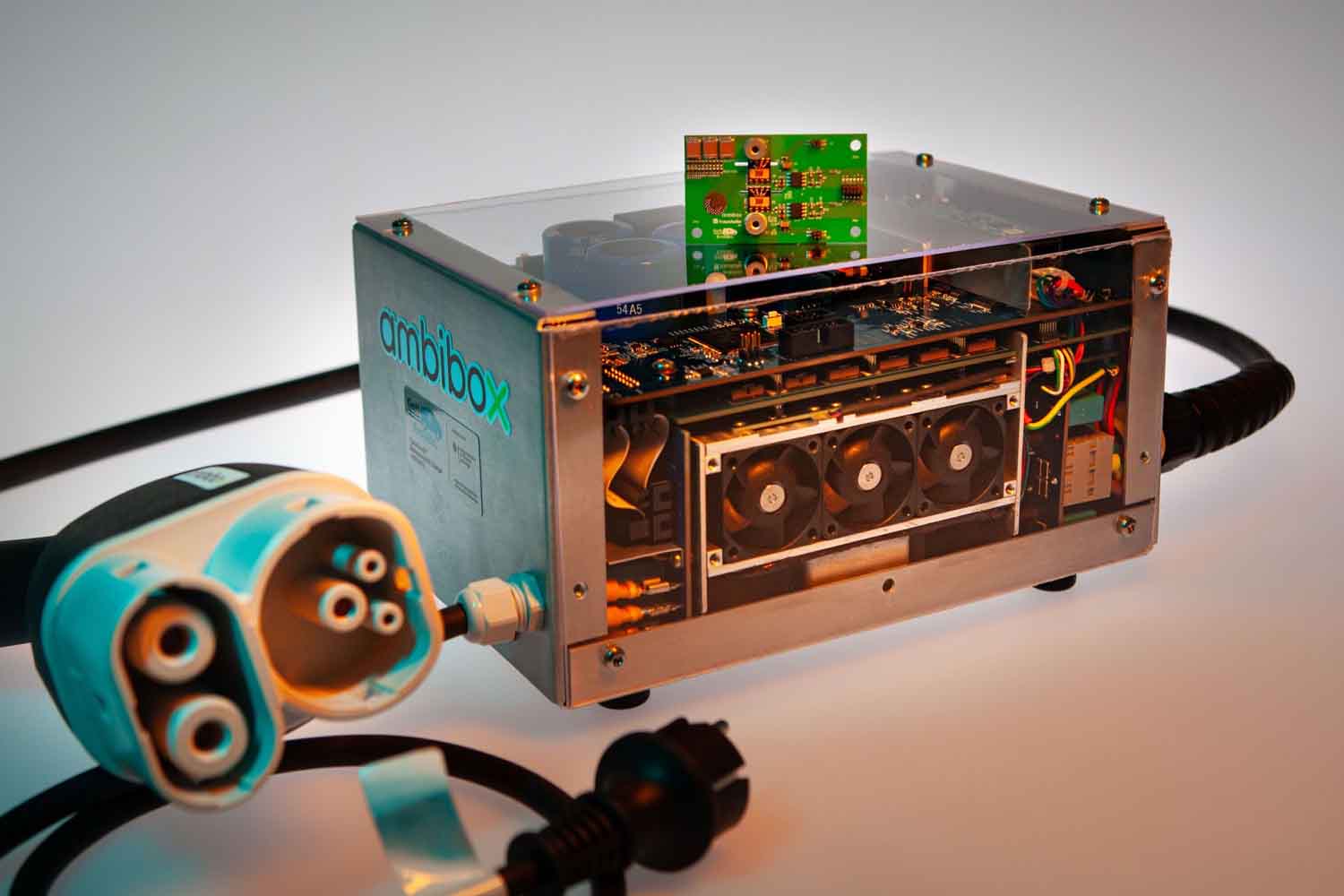
From here the work of Fraunhofer IAFthe German Institute for Applied Solid State Physics, which presented a demonstrator of portable two-way charger for electric cars. The point to keep in mind is this: we are talking about a prototype, not a ready-made accessory to buy and stick in the trunk tomorrow morning. However, the dimensions tell the direction well: 5.7 kilos in weight, including plugs, 8.3 liters of total volume and a bidirectional power of up to 3 kW. Enough to move the discussion from the fixed column to a much more compact object, almost to be carried with you.
A battery with wheels
The technology is called bidirectional charging. In practice, energy can go in two directions: from the grid to the car battery, as normally happens, or from the car battery outwards. In a domestic scenario, this means using the car as storage: during hours of abundance, for example when photovoltaic panels produce more than necessary, the battery charges; later, when the sun goes down and consumption rises, that same energy can come in handy at home or on the grid.
The idea is not new, but so far it has come up against very practical obstacles: costs, size, efficiency, technical complexity, compatibility with the high voltage architectures of the most recent electric cars. The German GaN4EmoBiL project was created precisely to work on this missing piece, i.e. more compact, efficient and industrially sustainable bidirectional charging systems. The consortium includes research and industry, with Fraunhofer IAF, University of Stuttgart, Bosch and Ambibox.
The demonstrator developed by Ambibox integrates a power electronics module made by Fraunhofer IAF. It is an “off-board” single-phase DC charger: the energy conversion is moved outside the car, to an external module. Today many electric cars have integrated on-board chargers that transform the alternating current at home or from charging stations into direct current for the battery, often with power ratings of 11 or 22 kW. Here the power is lower, 3 kW, so charging remains slower. In return, the object becomes mobile, lighter and more flexible.
The heart is GaN
The most interesting part lies in the material used for the module: the gallium nitrideoften referred to by the acronym GaN. It is an increasingly important semiconductor in power electronics because it enables faster, more compact and more efficient devices than many traditional solutions. In this case, the researchers worked with 1200V GaN components built on an insulating substrate, designed for 800V bidirectional DC charging systems.
The module has been tested to work with battery voltages between 150 and 920 V. This detail weighs heavily, because recent electric cars are moving towards increasingly higher voltage architectures, useful for improving efficiency and charging times. If the charger has to talk to many different batteries, it has to handle a wide range without becoming a closet full of electronics, fans and heatsinks.
GaN also helps on another front: it can work at high switching frequencies, reducing losses and heat. Less heat means less need for bulky cooling systems. And it is precisely there that a laboratory device begins to resemble something usable outside a laboratory: smaller, lighter, less rigid in its placement.
Three kilowatts, no miracles
The 3 kW power must be read in the right way. We are not faced with a pocket rapid charging station. Three kilowatts are used for slow charging and support uses, closer to daily energy management than to a quick top-up before leaving on holiday. The interesting value lies in the double direction of the flow: the car battery can receive energy, then return it at peak times or when renewable production drops.
The prototype uses connectors compatible with the standard CCSthe Combined Charging System used in Europe for direct current charging, and a Schuko plug, the classic “German” one that many people also know in Italian homes, often through compatible sockets or adapters. This makes the concept closer to real life: a cable, a car, a battery that works even when stationary. Then come the less photogenic pieces, the ones that really decide the future of a technology: certifications, safety, vehicle compatibility, network standards, home installations, costs.
The research group is already looking beyond 1200 V. The declared objective is to push GaN towards even higher voltage classes, up to 1700 V, to arrive at more powerful and efficient systems also in electromobility and bring performance from advanced semiconductors at costs closer to those of silicon, which remains the historical reference for electronics.
