
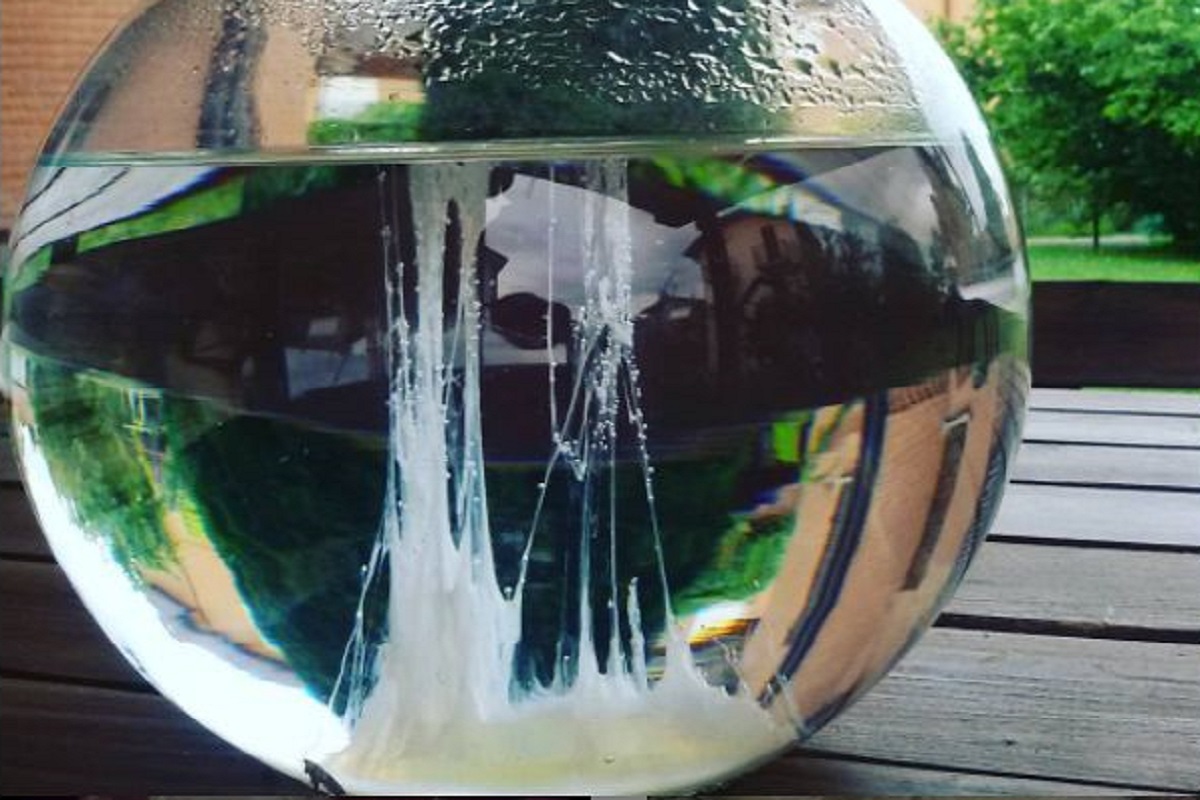
There is a detail that often generates doubts among those who want to try this ritual for the first time: it is not enough to know “what to do”, but also “when to do it”. Wrong times can mean an unsuccessful boat, or worse, waiting for magic that doesn’t manifest as it should. Let’s see the right times, both for preparation in the evening and for observation the next morning.
The evening of June 28th: sunset is better
The ideal time to prepare the container is sunset on June 28th, when the daylight gives way to the coolness of the evening. There is no fixed time per minute, but popular tradition suggests moving precisely in this band, before it gets completely dark: it is the moment in which the day ends and the “magical” night of Saint Peter and Paul begins, symbolically. Pouring the egg white into the water later, already in the middle of the night, would not compromise the result from a practical point of view, but it would go against the most suggestive meaning of the ritual: experiencing the preparation as a small moment of passage between day and night.
Because the terrain of the day also matters
There is an interesting detail regarding the time, but in an indirect way: the phenomenon that gives shape to the boat depends on the heat accumulated during the day by the ground or the windowsill on which the container is placed. For this reason, it is good that the day of June 28th was sufficiently warm and sunny: the more the ground warmed up during the daytime hours, the more effectively it will release heat during the night, favoring the formation of the characteristic “sails”.
The morning of June 29: dawn is the right time
As regards observation, the most widespread advice is to get up early and watch the result at dawn, or in any case in the early hours of the morning of June 29th. This is for two reasons: the first is symbolic, because dawn represents the moment in which the “magic” has just taken place and is still intact; the second is more practical, because as the hours pass and the temperature increases, the shapes of the egg white can begin to disintegrate or lose their definition, making interpretation more difficult.
Better not wait too long
Those who postpone observation until mid-morning or afternoon risk finding a less defined “boat”, with the albumen filaments less clear than those that could be admired shortly after dawn. For this reason, if you want to experience the ritual in the most authentic way possible, it is worth setting the alarm clock a little earlier than usual: the surprise, according to those who repeat this tradition every year, always repays the wait.
In summary: two dates, one night only
The boat of San Pietro is therefore contained in two precise moments: the preparation at sunset on 28 June and the observation at dawn on 29 June. Between these two appointments, a whole night spent outdoors, between dew, cool night time and a pinch of waiting, just as generations of Italian families have done before us.
Because only egg white is used and not the whole egg
Another fundamental detail of the ritual, often underestimated by those who try it for the first time, concerns the choice to use exclusively the egg white, leaving the yolk aside. It is neither a coincidence nor a simple habit: there is a precise physical reason behind this choice.
In fact, egg white is composed almost entirely of water and proteins, and it is precisely this composition that makes it perfect for the phenomenon that gives life to the “boat”. Adding the yolk, in addition to visually clouding the water making it difficult to distinguish any shape, would compromise the effect: the yolk has a different consistency and density, which does not behave in the same way when it comes into contact with the cold water of the night.
It is precisely the slightly higher density of egg white compared to water, combined with its ability to congeal when the temperature drops, that creates those thin, branched filaments that are reminiscent of sails and masts. The yolk, on the other hand, would simply tend to settle to the bottom in a single compact mass, without giving rise to any suggestive shape to interpret.
For this reason, those who want to try the ritual must be careful to separate the two parts of the egg well: the yolk can be kept for cooking (excellent, for example, for an eggnog, as was once done in country houses), while only the egg white will have the task of transforming, during the night, into St. Peter’s boat.
