
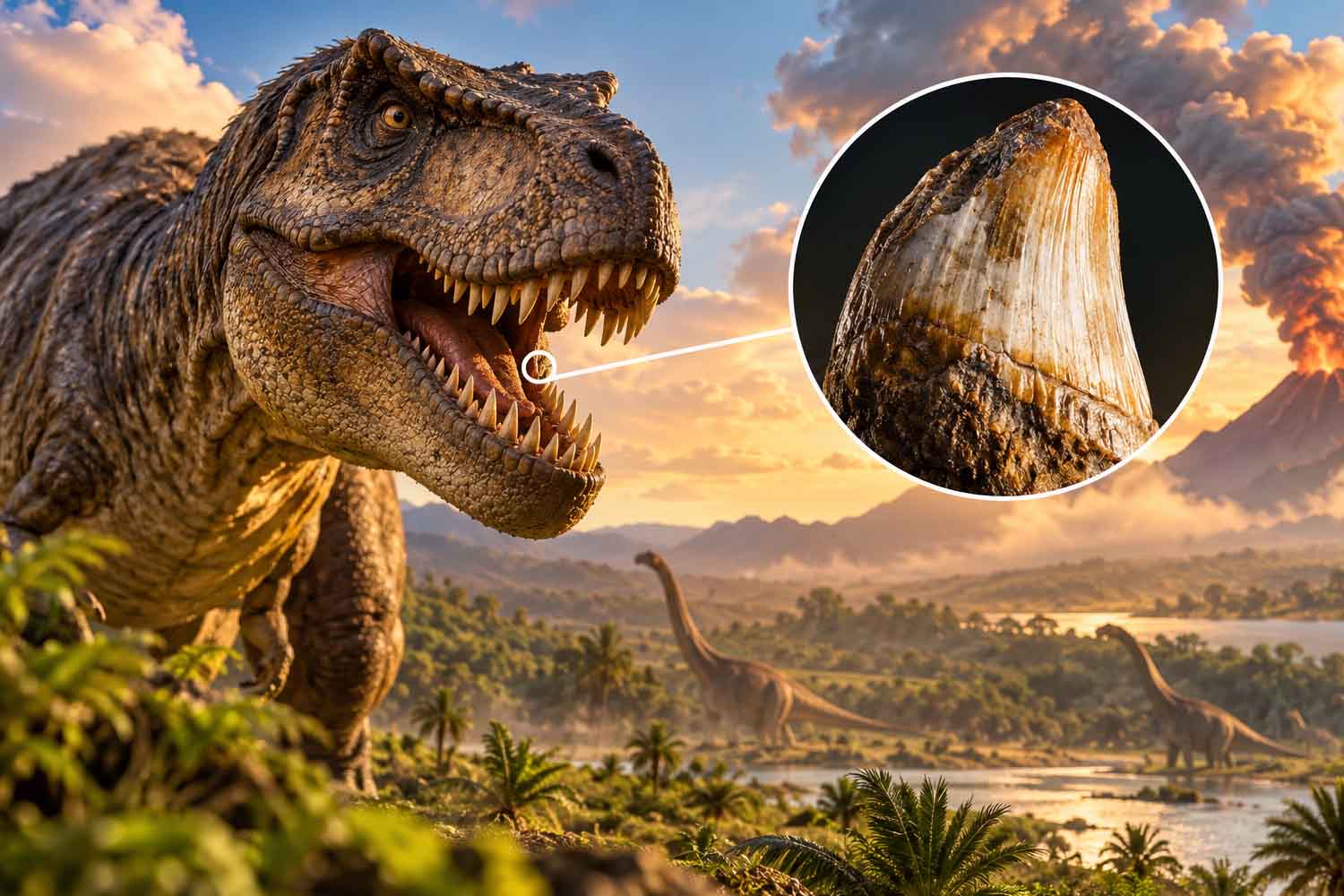
A dinosaur tooth can preserve a trace of the air breathed by the animal when it was still alive for over 150 million years. By analyzing fossil enamel, a group of German researchers estimated that in the Late Jurassic the atmosphere contained approximately 1,200 parts per million of carbon dioxidealmost three times the current concentration. In the Upper Cretaceous, however, the estimate drops to around 750 parts per million. Numbers that tell of a much warmer planet, on which enormous dinosaurs moved among ecosystems very different from those we know.
The research, published in the scientific journal PNAS, was conducted by the Universities of Göttingen, Mainz and Bochum, in Germany. For comparison, according to NOAA measurements, the global average CO₂ concentration in July 2026 was about 426 parts per million. Before the industrial revolution it was around 280.
The researchers then found a way to directly interrogate the remains of the animals that inhabited that world. Of course, not a tiny prehistoric air bubble was trapped in the teeth. It would have been far too convenient.
How a tooth can retain the trace of the atmosphere
The team led by geochemist Dingsu Feng studied fossil teeth from five sites distributed across the United States, Canada, Morocco, Germany and Tanzania. The animals examined include large herbivorous sauropods, such as Giraffatitan and Europasaurusand predators like Tyrannosaurus rex And Albertosaurus.
The secret lies in enamel, one of the biological materials most resistant to transformation over time. During the animal’s life, some of the oxygen breathed enters the body fluids and leaves a chemical trace in the forming tissues, including the teeth. Scientists measured the relationships between three natural isotopes of oxygenthat is, forms of the same element that differ in the number of neutrons. Their proportions in the atmosphere also depend on the amount of CO₂ present and the photosynthetic activity of the organisms.
By comparing these signals with those of current animals, including birds, reptiles and mammals, the researchers reconstructed the atmospheric conditions of two very distant periods: the Late Jurassic, between about 152 and 143 million years ago, and the Late Cretaceous, between 73 and 66 million years ago. First, however, they had to exclude the altered samples from fossilization. A tooth that has been buried for millions of years may have undergone chemical transformations capable of modifying the very information you are looking for.
An atmosphere rich in CO₂ and very productive vegetation
The reconstructed concentrations are high, but must be read together with the margins of uncertainty: 1,200 ± 150 parts per million in the Late Jurassic and 750 ± 200 in the Late Cretaceous. There is also an important condition. These values were calculated assuming that global primary production, i.e. the quantity of organic matter produced by organisms through photosynthesis, was comparable to the current one. By changing this assumption, the CO₂ estimates also change.
The authors also tried the opposite route: using carbon dioxide concentrations reconstructed through other methods to estimate the productivity of ancient ecosystems. The results suggest global primary production approximately 20% higher in the Late Jurassic and potentially more than double in the Late Cretaceous, although the latter estimate presents considerable uncertainty.
It means that terrestrial vegetation and marine photosynthetic organisms may have produced much more organic matter than today. An availability of resources capable of influencing entire food chains, including those that supported some of the largest animals ever to have lived on Earth.
Anomalies in teeth and the possible role of volcanoes
Some teeth tell something even more interesting. Two samples, belonging to one Tyrannosaurus rex and to a Kaatedocus siberipresent isotope ratios very different from those of the other dinosaurs examined. In the case of T. rex, the value could correspond to an atmospheric concentration of approximately 1,800 parts per million CO₂significantly higher than the average estimated for the Upper Cretaceous.
One possible explanation involves sudden increases in atmospheric carbon dioxide. During the Mesozoic the Earth went through periods of intense volcanic activity and, towards the end of the Cretaceous, the great eruptions of the Deccan Traps, in present-day India, released enormous quantities of volcanic material and gas.
According to the researchers, relatively rapid oscillations in CO₂ may also have left traces in the enamel of dinosaurs that lived during those episodes. But attributing those anomalies directly to the eruptions would be premature. The same authors consider alternative explanations, linked to the environment and the physiology of animals. In T. rex, for example, isotopic characteristics could reflect particularly arid conditions and a different availability of drinking water, leading to overestimations of atmospheric CO₂. The teeth, therefore, suggest possible oscillations of the ancient climate. To link them to a specific eruption, further evidence will be needed.
What we really know about the air dinosaurs breathed
The study adds a source of information to climate reconstructions, so far based mainly on marine sediments, soil carbonates and other geological indicators. The novelty consists in being able to also use the remains of terrestrial vertebrates to estimate the composition of the atmosphere of the past.
However, pay attention to one detail: more carbon dioxide does not automatically mean less oxygennor does this research measure what percentage of the atmosphere was composed of oxygen. The analysis concerns the proportions of its isotopes, used as indirect indicators of CO₂ and photosynthesis. From these results, therefore, we cannot establish whether dinosaurs would have found today’s air more or less breathable.
The method can also be applied to other fossil vertebrates, provided that sufficiently preserved teeth are found and the physiological differences between the animals are taken into account. For now, those few samples have already allowed us to reconstruct two chemical photographs of the atmosphere, separated by tens of millions of years. There remain plenty of gaps to fill and some anomalies to explain. The teeth have survived all this time. To make them speak more precisely, more fossils will be needed.
