
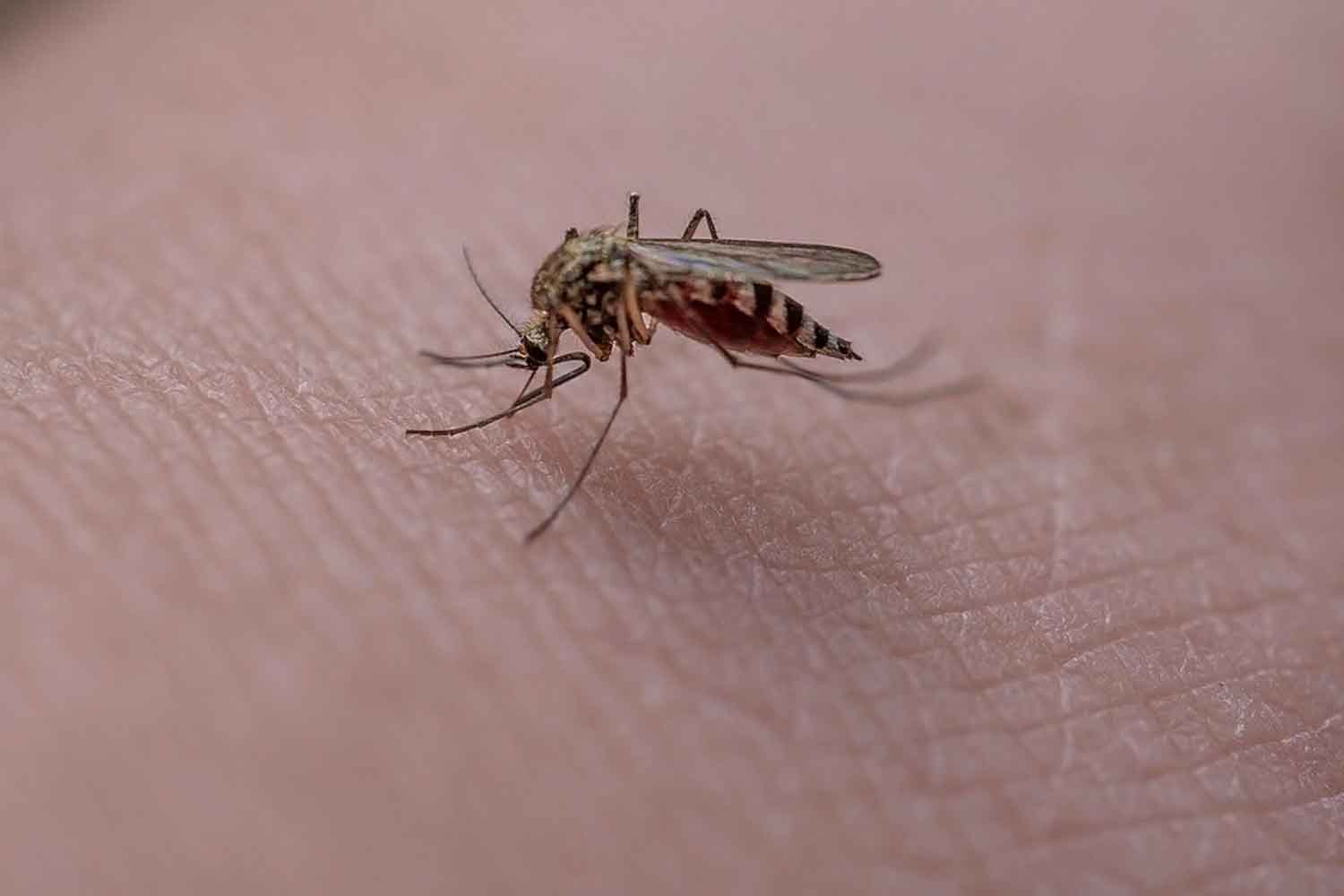
For many people, summer has an unmistakable undercurrent: the subtle buzz of a mosquito circling around your head as we try to fall asleep. It is a sound that has always belonged to everyday life, almost as if it were a natural part of human life. In fact, the relationship between mosquitoes and humans it has a much older history than we imagine, a history that spans millions of years of evolution and which today scientists are reconstructing thanks to genetics.
A new study published in the journal Scientific Reports tells something surprising: some species of mosquitoes have started to prefer human blood over a million years agowhen the first ancestors of man began to spread into Asia. In other words, while our ancestors were taking their first steps out of Africa, certain insects had already begun to consider us a particularly interesting source of food.
To understand how this attraction arose, researchers analyzed the DNA of several modern mosquito speciestransforming the genetic heritage of insects into a sort of evolutionary archive capable of telling when and why this change occurred.
When mosquitoes started to prefer human blood
Scientists have studied the genetic material of 38 contemporary mosquitoesfocusing in particular on eleven species belonging to the group Anopheles leucosphyrus. This group was chosen because it offers a rather complete overview of the genetic variety present in these mosquitoes.
Within these species there are very different feeding behaviors. Some are considered anthropophilicthat is, particularly attracted to human blood. Among these we find Anopheles dirus And Anopheles baimaiiinsects also known for their role in the transmission of malaria. Other species, however, continue to feed mainly on the blood of non-human primateslike monkeys, or alternate between both sources.
To reconstruct the evolutionary history of these mosquitoes, the researchers analyzed the speed with which mutations accumulate in the genes. This method allows us to estimate the moment in which some evolutionary lines changed their eating behavior. The findings indicate that an ancestral species would have developed a preference for human blood between 2.9 and 1.6 million years ago.
The place where this transformation would have occurred is located in a region that today no longer exists in its original form. Scholars talk about Sundalanda vast mass of land now largely submerged, whose fragments correspond to the current ones Malay Peninsula, Borneo, Sumatra and Java.
Before the arrival of humans, these mosquitoes lived mainly in the upper part of the rainforest and fed on the blood of the primates that inhabited the tree canopy. This behavior represents what scientists call their ancestral habitprobably developed over 3.6 million years ago.
Early hominins in Asia may have changed the evolution of mosquitoes
The most interesting point of the research concerns the link between the evolution of mosquitoes and the history of our ancestors. Scholars believe that the appearance of the preference for human blood occurred when i first hominins arrived in Southeast Asiacreating a new and abundant source of food for these insects.
According to evolutionary biologist Catherine Walton of the University of Manchester, the fact that surprised scientists the most concerns the antiquity of this transformation. The simplest explanation suggests that mosquito adaptation occurred in response to the presence of early humans in the region.
Archaeologists still debate when human ancestors began to spread from Africa to Asia. However, genetic analysis of mosquitoes offers an independent clue: their evolution suggests that these shifts may have occurred about 1.8 million years ago.
This coincides with other recent research that has dated some of the oldest skulls of Homo erectus discovered in China at the same period. If our ancestors were indeed already present in large numbers in Southeast Asia, they could have exerted strong evolutionary pressure on mosquitoes.
A key element may have been the characteristic odor of humansdifferent from that of other primates and capable of attracting some species of insects. However, for an evolutionary change to consolidate, an abundant and constant presence of the new source of nourishment is needed. In other words, mosquitoes would have needed to encounter many individuals of Homo erectus to really develop this preference.
Today they exist approximately 3,600 species of mosquitoes in the worldbut only about a hundred developed a strong interest in human blood. Yet this small group of insects is more than enough to transform our summer evenings into a continuous fight against itching.
After all, the next time we hear the buzz of a mosquito in the room, we will be able to look at the situation with a different perspective: that tiny insect is the result of an evolutionary relationship that began millions of years agowhen our ancestors were taking their first steps into the world and someone else had already decided that their blood was particularly interesting.
