
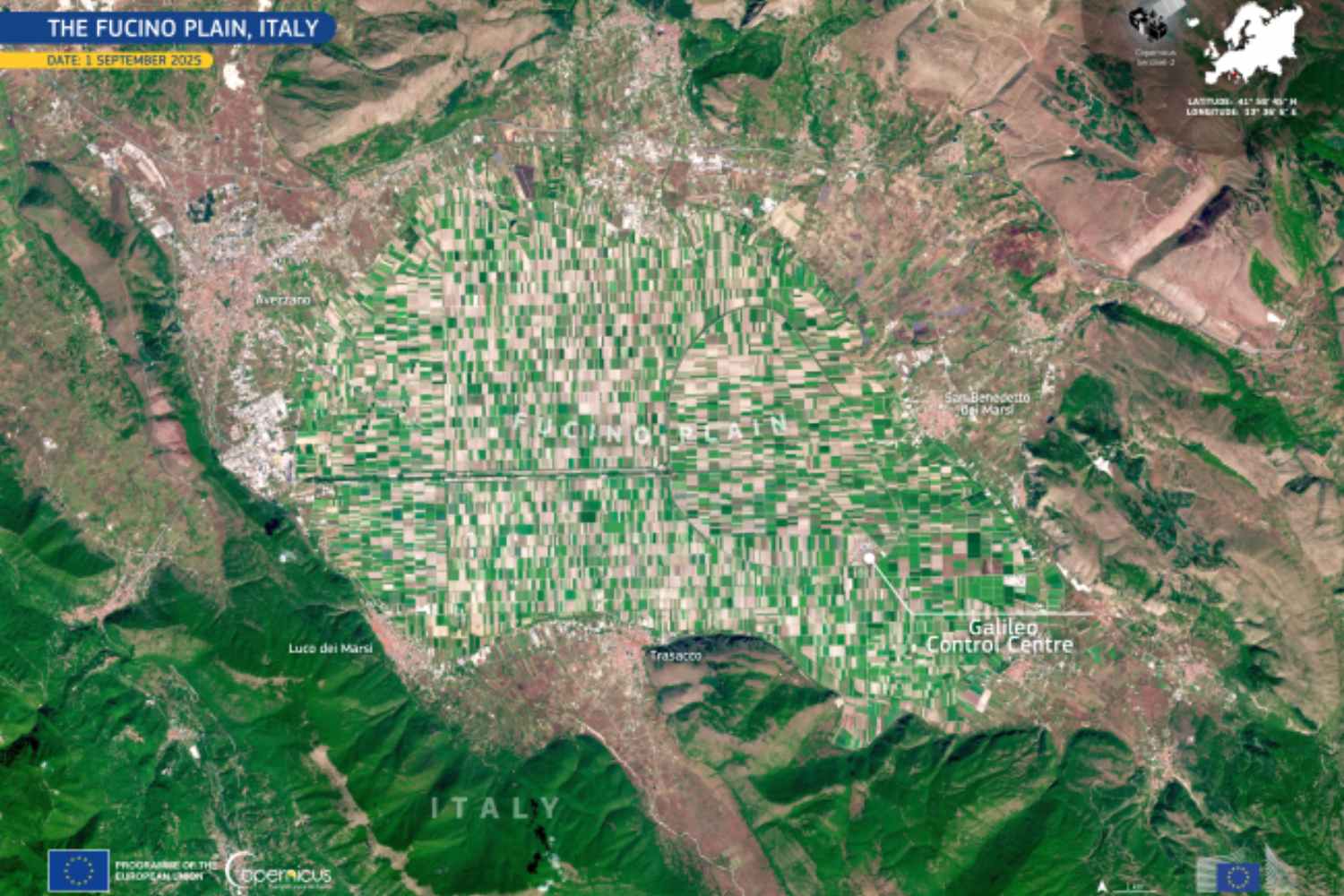
To look at it from space, as in the image captured by one of the Copernicus Sentinel-2 satellites, the Fucino plain, in Abruzzo, appears as a low resolution screen, a digital work of art consisting of thousands of colored pixels. But it is not a wide image: it is the photograph of one of the most radical environmental and human transformations in the history of Italy.
Where today an orderly mosaic of rectangular fields for 160 km² extends, once was the third largest lake on the peninsula, after Garda and the major. The story of this place is the story of a secular struggle between man and water. The Fucino lake, of tectonic origin without a natural emissary, was subject to unpredictable and drastic level variations. His floods flooded the fields, while the dry periods left unhealthy swamps, outbreaks of malaria. Already the Romans, who also appreciated the area for the dry climate and the holidays, attempted the company. The emperor Claudio, between 41 and 52 AD, mobilized 30,000 men to dig an underground emissary of over 5.6 kilometers under Monte Salviano, a colossal engineering work to drain the waters in the Liri river. The outcome was only a partial and temporary success: with the fall of the Roman Empire, maintenance failed and the lake slowly recovered its spaces.
Torlonia’s feat and its consequences
The decisive chapter was written in the second half of the nineteenth century by the banker Alessandro Torlonia. Resuming and expanding the Roman project, he invested enormous capital and employed thousands of workers in a company that seemed impossible, so much so that he pronounced the famous phrase: “Either Torlonia dries the Fucino, or Fucino dries Torlonia”. The works, which lasted from 1854 to 1878, led to the total drying up of the pelvis. The bottom of the lake proved to be an extraordinarily fertile ground, but its conquest had very high social costs.
The reclaimed land became almost entirely properties of the Torlonia, transforming the communities of fishermen into an army of agricultural laborers. The condition of these peasants, the “cafons”, was described by Ignazio Silone in his novel Fontamara: “In the end of everyone there is God, master of the sky. This everyone knows. Then comes Prince Torlonia, master of the earth. Then the prince’s guards come. Then the dogs of the prince’s guards come. Then, nothing. Then, still nothing. Then, still nothing. Then the cafons come. And it can be said that it is over ». The harsh peasant struggles of the second post -war period, culminating in the 1950s’ massacre, led to the agricultural reform that expropriated the land and redistributed them to the growers.
From the garden of Italy to the space
Today, the Fucino plain is one of the most productive “vegetable gardens” in Italy, famous for its cultivations of vegetables and tubers, including the Potato del Fucino PGI and the carrot of the Fucino PGIP plateau. However, the drying up also deeply altered the local microclimate. Without the large mass of water to mitigate the temperatures, the area is now subject to strong thermal excursions, with more rigid winters and intense frosts, and drier summers. In this land of contrasts, alongside the ancient agricultural traditions, a symbol of the most boosting modernity stands: the “Piero Fanti” Space Center in Telespazio, one of the greatest canvases in the world for satellite telecommunications.
