
Tomato puree is one of those things that is almost never missing in the kitchen. We use it to season pasta, prepare a quick sauce or add flavor to many recipes. And at the supermarket, faced with a shelf full of very similar bottles, we often end up choosing the one that costs the least or the brand we have always bought.
But who really produces the puree sold under the supermarket’s name?
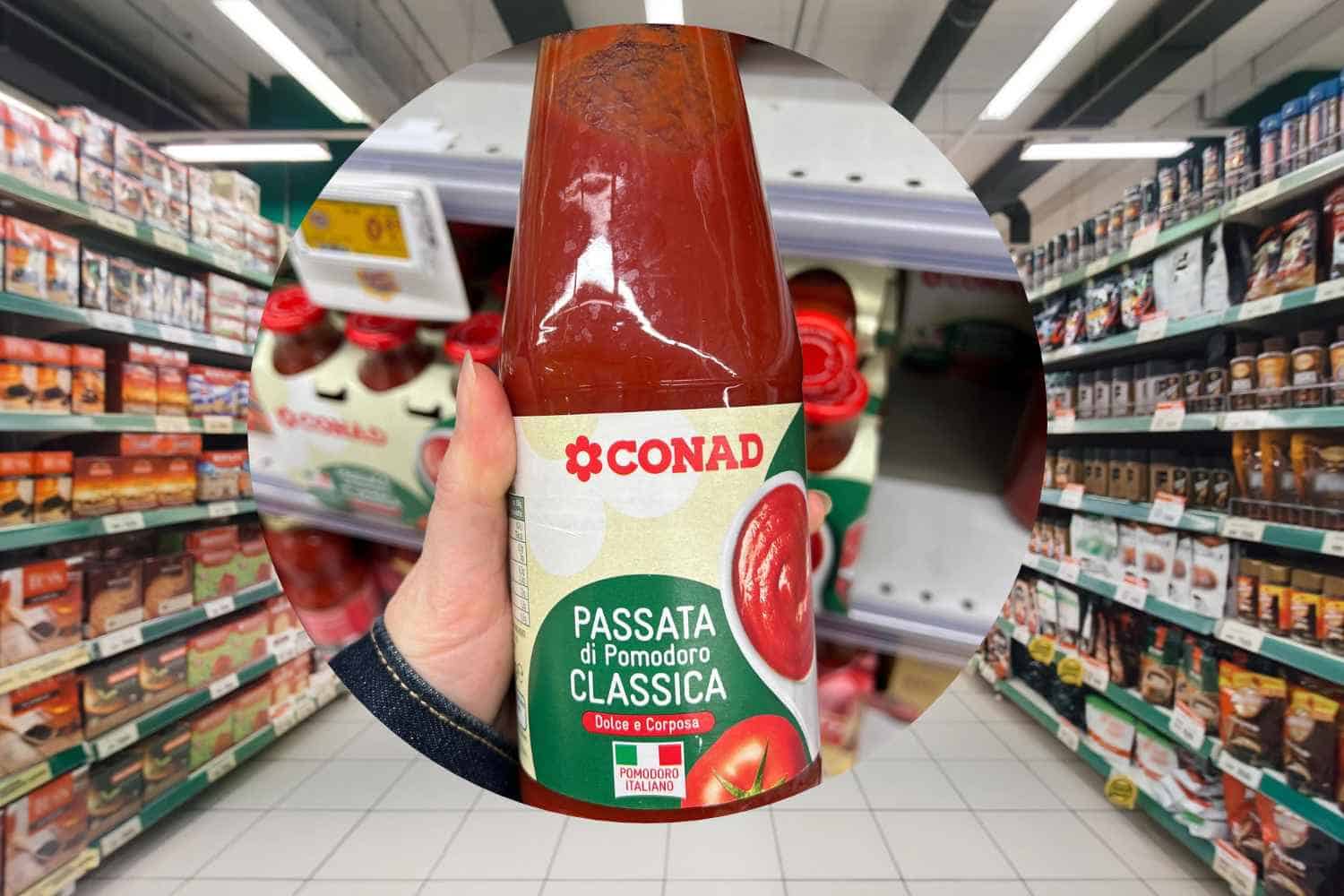
We asked ourselves this in front of the 700 gram Conad classic tomato puree. We took a bottle off the shelf and read the information on the back. And we discovered a name that many consumers know, even if they probably don’t associate it with the past Conad: Conserve Italia, the large Italian cooperative that owns Cirio and Valfrutta.
Not only that, three possible production plants are indicated on the label and an important clarification on the origin of the raw material: the tomato is Italian.
Who produces Conad tomato puree?
The answer is clearly shown on the label of the bottle we photographed:
Produced for Conad SC, Via Michelino 59, Bologna, by Conserve Italia Soc. Coop. Agricultural.
@Marco Crisciotti/GreenMe
Conserve Italia is one of the main Italian companies in the fruit and vegetable preserves sector. It is an agricultural cooperative company that processes and markets tomatoes, fruit and vegetables through various production plants.
Its peculiarity is precisely the cooperative model: at the base of the supply chain there are agricultural producers who provide the raw materials intended for industrial transformation.
We are talking about a group that in the 2024-2025 financial year achieved a consolidated turnover of approximately 1.15 billion euros and which, through its brands, has been present in Italians’ pantries for decades. And the brands are the most curious part of this story.
It is the same group that produces Cirio and Valfrutta
Behind the former Conad we find the same company that owns some of the best-known food brands in Italy.
Conserve Italia markets products under the Cirio, Valfrutta and Jolly Colombani brands, but also Yoga and Derby Blue, particularly well-known in the fruit drinks sector.
Cirio, in particular, is one of the historical names of Italian tomato preserves, with origins dating back to 1856. Since 2004 it has been part of the Conserve Italia group. This means that the producer of Conad puree is the same industrial group that also produces purees and preserves marketed under the Cirio brand.
And it’s not just a corporate coincidence: some Conserve Italia factories process both products for the group’s brands and references intended for large-scale distribution.
But be careful: this does not mean that the former Conad and Cirio are identical. Each product can have different characteristics, from the selection of tomatoes to the consistency, up to the processing specifications.
Where is Conad puree produced? There are three factories
An interesting detail is found right next to the manufacturer’s name. The label indicates that the puree can be made in three different factories, identified by an acronym shown on the capsule:
All three are connected to the Conserve Italia production network. The Albinia plant, for example, is one of the centers dedicated to the processing of tomatoes, in an area particularly suited to this cultivation.
Ravarino also specializes in tomato processing, while the Pomposa plant, in the municipality of Codigoro, is one of the group’s main production plants.
How do you understand which one your bottle comes from? Just look for one of the acronyms indicated on the label on the capsule.
In the photographs we took it is not possible to read the capsule code clearly enough, so we cannot attribute the bottle with certainty to one of the three implants. However, we know that production is not necessarily concentrated in a single factory.
Are Conad pureed tomatoes Italian?
Yes, at least for the packaging we photographed. On the back of the bottle there is the wording «Origin of the tomato: Italy», while on the front appears the symbol with the Italian flag and the writing «Italian tomato».
This means that the raw material used for this puree is declared to be of Italian origin. It is useful information above all because, when we purchase processed products, it is important to distinguish the place where the processing takes place from the place where the raw materials are grown.
In the case of the past Conad photographed, both information refers to Italy. Furthermore, Conserve Italia bases its business on an agricultural cooperative supply chain, with processing plants distributed across various Italian territories.
What does Conad tomato puree contain?
Another item we checked is the ingredient list.
The classic Conad puree contains:
It is therefore a simple formulation, with no added sugars in the list of ingredients. Citric acid is used as an acidity regulator and is an ingredient permitted in food preserves. Its presence is not, in itself, an indicator of poor quality.
The nutritional table reports, per 100 grams of product, 35 calories, 6.3 grams of carbohydrates, of which 4.4 grams of sugars, 1.1 grams of fiber and 1.2 grams of proteins. The salt content is 0.6 grams per 100 grams of puree.
This last value deserves to be considered when using the product for cooking, especially if additional salt is added when preparing the sauce.
The sugars reported in the nutritional table, however, do not imply the addition of sugar as an ingredient: tomatoes naturally contain sugar.
Is the past Conad the same as the Cirio one?
This is the question that comes naturally to oneself after discovering who produces the bottle. The answer is that we can’t tell from the manufacturer’s name alone.
Conserve Italia creates different types of purees and preserves, each with specific characteristics. The selection of raw materials, the consistency of the product, the concentration and the processing methods may vary.
The fact that two bottles come from the same group, or even from the same factory, therefore does not mean that they contain exactly the same puree.
To understand whether two products are truly equivalent it would be necessary to compare the technical data sheets and the processing characteristics, as well as tasting them, of course.
In the case of the past Conad, however, we have some concrete information: the tomatoes are declared Italian, the production is entrusted to Conserve Italia and the ingredients are clearly indicated.
Because reading the label of the purée can hold surprises
That of the past Conad is a story that tells something broader about the functioning of large-scale retail trade.
Many products sold under a supermarket brand are not made directly by the brand, but entrusted to specialized food companies, often the same ones that produce well-known brands.
It is the world of the so-called private labelsin which the name on the front of the package does not necessarily coincide with that of the manufacturer.
In our case, behind a common 700 gram bottle of Conad puree we found Conserve Italia, the group of Cirio and Valfrutta, and a production distributed across three possible Italian factories.
This does not prove that the past Conad is identical to that of the most famous brands, nor that it is better or worse.
However, it reminds us that to understand what we really bring to the table it is also worth looking at the back of the package.
