
It’s not often that public health advice passes through the home kitchen. But Frer the solar eclipse on August 12, the British health agency has decided to focus on an object that almost everyone already has in a drawer: it colander.
The official notice
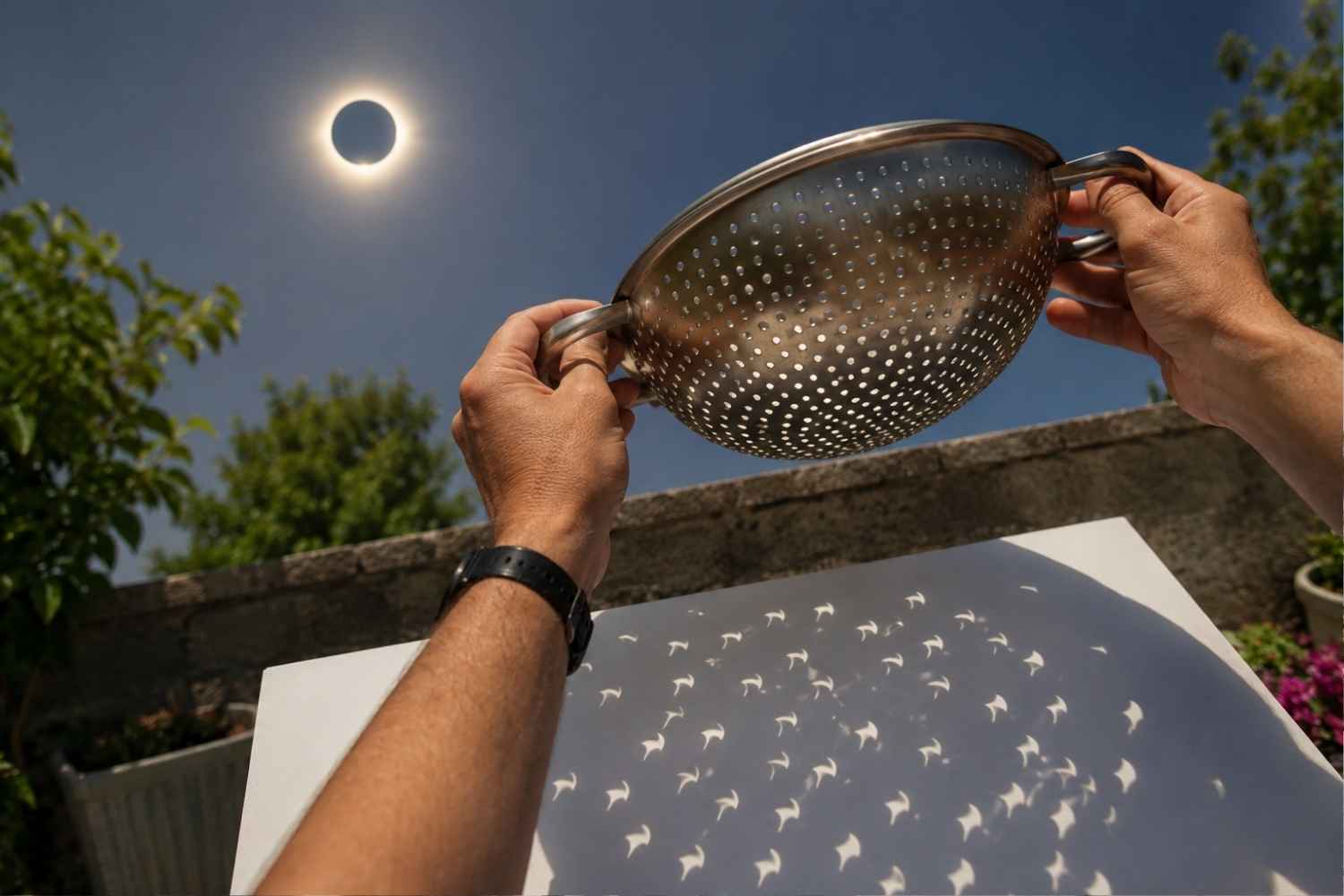
As the UK Health Security Agency explains in a note published on its institutional blog, a partial solar eclipse will be visible across the United Kingdom on Wednesday 12 August, with maximum coverage of the Sun expected in south-west England. The agency recalls that looking directly at the Sun without adequate protection can cause permanent damage to your eyesight, and indicates among the safe methods the projection of the solar image through the holes of a colander or between the leaves of trees, in addition to the classic pinhole projector onto a sheet of paper.
Why the colander works
The principle is that of darkroomin which every single hole in the colander acts like a small pinhole, projecting onto the ground, or onto a white sheet, dozens of tiny sickle-shaped images, which reproduce in miniature the phase of the current eclipse. No direct contact with concentrated sunlight, therefore no risk to the retina. The only precaution, reiterated by the agency itself, is to never look at the Sun through the holes, because the object must be held with its back turned to the Sun, observing only the shadow projected.
A real danger, not just theoretical
The risk is not anecdotal. According to the UKHSA, after the last total eclipse visible in the UK, in 1999, the Royal College of Ophthalmologists recorded around 70 cases of sight damage, 40% of which involved people who had stared at the Sun for less than a minute. A detail that undermines the idea that “a quick glance” is harmless.
The alternatives for those who want to see it well
For those who prefer direct observation, traditional certified eclipse glasses remain valid, available for example through the Royal Observatory in Greenwich. The Royal Astronomical Society has published a detailed practical guide on all these methods, including the colander, for those who want to remove any doubts before the big day.
