
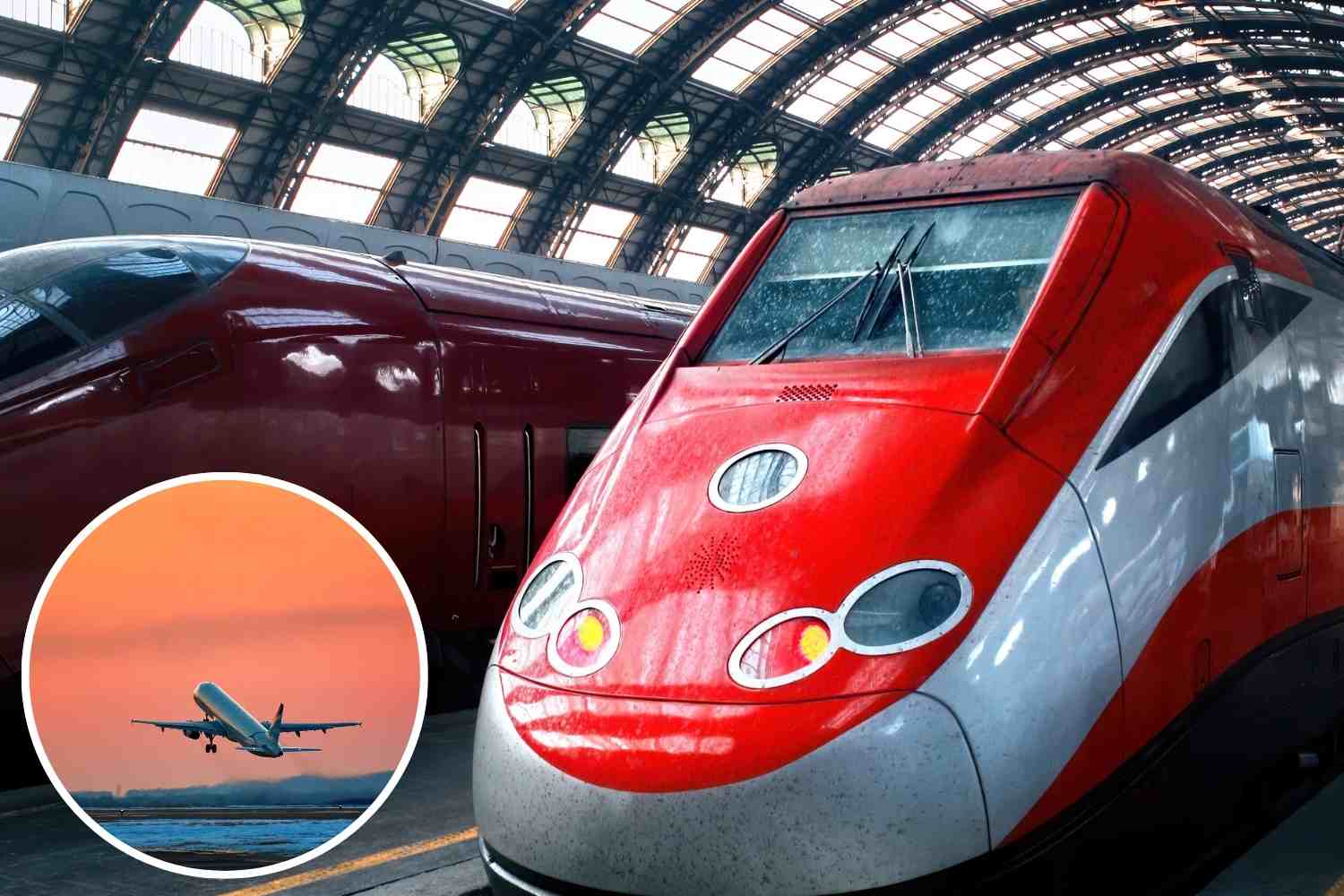
Paying a 389 euro train ticket when the flight for the same route costs less than 15. It is the most extreme example, but not an isolated case, of a European transport system that row against sustainability. This was reported by the new detailed report by Greenpeace EEC, “Flying Cheap, Paying Dear”, which reveals how, due to tax privileges and unfolded subsidies, the plane is almost increasingly convenient than the train. The investigation, conducted on 142 routes, reveals that in more than half of cross -border travel (54% of those analyzed) flying less, with Italy among the countries most penalized by this paradox.
Italy: the worst fourth in Europe for train travel
For travelers departing or arriving in our country, the picture is particularly critical. Italy ranks fourth in Europe among those where the train is more disadvantageous than the plane, immediately after France, Spain and the United Kingdom. According to data, 88% of the international sections concerning Italy is almost increasingly expensive on rail. The price differences are remarkable: a journey from Luxembourg to Milan, for example, can cost the train up to 11.6 times more than a flight (214 euros against 18.49 euros).
Among the 16 international routes analyzed that involve Italy, 12 were classified as “red”, that is, almost increasingly expensive by train. These include very popular connections such as Paris-Milan, Rome-Berlin, Vienna-Venezia and Barcelona-Milan. The only international trafficking that was almost increasingly cheaper on the train was Ljubljana-Milan. Even on the internal front, where the convenience of the train is generally greater, Italy does not shine. Of the three national routes examined, only the Milan-Rome was almost increasingly economic by train, while the Rome-Palermo was mainly more expensive.
A tax system that promotes those who pollute
The reason for this disparity does not reside in efficiency, but in a system of rules and taxes that, according to Greenpeace, is deeply unbalanced. “This situation is not due to issues of efficiency, but to the European political inertia that allows airlines to enjoy unjust tax privileges that dispel rail transport at the expense of the planet’s climate”, declares Federico Spadini of the climate and transport of Greenpeace Italy.
Airlines, in fact, enjoy enormous advantages: they do not pay kerosene taxes (planes fuel) nor VAT on tickets for international flights. On the contrary, the railway companies are subject to energy taxes, pay VAT and, in many countries, they must pay expensive tolls for the use of the tracks. This imbalance allows above all the low-cost companies to practice torn prices, making competition unsustainable for railways. The cost of this system is environmental: a flight emits on average almost 5 times more greenhouse gas of a train journey, a gap that can exceed 80 times if you compare the plane with trains powered by 100% renewable energy.
The proposals for fair transport
To reverse the course, the environmental association makes precise requests to national governments and the European Union. The priority is to put an end to the tax advantages of the air sector, introducing a fair taxation that takes into account its climatic impact, starting from a tax on business flights and first class. In parallel, it is essential to invest in rail transport, reducing or eliminating VAT on train tickets and access costs to the network, in particular for night trains.
Another key proposal is the introduction of “climatic tickets”: simple and economic national subscriptions, valid on all means of public transport, on the model of what has already been done in Austria and Germany. “Any section in which the plane is cheaper than the train is a political failure,” concludes Spadini. “Europe must make the train the cheapest option, rather than the most disadvantageous because it is less financed.” The necessary resources, according to the report, could come from a right taxation of the aerial sector and from a tax on the great assets, to finance a future in which to travel in a sustainable way it is not a luxury for a few, but an opportunity for everyone.
Don’t you want to lose our news?
