
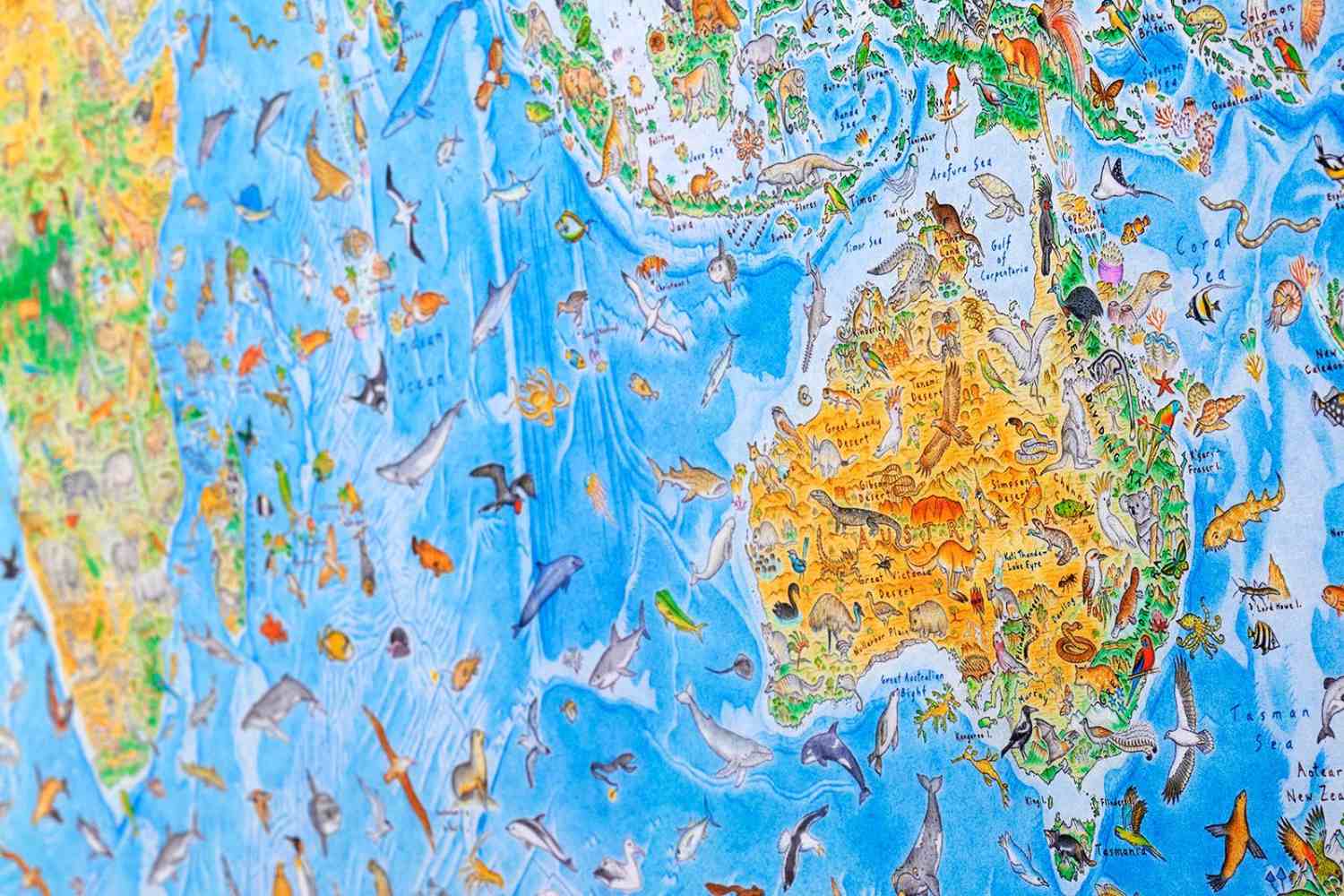
Imagine a world map without roads, capitals or political borders. In their place, forests, deserts, mountain ranges and oceans inhabited by thousands of wild species. This is the vision of Anton Thomas, a New Zealand artist and cartographer, who took three years to complete “Wild World”, an extraordinary hand-illustrated map featuring 1,642 animals.
Made entirely with colored pencils and pen, the work uses the Natural Earth projection as a geographical basis, but overturns the traditional point of view: at the center there are not nations, but rather the wild nature that still populates the planet today. Each species depicted meets three precise criteria: it is wild, native and extant. No pets, no extinct creatures. Only what still lives on Earth.
View this post on Instagram
A project born during the lockdown
Growing up in New Zealand, surrounded by spectacular landscapes, Thomas cultivated a passion for maps and nature documentaries from an early age. The idea of drawing a world map populated exclusively by wildlife had been with him for years, but it was during the pandemic lockdown, in his Melbourne studio, that the project took shape.
The first animal to appear was a grizzly bear in Alaska, intent on catching salmon. From there began an artistic and scientific journey that required enormous research on habitats and physical geography. About a third of the time spent was dedicated to verifying the distribution of species and the accurate representation of relief, ocean currents and natural environments.
View this post on Instagram
A celebration of wilderness
“Wild World” is not an idealized fantasy. It is a photograph of the present. Mountains, coral reefs, arctic tundras and rainforests are home to iconic species and lesser-known creatures, from large predators to almost mythological-looking deep-sea fish. Each element is hand-traced, with a level of detail that transforms the map into an immersive visual experience.
In an era dominated by climate crises and biodiversity loss, Thomas chooses a different language: that of hope. His work suggests that the planet, although wounded, remains profoundly wild. It is an invitation to recognize the biological richness that surrounds us and to defend it. Not a utopia, but a visual reminder of what really exists and can still be protected.
In addition to being an illustrative masterpiece, the map functions as an educational tool. The physical characteristics are precisely labeled, transforming the work into a geography and biodiversity lesson hidden within an artistic project. In a world where digital maps guide every move, “Wild World” brings attention back to a sense of place. And remember that, before borders, nature existed – and continues to exist.
View this post on Instagram
You might also be interested in:
