
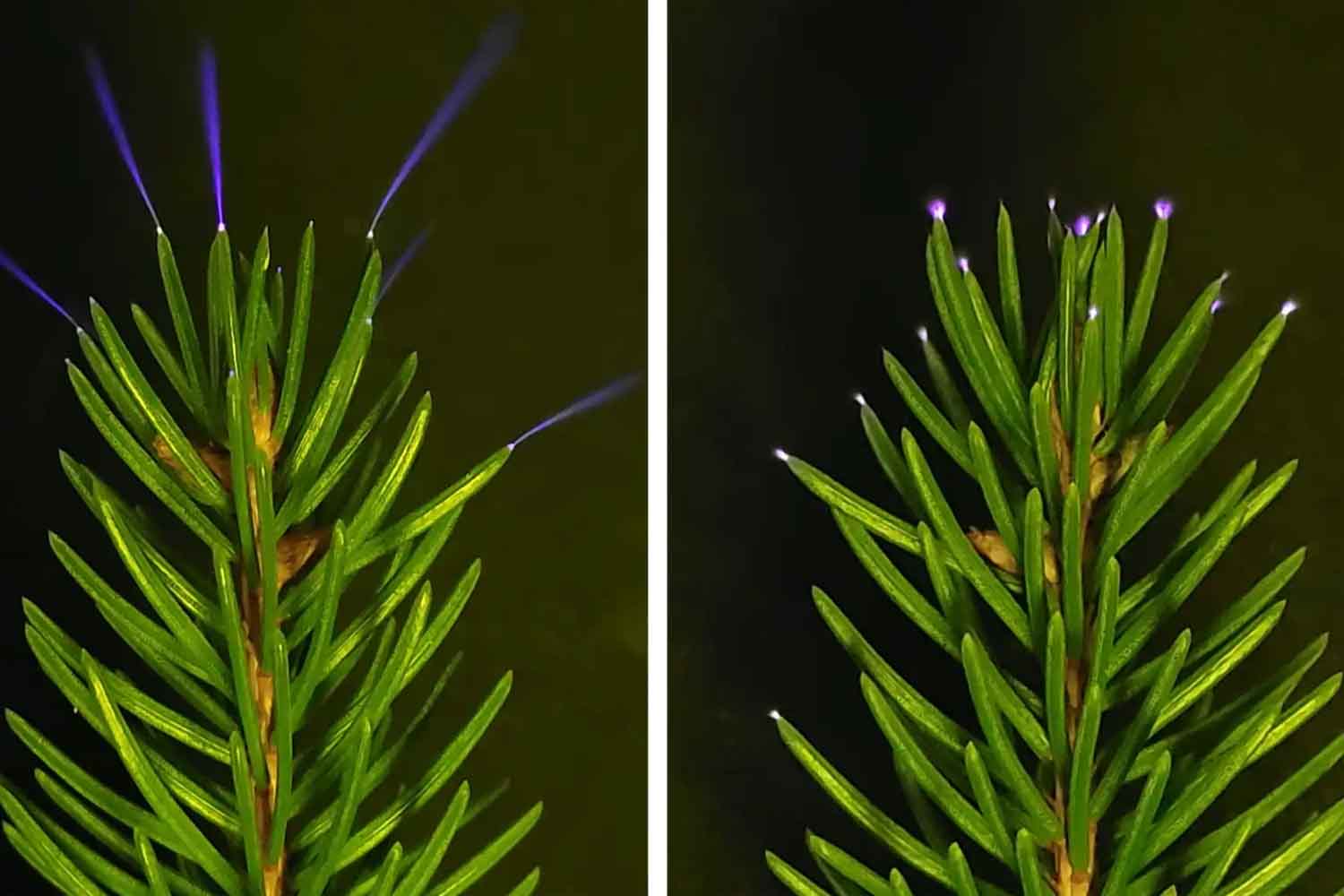
There is an aspect of storms that almost no one talks about, and which also closely concerns the way forests breathe, defend themselves and even contribute to “cleaning” the air we breathe. When the sky is charged with electricity and we seek shelter from the roar of thunder, something surprising happens above our heads: the crowns of the trees light up with an invisible blue light, an electric dust that dances on the tips of the leaves without us realizing it.
This is not a poetic image, but a real physical phenomenon, documented for the first time in nature by a team led by meteorologist Patrick McFarland of Penn State University. To capture it, the researchers did something that speaks well of how science sometimes needs a pinch of madness: they transformed a 2013 Toyota Sienna minivan into a laboratory on wheels, drilling a hole in the roof to install an optical system capable of detecting ultraviolet radiation.
The result is the first direct evidence of so-called corona discharges in treetops during thunderstorms.
Forests under the storm: what happens to the leaves
When a storm cloud gathers over a forest, its electric field induces an opposite charge to the ground. This charge “goes up” along the trunks and is concentrated in the thinnest and most pointed points of the vegetation, i.e. on the ends of leaves and needles. It is there that, once a certain threshold is exceeded, the electricity disperses into the air, generating a corona discharge.
Unlike lightning, which can reach very high temperatures and release tens of thousands of amperes, corona discharges are weak and localized. We are talking about currents in the microampere range, one millionth of an ampere. The overall energy is small, but concentrated in a tiny spot, so much so that the tips of the leaves may appear slightly “burnt” after a few seconds of exposure.
In the laboratory, by turning off all the lights and screening the windows, these discharges appear as a faint bluish glow. Outdoors, however, they are practically invisible to the human eye, because the light emitted is much weaker than even a segment of the moon. For this reason the team chose to intercept the ultraviolet component, using a “solar-blind” camera, capable of isolating wavelengths that are not disturbed by sunlight.
During a thunderstorm in Pembroke, North Carolina, researchers pointed the lens toward the top of a sweetgum tree and, in about an hour and a half, recorded 41 distinct clusters of discharges. The sparks lasted from a fraction of a second to over three seconds and appeared to jump from leaf to leaf following the movement of branches in the wind.
Similar observations were also made on loblolly pines and in several storm chases between Florida and Pennsylvania. This suggests that the phenomenon is widespread and that, during each storm, tens or hundreds of leaves on each tree can discharge electricity simultaneously. If we could see in the ultraviolet, the forest canopy would appear as a continuous swarm of tiny electric fireflies.
A possible invisible ally against pollution
Perhaps the most interesting part concerns the atmospheric impact of these discharges. Corona discharges produce large quantities of hydroxyl radicals, known as OH radicals, extremely reactive molecules that play a key role in atmospheric chemistry. OH radicals are considered a sort of “atmospheric cleaner”, because they contribute to degrading greenhouse gases and pollutants.
Previous estimates suggested that around the top of a tree, during a thunderstorm, discharges could generate thousands of times more OH radicals than other known sources. Now, thanks to these first direct measurements, scientists can integrate hard data into climate models and better understand how much forests contribute to cleaning the air during storms.
In a context of climate change, in which an increase in the frequency and intensity of thunderstorms is expected, this electrical dialogue between sky and vegetation takes on an even more relevant meaning. Forests are not just carbon sinks or treasure chests of biodiversity, but dynamic systems that interact in surprising ways with the atmosphere, even through invisible and silent mechanisms.
A fundamental question remains open: what effects do these micro-discharges have on the health of trees in the long term? Since thunderstorms regularly affect large forested areas, it is possible that over the millennia plants have developed morphological adaptations to mitigate this electrical stress.
The study, published in Geophysical Research Letters, therefore opens a new perspective on the relationship between forests and the atmosphere, inviting us to look at storms with different eyes. The next time the sky darkens and the air vibrates with electricity, we can imagine that, above us, the treetops are shimmering silently, contributing to a balance we are still learning to understand.
You might also be interested in:
