

The wisteria is one of the ornamental shrubs more beautiful and widespread in the world. His ability to climb any type of support and his Bulpoli flowering feature they make it One of the richest plants of the absolute charm.
Is one very scenic plantwhich lends itself to be used for decorate pergolas, Balconies, terraces, columns, walls, arches, but also other trees.
Origin and description
Glycine is a deciduous climbing that produces enchanting flowers, gathered in bunches, Very fragrant and colorful in shades of purple, lilac, pink and white. Originally from China, Japan and North America, this plant is one leguminous extremely rustic and vigorous belonging to the genre wisteria, of the great family of Fabaceae.
It has imparison leaves, composed of oval or lanceolate leaves, covered with a light hair that vanishes over time. The fruits, about 15 centimeters long, are very similar to beans.
Like screw, glycine has a flexible stem that needs support to be able to proliferate.
Among the most common species of wisteria, the Wisteria Sinensisoriginally from China, also called the common glyks, and the Wiseria Floribundacoming from Japan.
The first reaches considerable dimensions, Which can also exceed 30 meters, it is very vigorous and blooms in April-May. The second one can reach a maximum of a height of 10 meters and has one more late floweringgenerally in the two-year-May-June.
How to cultivate glycine
Glytine is a plant relatively easy to cultivate, but requires some precautionsespecially in the phase immediately following the system. This shrub can be grown in pots or in the ground, But we must keep in mind that we are faced with one Extremely vigorous plant, which tends to expand a lot.
After a few years, the wisteria can easily reach a development of 30 meters both in height and in width, while Its roots are so robust as to be able to damage walls or lift sidewalks.
Therefore, before planting a glyce in the ground, it is advisable to consider the its luxuriant vegetative development, ensuring that he has adequate space.
To avoid the damage produced by the roots, you can Back a sheet of plastic of about two meters per 1 meter deep In the direction in which we do not want them to take root, forcing them to take other directions.
How to implant it: by graft or cutting
The wisteria we find in nurseries can be obtained for cuttingFor graft or it can be sprouted from seed. In the latter case, the plant will take 10 to 15 years to get into flowering. Sometimes this method is used because it is the simplest and cheapest, while the reproduction for cuttings requires greater job.
The graft is even more difficult And for this reason it is practiced only in Specialized nurseries. Before purchasing, therefore, it is better to contact a trusted professional or inquire well about the way our glycine was reproduced.
As for the system, the wisteria can be placed during the whole year, but the best time to do it is autumn or winter, by March.
You dig a hole with a diameter of at least 50-60 centimeters, With a fund of pebbles and expanded clay, combining the land of manure and 200-300 grams of slow transfer fertilizer. Once planted It is necessary to irrigate abundantlymaking sure that the clod we transplanted from the vase is actually wet.
If, on the other hand, we decide to cultivate the Vase wisteriawe have to get one who has a lDarkness of at least 60 cm and adequate depth. After some time the plant will literally devour the whole earth at its disposal. At this point it is necessary to intervene, because the wisteria will no longer be able to draw water or organic substances for its development.
Yes they remove about 1/3 of the radodicie, consequently, The plant is pruned in such a way that the radical apparatus is sufficient to feed it. You pour new universal soil and repress itself, linking the wisteria to support. After a few years, however, the glycine should be placed in the ground.
Sun or shadow? How to expose the glycine
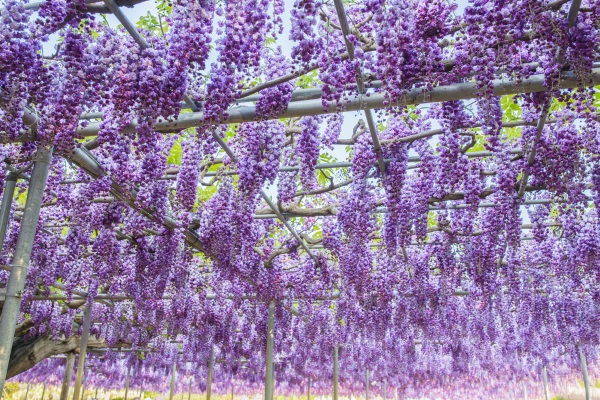
The glycine prefers an exposure in full sunbut it also tolerates the positions at half shadow or completely shaded. In these cases, however, Flowering will be slowed down and will take place in a less generous way with respect to the development of a plant subjected to the direct action of sunlight.
What kind of soil prefer to glycine
The ideal soil for glycine is Soft, fresh and rich in organic material. This plant since its roots struggle to absorb the iron that is contained.
In this case the wisteria can contract the leaf chlorosisnot a real disease but one Phytopathy that manifests itself through a yellowing of the leaves. To erase it completely, it is necessary distribute iron and sulfur sulfate in the groundrespectively in quantities of 50 and 100 grams per square meter.
How often to water
In the period following the setting, the wisteria must be watered abundantly. Later, you can water less. If the plant is located in the ground and the season is fresh, rainwater will be sufficient. If instead the wisteria was planted in pots, it will be watered every 2-3 weeks.
The necessary amount of water also varies according to the season and the age of the plant. In the summer, more frequent irrigation will be needed, just as it will be necessary to water the young specimens more abundantly.
Glycine, fertilization
In the first two or three years of life, the wisteria It will be fertilized abundantly with multipurpose fertilizers rich in nitrogen, phosphorus and potassium.
Subsequently, however, it is very important eliminate the integration of nitrogen, Since this plant, like all legumes, is able to self -produce this element thanks to a symbiotic relationship with some fixing nitrogen bacteria present in the radical apparatus.
A further contribution would favor Excessive growth of the plant and the foliage at the expense of flowering.
How to prune the wisteria
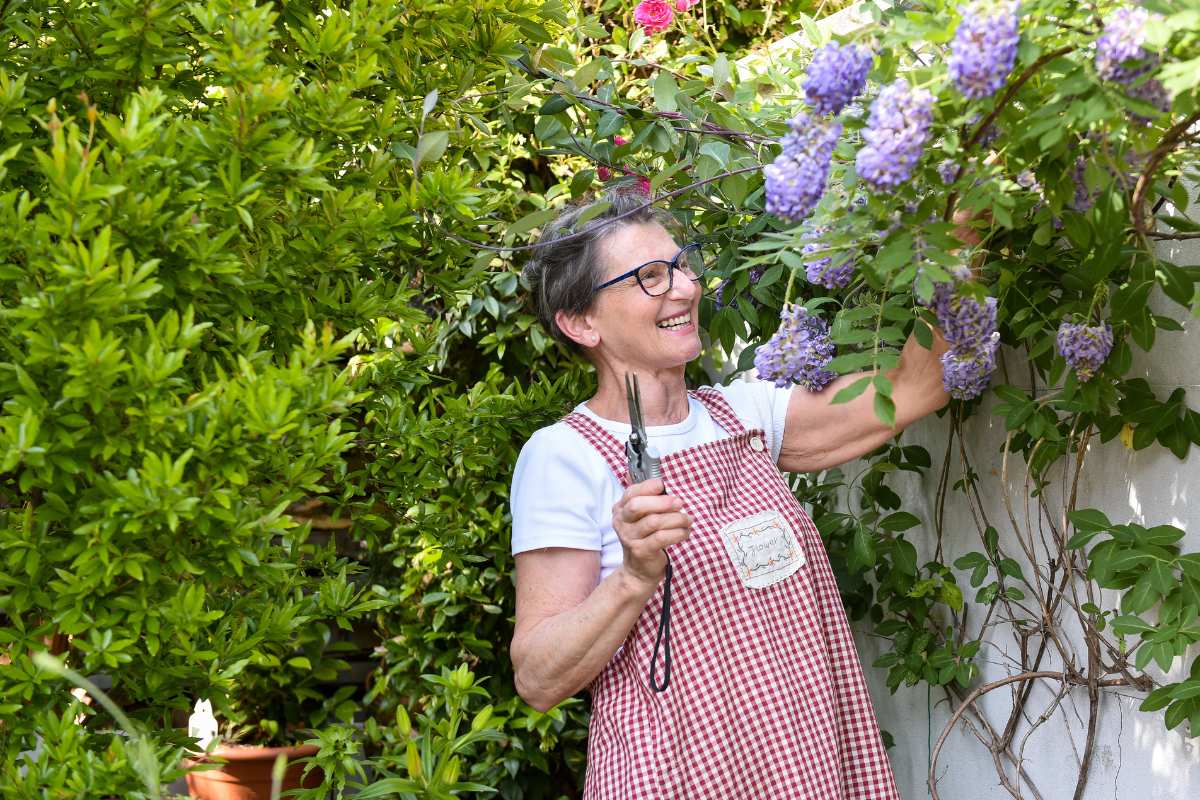
To obtain a more pleasant and harmonious result, The glycine should be pruned twice a year: At the end of winterby February, and then one must be performed green pruning during the summer period.
Winter pruning must be carried out once the glycine has lost all the leaves: We must shorten the branches that are one year of age, leaving only 4-5 gems. In addition, the dry, sick or damaged branches and any lungs must be eliminated.
In summer we proceed to one light pruning, for containing purposesin order to make vegetative development more orderly and harmonious.
How to make the annual maintenance of the wisteria
Cultivating a wisteria is not a momentary commitment, but an investment over time. After the first years of growth, it is important to establish an annual maintenance plan to make sure that the plant remains healthy, flourish regularly and does not become invasive. Every year, at the end of the winter, it is useful to carry out a verification of the support structure, since the wisteria, growing, exerts strong pressure on pergolas and fences.
In spring it is essential to remove the dry branches and check the presence of parasites. During the summer, in addition to green pruning, it is advisable to eliminate the dried bunches to encourage a second flowering. In autumn a potassium fertilizer can be administered to strengthen the plant in view of the cold.
Finally, every 3-4 years, it is useful to carry out a slight radical pruning (if in pots) and a renewal of the surface soil, especially in the presence of signs of nutritional impoverishment.
Glyce diseases and problems
As mentioned, the most common enemy for glycine is represented by chlorosiswhich causes the yellowing of the leaves due to the absence of chlorophyll. In addition to aesthetic damage, this phytopathy causes structural problems, in terms of less growth and reduced flowering.
As well as from too calcareous land, Leaf chlorosis can be caused by the presence of old rubble buried in depth in the ground. In this case, it will be necessary to proceed with a reclamation of the soil.
The wisteria can be attacked by the red spider, black aphide, oidio and caries of wood.
When it is hit by red spiderthe plant takes on a characteristic scorcchious appearance. Generally the arrival of the fresh season solves the problem. Only in case of particularly virulent attacks it is necessary to administer a Acaricidal product.
The black aphid it can only be harmful if it attacks Young plants. If necessary, it is necessary to deal with a undefined product.
In case of cryptogamous diseases, The situation differs according to the type of mushroom or bacterium that attacks the plant.
The Oidio or White Sorefor example, manifests itself through the appearance of white spots on the foliage. But normally this fungal disease does not cause damage and it is not necessary to intervene.
Instead, in the case of the so -called Caries of woodthe related mushrooms are installed in the trunk of old plants, until it causes death. In the presence of these microorganisms, it is necessary remove dead wood with sharp tools. After that the healthy part will be brushed with a fungicidal paste.
How to multiply the wisteria
As mentioned, glycine can multiply in different ways, but certainly the simplest is the Play for cutting. The cutting must be at least 10 centimeters and must be taken from July to September.
Must be placed in a Picture full of sand and peatto allow the formation of a good radical apparatus. When the roots are large enough, it can be placed in the ground.
Glywasses, symbolism and flower language
In Eastern philosophies the glycine represents the consciousness of man. This climbing, in fact, grows by making constant twisting clockwise or anti -clockwise. This typical movement of his is associated with Human consciousness that, developing, radiates from its vital center and permeates the outside world of itself.
In the language of flowerson the other hand, to give a wisteria symbolizes sincere friendship and gratitude.
How to use wisteria flowers
There are those who eat wisteria flowers, but we want to remember that all the components of the wisteria are toxic both for humans and for pets and seed he is pods in particular they are Absolutely to avoid. Here, in fact, the most toxins.
On the wisteria it may also be interested in:
