
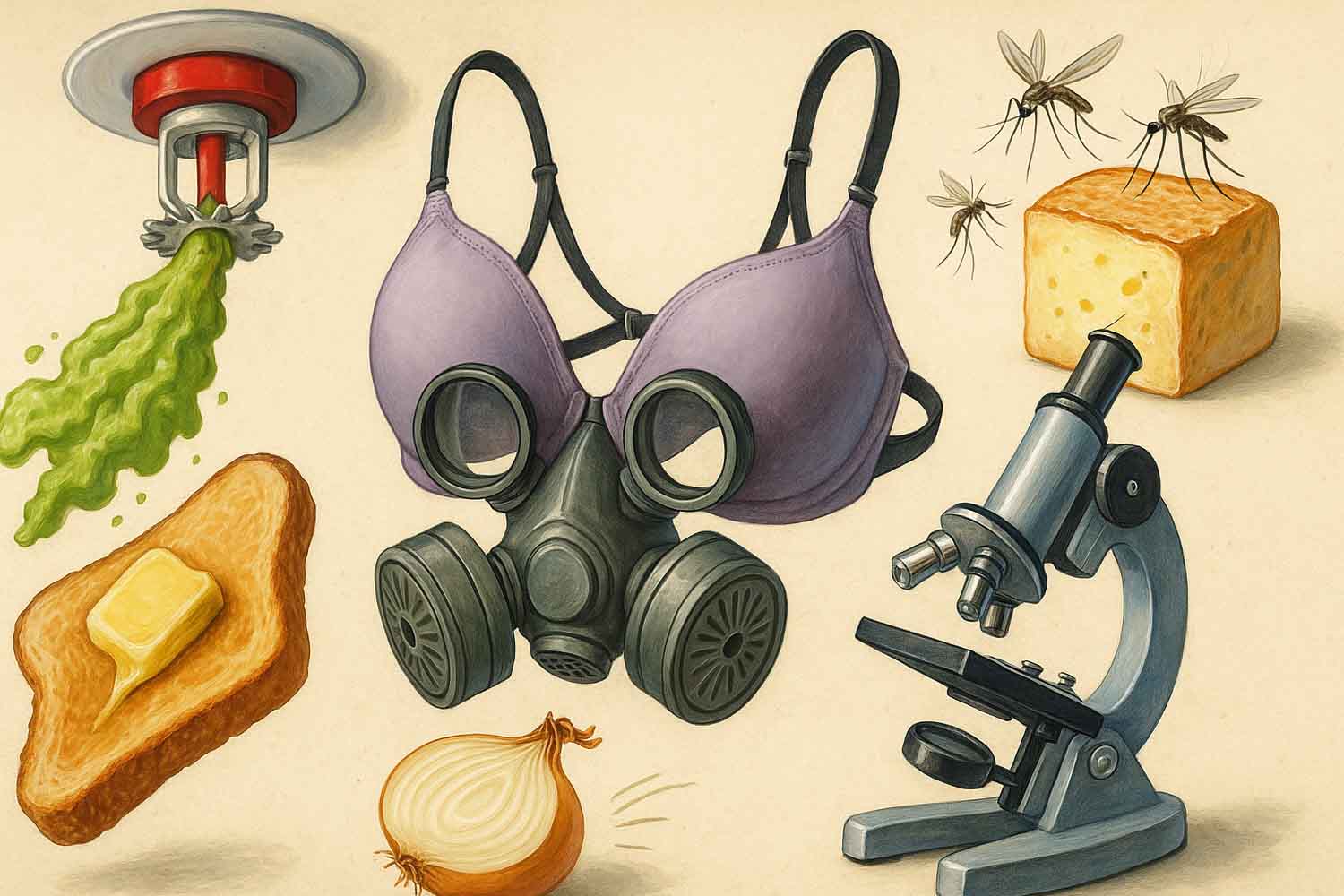
Every year, a ceremony rewards the strangest scientific studies in the world. No, we are not talking about the Nobel, but of theIgnoBel Prizean international recognition that goes to those who have published a lot of research extravagant To seem like a joke … but which in reality contain bright and surprising intuitions.
From alarm clock to Wasabi for deaf people to a test of infidelity based on the smell, passing through bras who turn into antigas masks, cheeses that attract mosquitoes and onions that no longer cry: these inventions make us smile, but then make us reflect. Because, on closer inspection, there is a small revolution behind every laugh.
An fire -fighting alarm that smells of Wasabi
In 2011, two Japanese researchers, Mayu Yamamoto And Makoto Imaithey invented a truly out of the ordinary fire alarm: instead of the classic acute sound, it emits Wasabi gas. That’s right, precisely that pungent substance that accompanies sushi and makes you burn your nose.
The idea was born to help people with auditory problems: when activating, the alarm releases a dose of isotiocyanate of Allilewho in a few seconds can also wake up who sleeps deeply. It is not just a bizarre stunt: the device has received a patenthas been tested in real nursing homes and could really make a difference in emergency situations. A perfect example of sensory replacementwhere the sense of smell takes the place of the hearing to report a danger.
Why does the toast always fall on the side of the butter?
How many times has a toast fell and touched the floor right with the buttered part? It is not just a chronic bad luck: in 1996, the body Robert Matthews of the University of Aston has decided to deepen the question scientifically.
His research has shown that the culprit is not fate but the physics: The average height of a table does not allow the toast to complete a complete rotation during the fall, so it almost always ends up face down. The phenomenon was even tested in the program Mythbusterswith a car that dropped the toasts in series. The result? Matthews was right. A simple discovery, but which reminds us how even small daily things can hide fascinating mechanisms.
A bra that turns into two antigas masks
An idea was born from Chernobyl tragedy that can make you smile, but which has a very profound meaning. The Ukrainian doctor Elena Bodnar created a emergency bra which is divided into two Antigas masksone for himself and one to offer to those close. The idea is simple: in case of disaster, every second it is precious, and having a protection at hand can make the difference.
Even if the invention has never arrived on the market in a massive way, it received a Patent in the United States and attracted the attention of the scientific community. Because yes, sometimes the genius hides in the most unexpected solutions.
Mosquitoes love stinking cheese
It may seem incredible to you, but the Malaria mosquitoes they are attracted by Limburger cheese. The reason? Emana smells similar to the sweat of human feet. The Dutch biologist Bart Knols And his team used this discovery to create cheese -based traps: mosquitoes lay eggs in cheese infusions, but then the microorganisms present in the cheese they kill larvae.
This “ecological trap” is a simple technique, cheap and sustainable which today is also designed to control other harmful insects, such as the Drosophila Suzukiia scourge for many fruits cultivated in Italy. From a bizarre discovery to concrete help for agriculture and public health.
Onions that do not cry
Cutting an onion without crying is no longer a dream: in 2013, some Japanese chemists areolated the enzyme responsible for tears, the Synthesis of the tear mestate factorand thanks to Non GMO selective crossingsthey managed to create “tearless” onions.
After years of experimentation, these onions are today On the market in different countriesand promise to revolutionize everyone’s cuisine. But there is also an important scientific work behind: the discovery has made it possible to understand better the mechanisms of defense of plantsopening new roads for agriculture of the future.
Vanilla from cow’s feces
In 2007, the Japanese researcher Mayu Yamamoto he surprised the world by showing that it is possible to extract vanillinthe molecule that gives vanilla taste, directly from cow. Yes, you read well.
His research has won a IG Nobel for its potential ecological and sustainable: exploiting organic waste to obtain aromas or useful substances is today one of the most important challenges of green chemistry. And even if the idea of “poop vanilla” makes the nose turn up, the message is clear: Nothing is really refusal, if we know how to reuse it.
A doctor makes a colonoscopy alone (and does it for a good cause)
In 2006, the Japanese gastroenterologist Akira Horiuchi He published a shock study: he performed one colonoscopy in sitting positionusing only a pediatric colonoscope and local anesthesia.
His gesture, however extreme, had a noble goal: raise public awareness Japanese on the importance of the prevention of colon canceroften neglected for embarrassment or fear. His experiment obtained IG Nobel for medical education in 2018, but above all he started a debate on how make medicine more accessible and less frightening.
Behind every laugh, a small truth
The inventions rewarded byIG Nobel They seem follies born from too creative minds. Yet in each there is something true, useful, sometimes brilliant. Are projects that teach us to look at the world with different eyesto welcome the absurd as a stimulus to find new solutions.
Because after all, as he said Isaac Asimov:
The most exciting phrase to hear in a scientific discovery is not ‘Eureka!’, But ‘it’s funny …’
