
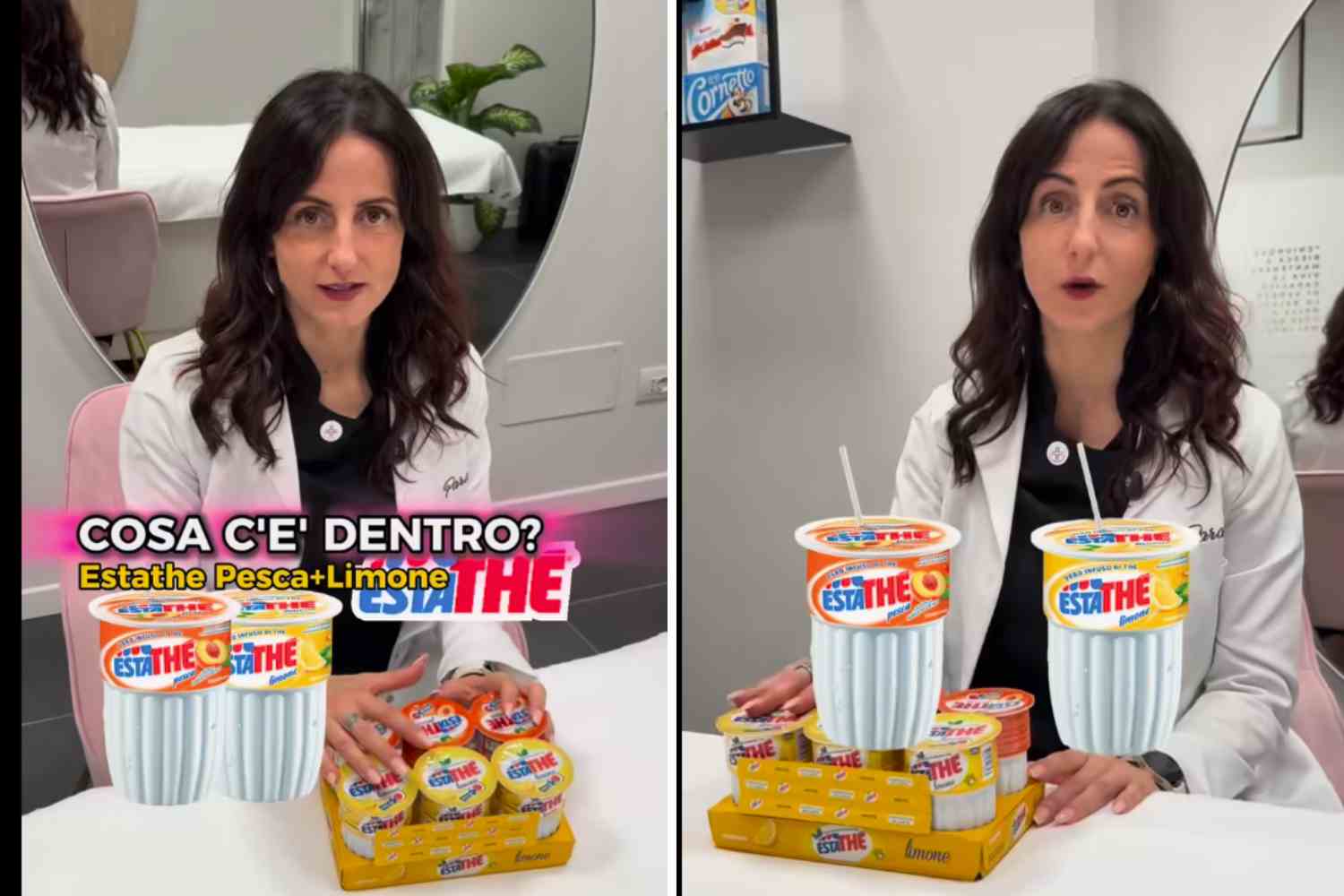
For years he has been one of the symbols of the Italian summer: Estheté, in Brick or in the glass, accompanies the hot days with an apparent simplicity. Fishing or lemon taste, fresh, practical, “it looks light”. But is it really the case?
To dismantle the myth of healthy cold tea, the nutritionist Angy Bro thinks about it, who in a video on Facebook analyzes the ingredients and nutritional values of the famous drink by Ferrero. And what emerges is not light at all.
“We analyze both fishing and lemon. Let’s see the differences.
Behind that 200 ml bottle, there is more sugar than fruit. And the risk, according to the nutritionist, is precisely in the incorrect perception that consumers have of this product.
How much sugar contains ecstatic?
The short answer? A lot.
In the classic 200 ml brick, there are 18 grams of sugar. A quantity that Angy Bro translates thus, to make it immediately understandable:
“In the classic 200 ml brick there are 18 grams of sugar, equal to 4 and a half sachets.”
You don’t need to be a nutrition expert to understand that four and a half sachets in one drink are many. And the problem is not only the quantity, but the fact that they are simple sugars in liquid form. This means that they are absorbed very quickly in the blood, causing blood sugar peaks and a sort of “dependence” effect.
“The more you drink sweet drinks, the more you find water inherent,” warns Angy.
Over time this mechanism can lead people to drink less and less water and more and more sugary drinks, feeding a vicious circle.
Fishing or lemon? The (small) differences
Estheté proposes two main flavors: fishing and lemon. But on closer inspection, the ingredients are practically identical, except for a slight difference in the fruity component.
In fishing taste we find 0.5% of concentrated fishing juice, while in the lemon version the fruit is present only in the form of rehydrated lemon juice.
“For this reason the fishing taste remains more fruity and sweet,” explains Angy.
For both tastes, the base is always the same: infusion of black tea (i.e. water and tea leaves), sugar, aromas, acidifying and flavor enhancers.
Zero fat? Does not mean healthy
One of the elements that can deceive is the wording “0 Grassi” shown on the label. But, as the nutritionist points out, this does not automatically mean that it is healthy.
“In the nutritional values, 0 fats is indicated, but 0 fats does not mean healthier. We must still be careful of excessive consumption due to the simple free sugars.”
In other words, the absence of fat does not compensate for the excessive presence of sugar. And the habit of drinking regularly ecstatic as it can help to dispose the natural taste of water and to increase the desire for increasingly sweet flavors.
Thein effect: do not underestimate the caffeine of tea
Another often forgotten aspect is the presence of thein, which is nothing but tea caffeine. It may seem like a detail, but it has concrete effects, especially on children and adolescents.
“Attention to Teina, because it is comparable to the effect of caffeine,” warns Angy Bro.
If consumed regularly and unaware, it can affect the nervous system, sleep and mood.
Esthahé, like many sugary industrial drinks, can be consumed occasionally, but should not be considered a substitute for water or a healthy alternative. Marketing presents it as a light and fruity choice, but the reality is very different: it is a drink with high sugars, aromas and very little true juice.
“Feeding your body, not to satisfy it”, is the phrase with which Angy closes his video.
A direct advice, without moralisms. And maybe it is from here that we should start again: from awareness. Drinking an ecstalé is not a crime. But knowing what you are drinking is your right.
https://www.facebook.com/reel/1463360834851739/?
Don’t you want to lose our news?
