
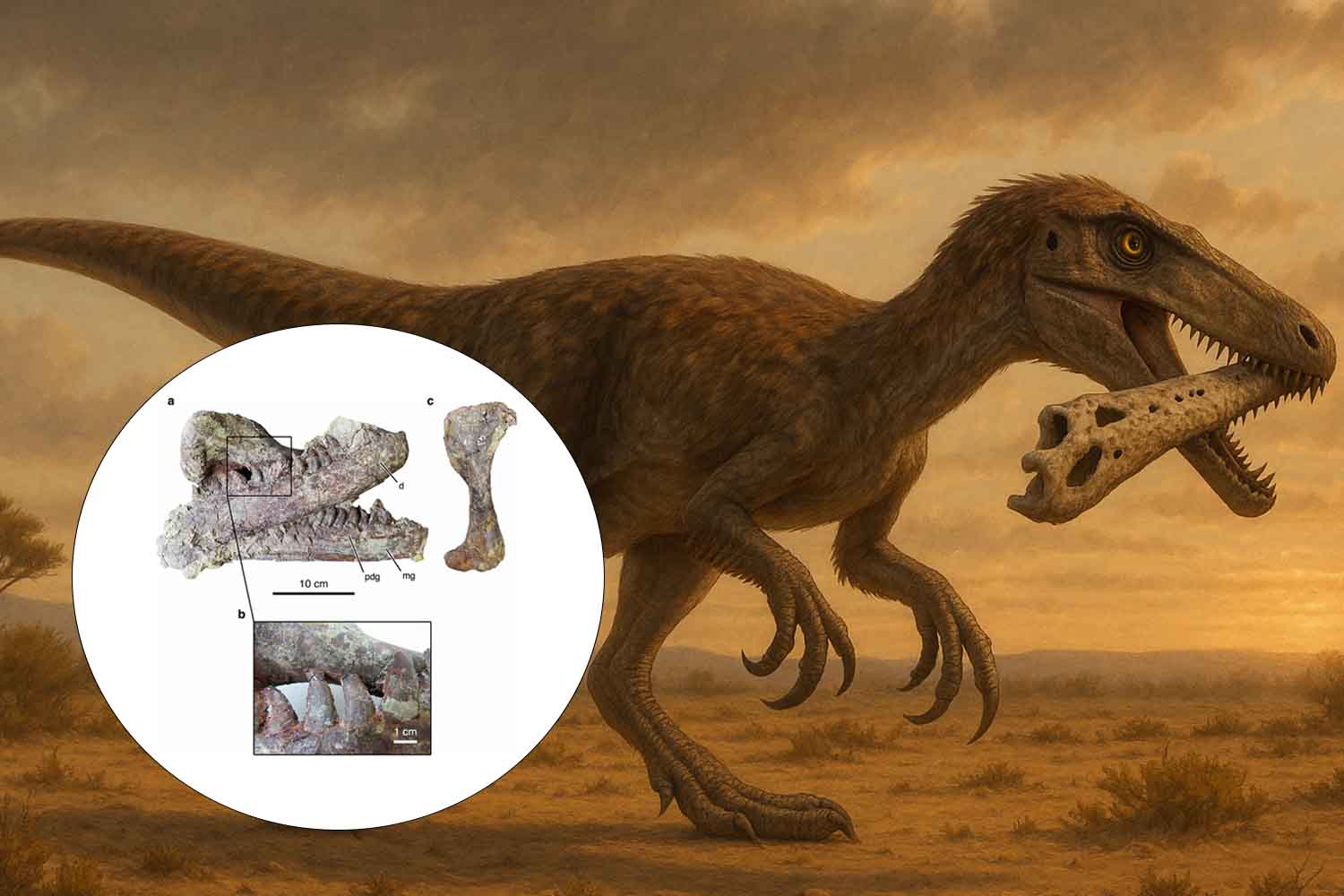
Was found with his last meal still in the mouth. A new Carnivore dinosaurlived about 70 million years ago In what is today the Argentine Patagonia has been brought to light with a Fossilized crocodile bone embedded between the jaws. This extraordinary discovery not only documents a possible predatory interaction between two prehistoric animals, but also represents one of the rare occasions when scientists manage to observe directly what a dinosaur was eating just before dying.
The new dinosaur was called Joaquinraptor Casalibelongs to the still little known group of megaraptorides And it was described by an international paleontologists team in the magazine Nature Communications.
A predator with huge claws and sharp teeth
The fossil was found in the Colhué Huapi lake trainingin the heart of the province of Chubut, in Argentina. To discover the first fragments in 2019 was Bruno Alvarezduring a shipment led by the paleontologist Lucio Ibiricuwhich was exploring the area in search of new fossiliferous sites. When they started the excavations, they immediately realized that they had found something important.
Joaquinraptor was a dinosaur over 7 meters long, with a muscular body and equipped with Strong arms with sharp clawsin particular A huge curvy claw on the thumba distinctive feature of megaraptorides. He also had a elongated muzzledifferent from the massive one of the most famous Tyrannosaurus Rex, which dominated North America in the same period.
This new predator was around in the dense forests of South America just before the asteroid that marked the end of the era of dinosaurs hit the earth. Although the remains are partial, it is one of the More complete skeletons ever found of a megaraptoridea group still wrapped in mystery due to the scarcity of well -preserved fossils.
A crocodile bone between the jaws
But what makes this fossil truly unique is a Crocodile bone found stuck between the jaws of the dinosaur. According to the team led by Matthew Lamannapaleontologist of the Carnegie Museum of Natural History, is not a coincidence.
Joaquinraptor’s bones were found in a relatively intact position, with several parts still connected to each other, which suggests that The dinosaur was buried quickly, perhaps shortly after eating. If it had been a coincidence, one would expect to find remains of other animals scattered on the site. Instead, The only other bone present was precisely that of the crocodileas Lamanna points out:
If it was not his meal, then nature is really making fun of us.
The colleague Ibiricu adds:
This detail could represent a real fossilized instantaneous of a moment of interaction between two prehistoric predators.
Also Fernando Novasone of the greatest experts in dinosaurs in Argentina, confirms the importance of the discovery:
It could be a scene crystallized over time: a megaraptor that was eating a crocodile just before dying.
Megaraptorids: large, clawed and still full of mysteries
Megaraptorids are not raptor in the classic sense of the term, such as Velociraptor (the one made famous by Jurassic Park), but much larger and more massive dinosaurs, with a completely different anatomy. The first specimen was discovered in 1998, but Most of the fossil found so far were very fragmentedso much so that their classification has generated doubts for years.
Many experts consider them today distant relatives of the tyrannosauribut adapted to live in environments where the latter were absent. The new discoveries, such as that of Joaquinraptorhelp to reconstruct their evolution and their ecological role.
The fact that this dinosaur dates back to a period very close to the intention of the dinosaurs (among the 70 and 66 million years ago) shows that megaraptorides they were still numerous and active until the end of the Cretaceousat least in South America.
And it is not excluded that the crocodile finished in the mouth of Joaquinraptor was a new speciesalso recently described: it’s called Kostensuchus Atrox And the same area and the same period lived.
In addition to the scientific value, this discovery affects for The vivid and concrete image that offers prehistoric life: a predator who is finishing eating his prey and is suddenly buried by a sudden event, preserving the evidence of that moment for millions of years.
Discoveries like this allow scientists to go beyond the hypotheses based on teeth or claws, and to seeing clearly what really happened in nature millions of years ago.
