
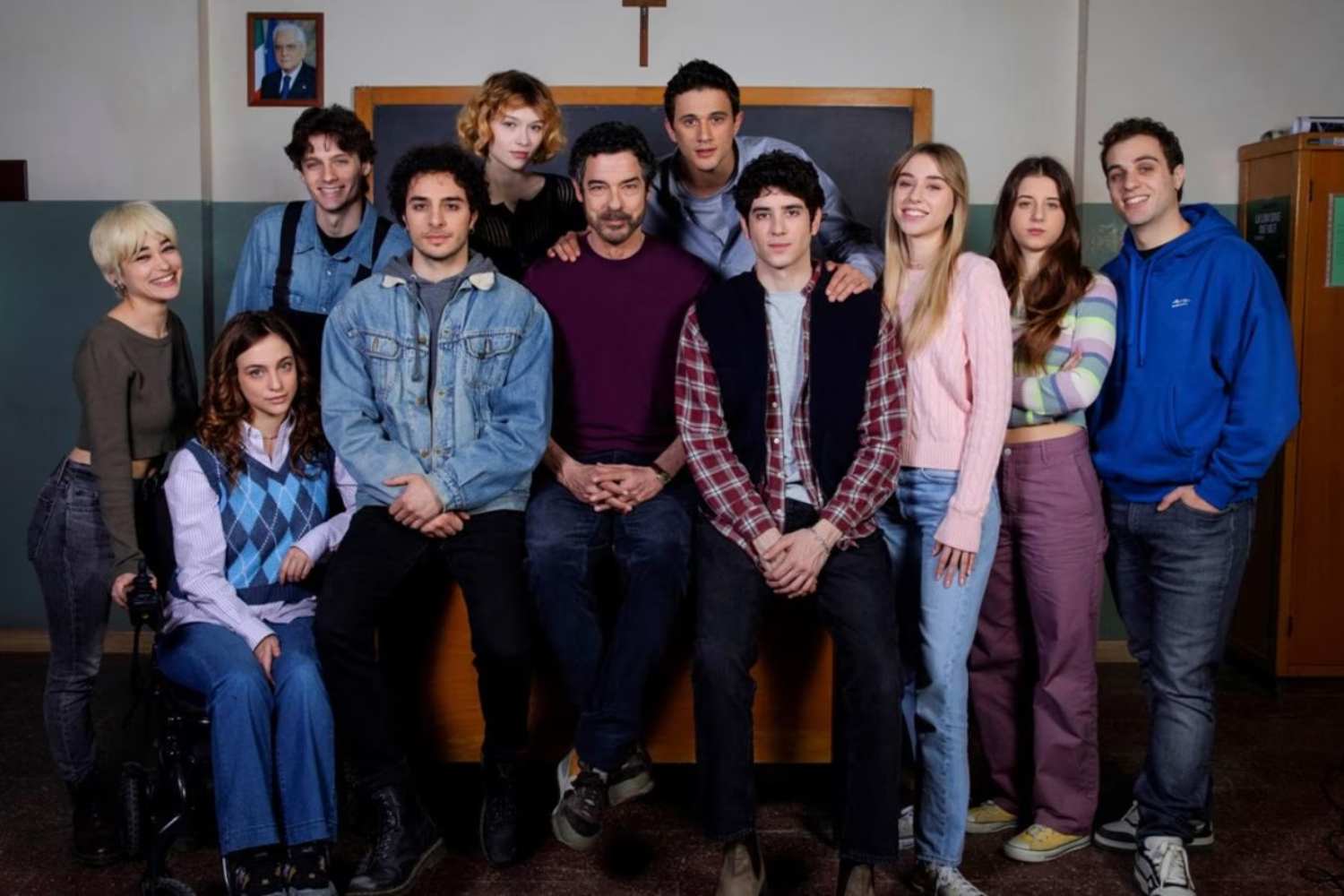
The third season of A professor broadcast starting this evening on Rai 1 marks the return of Dante Balestra, played by Alessandro Gassmann, ready once again to lead the 5th B in a year which, in addition to being that of the final exam, will be a test of personal growth for all the protagonists. The strength of the series, co-produced by Rai Fiction and Banijay Studios Italy, has always been its ability to blend school stories and real life, transforming philosophy into a tool for understanding emotions and contradictions.
We find the characters where we left them, but the picture has changed: the choices of the past knock on the door, relationships are redefined, new arrivals break apparently consolidated balances. It is a season that revolves around a key word: maturity, not only scholastic maturity, but that which calls into question identities, fears, desires and fragility.
View this post on Instagram
Dante between personal crisis and responsibility towards students
Dante, forced to leave his ex-wife’s villa, moves with Simone to his mother Virginia’s house. This change, apparently logistical, becomes a mirror of his deepest uncertainties: the brilliant and non-conformist professor is now called to deal with himself, with the weight of failures and with the expectations of others.
Anita returns next to him, played by Claudia Pandolfi, who receives a substitute at the Da Vinci high school. Finding yourself in the same corridors every day means accepting that unresolved and desire can coexist, and that adult love is often unstable ground, made up of wounds and restarts.
The search for his own identity shakes Simone’s heart
But the central point of the series, as always, remains the boys. In particular there is Simone, Dante’s son, who continues to explore his emotional and sexual identity. First there was the infatuation with Manuel, Anita’s son, in a relationship that has always escaped definition. Their story, made of intimacy, silence, unspoken complicity, represents one of the most delicate explorations of youthful identity.
On the other hand there is the open wound of the relationship with Mimmo, a Neapolitan boy who has served part of his sentence in a juvenile prison and who, thanks to Balestra’s intervention, ends up in his school as an aide. Theirs is a love born in fragility, linked to a dangerous secret and never really closed despite Mimmo’s entry into the witness protection program.
Yet the point of tension continues to be Manuel: constant presence, at times cumbersome, capable of arousing jealousy, protection, unconfessed attraction. Manuel, despite declaring himself attracted to girls, is unable to break the thread that binds him to Simone: a bond that defies labels and creates a space of sincere ambiguity, where the two try to understand who they are for each other.
The situation will become even more complicated with the arrival of Thomas, a friend from middle school, who will add another nuance to his journey: Simone seeks a definition that is not imposed from the outside, but which starts from his need for truth. The series addresses gay love without rhetoric, showing how desire can be a place of discovery but also of fear and conflict. The search for identity thus becomes one of the central themes, told with sensitivity and without rigid schemes.
Disability and the sense of being “less”
The new season will once again give space to the theme of disability, intertwining it with the emotional insecurities typical of adolescence. Viola, in a wheelchair after an accident, has finally opened up to the world but is always torn between the desire to be loved and the fear of “not deserving” that happiness and Rayan’s love, of not being enough and not being able to give him enough. It is one of the most delicate emotional issues: feeling like a burden, fearing the gaze of others, experiencing your body as a limit.
The series does not indulge in pietism: instead it shows how the lack of self-esteem can be more disabling than disability itself, and how the path to acceptance passes through relationships with others, but above all with oneself. Disability is treated as a real condition, not as a narrative obstacle, and becomes part of a broader search for identity, made up of acceptance and new possibilities.
New arrivals, new tensions
And then there are the new entries of the season. The entry of the new principal Irene Alessi, played by Nicole Grimaudo, pushes the school towards a more rigid, competitive and performative vision. Dante and Irene, attracted to each other, embody two opposite ways of reading the world: critical thinking versus the rigor of results.
At their side comes Leone Rocci, the new Physics professor, a former student of Dante: between them there is a painful past that re-emerges in the present, transforming the school into a field of subtle tensions. His “astronomical” lessons win over the students, but do not dissolve the frost that separates him from the old master.
A maturity that is not just scholastic
With this context, the 5th B prepares for the exam, but what makes this season more intense than the previous ones is the way in which each character, teenager or adult, faces a form of emotional growth. The philosophical questions that Dante brings into the classroom become ideas for dealing with internal changes: what does it mean to be authentic? How do you manage the fear of failure? How do you deal with your fragility? Maturity is not just a scholastic achievement: it is a test of identity, a passage that requires courage, understanding and the ability to recognize one’s limits without being crushed by them.
View this post on Instagram
You might also be interested in:
