
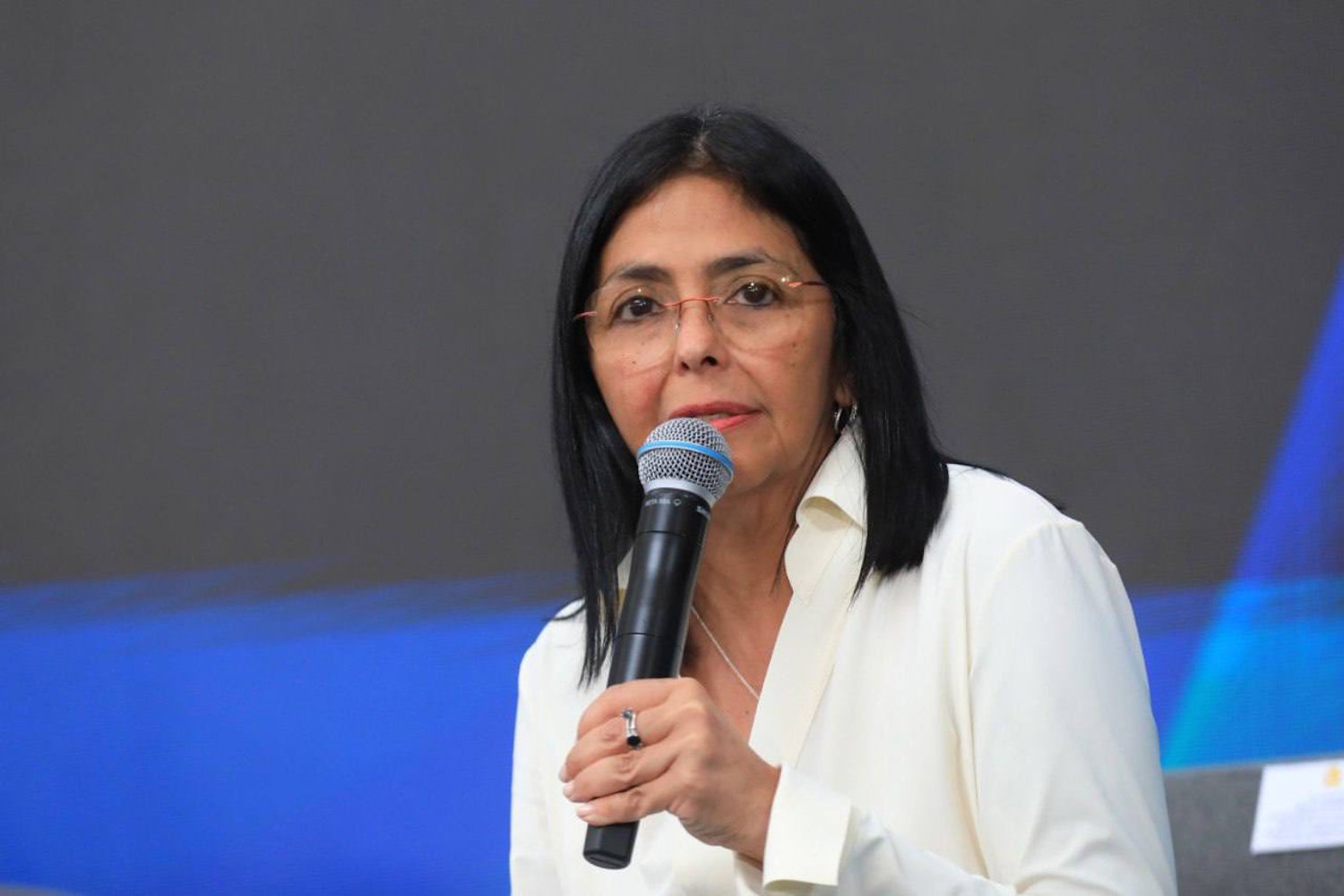
In the chaos following the US military operation that led to the capture of the Venezuelan president Nicolás Maduroone figure quickly (and necessarily) emerged as a point of reference for power in Caracas: Delcy Rodriguez.
Vice-president since 2018 and minister of hydrocarbons, Rodríguez became president interim of the country – as the Constitution dictates -, while Maduro and his wife Cilia Flores were transferred to the United States to face charges related to drug trafficking. But who exactly is he? Delcy Rodriguez?
If, in his head, Donald Trump is convinced that the United States “they will run the country” up to one “appropriate and judicious transition” of power, without obviously providing concrete details, this declaration raises many concerns in terms of international law and national sovereignty. According to the Venezuelan Constitution, in a scenario of “absolute absence”, the president interim should call elections within 30 days to re-establish a legitimate Government (in theory with a six-year mandate for the elected representative). But this constitutional scheme is complicated by a country torn by internal conflict and external pressures.
In this context, Trump indicated Rodríguez as a possible transition figure, claiming that she would speak with Secretary of State Marco Rubio and agree to collaborate with the United States.
But will it be like this?
Not exactly. Rodríguez herself, in a speech broadcast on state television, asked for evidence that Maduro and Flores are alive and reiterated that “we will never be slaves again, we will never be a colony of any empire againo”. A message that mixes nationalism, resistance and continuity with the project of Chavez.
At least for now, the power structure does not appear to have crumbled. Alongside Rodríguez, there remain central figures of the regime, such as the Minister of the Interior Diosdado Cabello and the Minister of Defense Vladimir Godfather López. A presence that reinforces the idea of a controlled transition, rather than a clear break.
Who is Delcy Rodríguez
Born in Caracas in 1969, Delcy Rodríguez comes from a family deeply marked by political militancy. His father, Jorge Antonio Rodríguezwas a Marxist leader and co-founder of the Liga Socialista, involved in the kidnapping of the American entrepreneur in the 1970s William Niehous. He died in 1976, aged just 34, while in prison.
Lawyer and professor at the Central University of Venezuela, Rodríguez began her political career in the early 2000s under the presidency of Hugo Chavezthe architect of the Bolivarian Revolution, holding various institutional positions. In 2013, with Maduro in power, she was appointed Minister of Communication and the following year she became the first woman to lead the Venezuelan Foreign Ministry, a role in which she firmly defends the Government from international criticism, even in forums such as the United Nations.
After presiding over the National Constituent Assembly, in 2018 she was chosen by Maduro himself as vice president. Since 2020, Rodríguez has also been Minister of Economy and Oil, a crucial role in a country whose economic survival is linked precisely to black gold. Precisely this technical competence is one of the elements that would have convinced the Trump administration to consider her a “manageable” figure, as reported by the New York Times: in a context of increasingly heavy sanctions, Rodríguez managed to partially stabilize the economy and increase oil production, earning the respect – albeit controversial – of some US officials.
Despite this, Delcy Rodríguez has been sanctioned by the European Union, Canada, Switzerland and the United States, accused of human rights violations and repression of dissent. She is also banned from entering Colombia, a country that openly opposes the regime in Caracas.
Now his political future remains uncertain. Trump has already announced his intention to take control of the Venezuelan oil industry, promising to “make the people of Venezuela richA statement that cannot help but raise disturbing questions about the fate of the country’s natural resources and the population and about the increasingly blurred boundary between political intervention and economic interest.
What is certain is that Delcy Rodríguez finds herself at the center of a very delicate phase: on the one hand the pressure of the States (which do not rule out new military actions if the new leadership does not align with their interests), on the other the loyalty to a system of power that is based on the army, oil and anti-imperialist rhetoric.
Once again, Venezuela’s fate seems to be played out more in the halls of global power than at the ballot box. And the civilian population risks paying the highest price, as often happens.
And as for Maduro?
Maduro is detained in the Metropolitan Detention Center in Brooklyn. Here he is expected in federal court in Manhattan, where he will have to respond to serious criminal charges of narco-terrorism, drug trafficking and weapons possession that date back to an original 2020 indictment.
The judicial framework that awaits him in the US is among the most severe possible: the charges include coordination of an alleged cocaine trafficking network and cooperation with cartels such as Sinaloa and the Tren de Aragua armed groups. These crimes, if proven, carry penalties potentially up to life in prison.
