
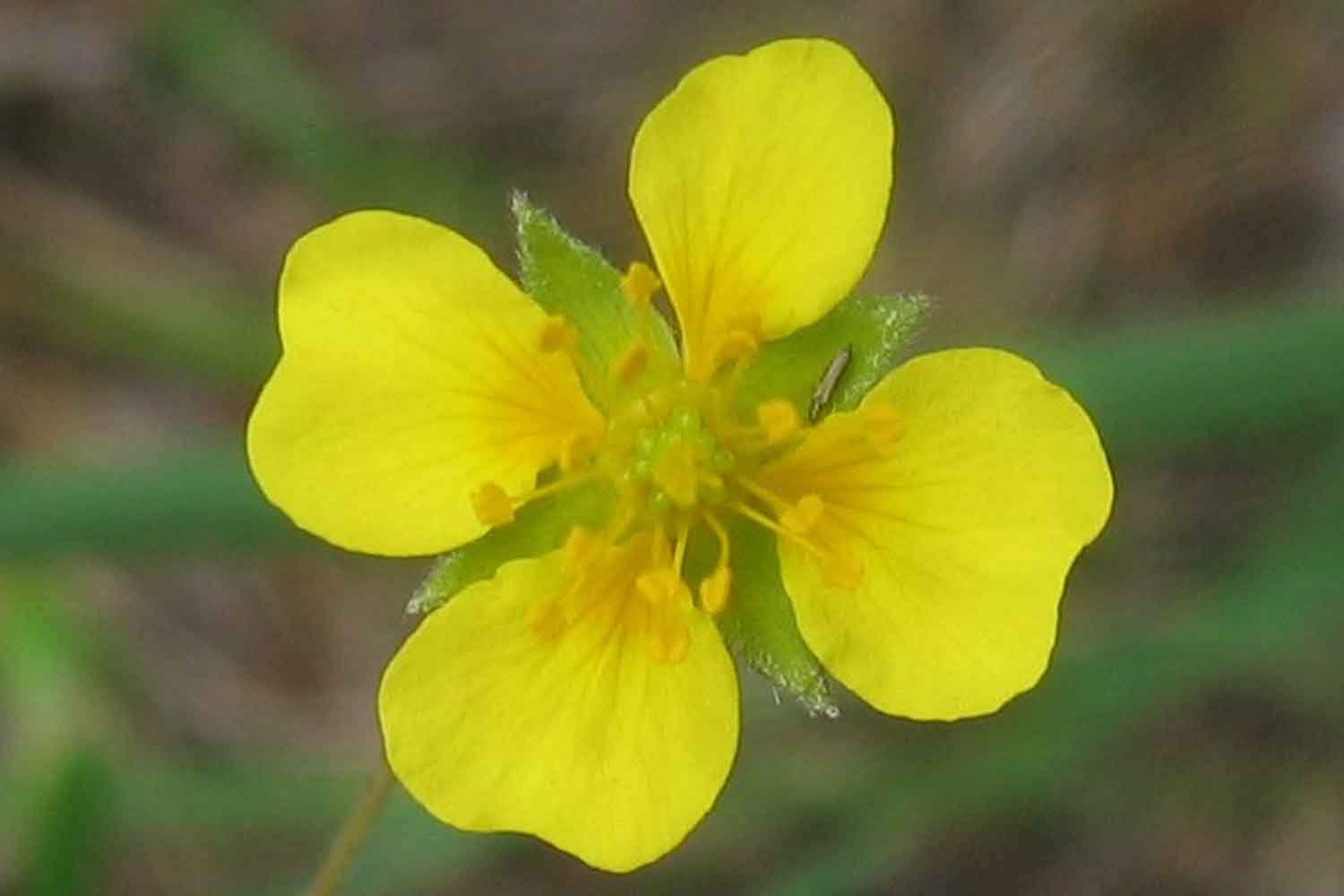
For years, swamps have had a bad reputation: damp, stubborn places, full of tiny life and substances that work silently. Then science arrives, it bends over the mud with the patience needed for serious things, and discovers that right there, among peat bogs and moors, grows a yellow flower that popular medicine already knew very well. The tormentilla (Potentilla erecta), also known as cinquefoil tormentilla, widespread in the United Kingdom, Ireland and many areas of Europe, entered a new chapter in its history when a study published in Microbiology has shown that its extracts are able to slow down one of the most stubborn pathogens in contemporary medicine.
The work started out wide, almost like explorers in lab coats. Researchers from the University of Southampton, the NatPro Center of Trinity College Dublin and Brunel University London analyzed 70 plant species from Irish wetlands, within a biodiscovery project built to search for active molecules where little is generally looked. The idea had simple, robust logic: a plant that survives in harsh environments builds effective chemical defenses, and those defenses, once brought into the laboratory, can transform into antimicrobial activity. In the midst of that collection of species, tormentilla immediately stopped seeming like any other weed.
The target of the test already had a name capable of freezing several hospital wards: Acinetobacter baumannii. We are talking about a bacterium associated with infections contracted in the healthcare sector, particularly dangerous for fragile or immunocompromised people, capable of affecting wounds, the respiratory system and the urinary tract. It is one of those pathogens that antimicrobial resistance has made increasingly difficult to treat, to the point of transforming it into a feared presence throughout the world. Within this scenario, the tormentilla showed two things together, and this double move already explains why the work attracted attention.
On the one hand it inhibited the growth of A. baumannii resistant to multiple antibiotics. On the other hand, it has shown the ability to enhance colistin, the antibiotic that is called the last line of defense when the options are limited. When it comes to colistin, the therapeutic margin is already narrow; when colistin loses its effectiveness, the picture quickly becomes harsh. The possibility of extending its shelf life, making it more effective through plant compounds, moves the discussion onto very concrete ground.
Popular memory had already seen something
The most fascinating part of this story lives at the point where traditional knowledge stops seeming like shelf folklore and returns to ask for a listen. Tormentilla has been included in European remedies for gastrointestinal disorders, mouth inflammation, wounds and pain for centuries. A long trail of popular uses has accumulated around it: roots boiled in milk for children’s colic, preparations for toothaches, applications for the oral cavity and for stomach problems. Its very name carries within it the pain it was thought to be able to relieve. That knowledge, today, appears less naive than much modern medicine would like to believe.
In the material linked to the study, a very precise ethnomedical trace even emerges, almost domestic in its immediacy: the reference to gargling with tormentilla in water to restore stability to loose teeth. Precisely signals of this type have pushed researchers to look for an antibacterial effect and to transform a historical intuition into a real microbiological investigation. It is the kind of passage that simple narratives do not like, because it mixes botany, popular memory and laboratory. This is exactly why it works.
The decisive point lies in the iron
The real value of this study lies here. The researchers avoided the “it seems to work” shortcut and went to find which molecules were responsible for the effect. They identified agrimoniin and ellagic acid, two bioactive compounds present in tormentilla, and clarified the mechanism with a precision that makes the work much more solid. These substances alter the bacterium’s iron homeostasis: in practice they starve it of iron, an essential element for its growth and for many of its vital functions. When the iron is reintroduced from the outside, the effect is reduced and the result confirms that the node is right there.
This detail changes the weight of the discovery. The tormentilla stops remaining suspended in the generic halo of the interesting herbal remedy and enters the much more serious terrain of the pharmacological candidates that show how they work. And it also shows another useful quality: roots, flowers and leaves contain sufficient quantities of the active compounds to be effective. In short, the plant distributes its weapons in several parts of the plant body, and this abundance widens the margin of study for possible future applications.
Then comes the data that interests anyone already thinking about developing a reproducible product: the same antimicrobial activity appeared in samples collected in Wicklow, Kerry and Tipperary. For a plant discovery, consistency matters almost as much as effect. An isolated result is seductive. A replicable result begins to build credibility. The tormentilla, at least on this point, gave a very clean answer.
Here it is best to keep your feet firmly planted on the ground. The study talks about the laboratory, isolated compounds, verified mechanisms and a concrete perspective. The clinical perspective still requires formulations, doses, safety, testing and time. No one is saying that just picking a marsh flower is enough to solve the problem of antibiotic resistance. Every serious step in this field brings with it the discipline of tests, the slowness of the obligatory steps, the rigorous control of effectiveness and safety.
However, a fact remains that is difficult to ignore. Antibiotic resistance continues to narrow the therapeutic space, and just as this space becomes narrower, a swamp plant used for centuries returns to the scene with a robust argument: it can target a bacterium feared in hospitals and it can make a last-line antibiotic stronger. Popular medicine, every now and then, leaves traces that only await better tools to be fully understood. The tormentilla had already begun to speak a long time ago. Microbiology has now decided to listen to it seriously.
You might also be interested in:
