
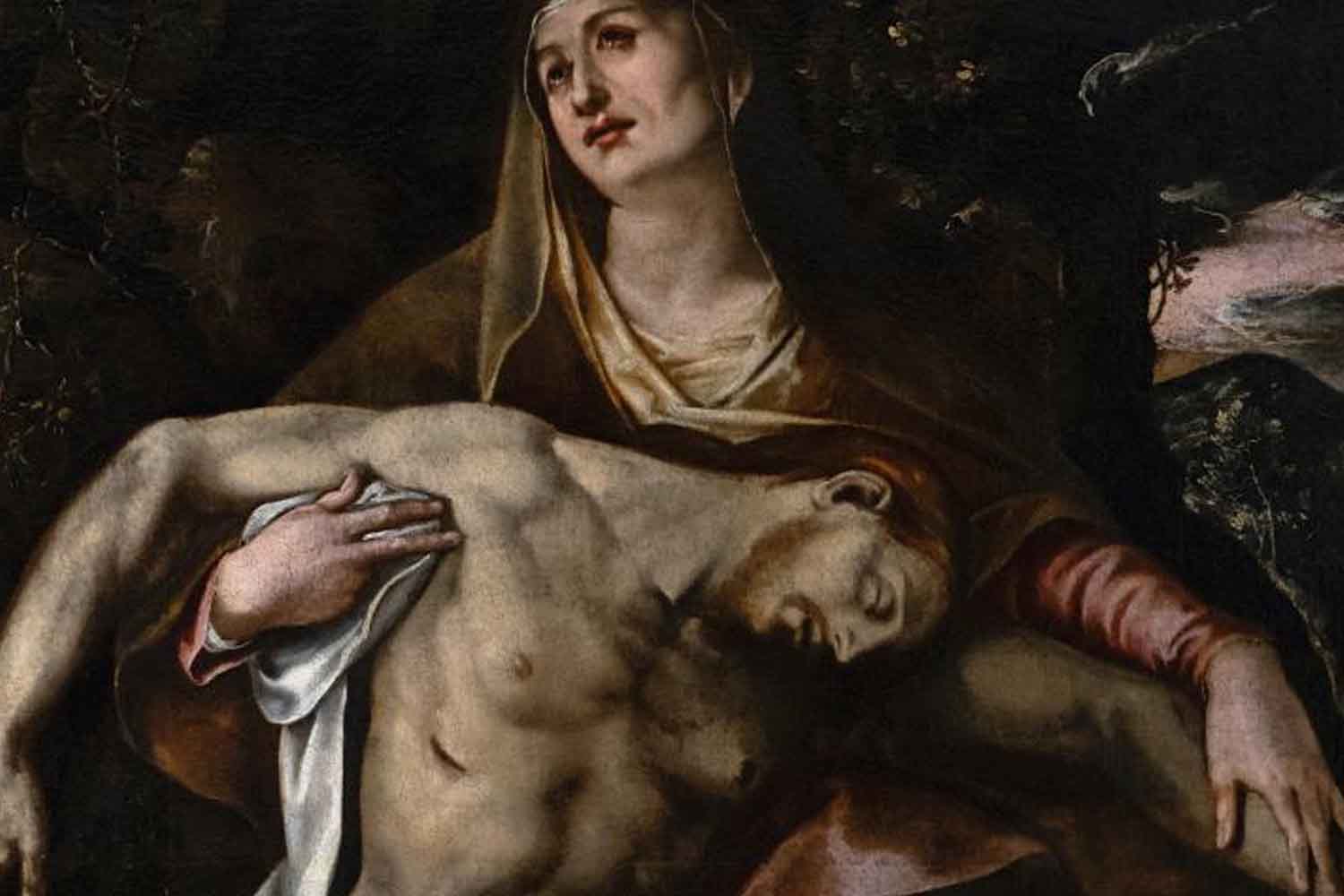
In the world of art, one detail is enough to change the fate of a work. A painting considered anonymous can suddenly transform into a sensational discovery when scientific analyzes and historical research suggest a possible link with a great master of the past. This is exactly what is happening around Michelangelo’s alleged secret Pietà, a painting purchased almost by chance and today at the center of a heated debate between scholars, diagnostic laboratories and art historians.
The news began to circulate after several European newspapers relaunched an indiscretion published by the Belgian newspaper Le Soir. According to this reconstruction, a painting that appeared on the antiques market as an anonymous work could be linked to Michelangelo Buonarroti, one of the most studied artists in the history of the Renaissance.
The case immediately attracted great attention also due to the context of the contemporary art market. A few weeks ago, in fact, a simple drawing attributed to the master was sold at auction for almost 30 million euros, demonstrating how the value of works linked to the Tuscan genius can reach extraordinary figures.
The possible case of Michelangelo’s secret Pietà
The painting that today fuels the mystery of Michelangelo’s secret Pietà was initially cataloged as an anonymous painting dating back to the 16th and 17th centuries. The work appeared in the catalog of the Wannenes auction house in Genoa, without any particular indication of its provenance.
In 2024, two Belgian collectors came across the image while consulting the sale catalog and decided to purchase the painting for around 35 thousand euros. At that moment there was no hypothesis of attribution to Michelangelo: it was simply an ancient painting with characteristics compatible with the painting of the Tuscan-Roman area.
Once it arrived in Belgium in April of the same year, the work underwent a program of scientific analysis at the Royal Institute of Artistic Heritage (IRPA) in Brussels. The investigation was launched after one of the owners noticed a curious detail under the layers of paint.
In fact, two almost invisible monograms appeared on the surface of the painting, one painted on a leaf and the other on a skull placed at Christ’s feet. This detail prompted collectors to commission an in-depth study.
The painting depicts the dead Christ with open arms supported by the Virgin, a classic scene of Christian iconography. The two figures are placed inside a cave that opens towards the landscape. The composition inevitably recalls the famous Pietà sculpted by Michelangelo in 1499 and preserved in St. Peter’s Basilica, even if in this case it is a painting and not a sculpture.
The work is known in more recent studies with the title of “Spiritual Pietà” and measures approximately 134 by 107 centimetres.
Scientific analyses, sixteenth-century pigments and a study of over 600 pages
The scientific investigations carried out in the IRPA laboratories have provided various elements compatible with the chronology of the 16th century. The specialists used a combination of advanced diagnostic techniques, including infrared reflectography, X-ray fluorescence, x-rays and carbon-14 dating.
The results placed the canvas support between 1520 and 1660, with a statistical probability of 95.4%. The analysis of the pigments also revealed materials compatible with the Renaissance period.
Among the most significant details appears the use of blue enamel obtained from ground glass, a rare pigment in Italian painting but documented in the artistic environment close to Michelangelo. Scholars have also identified a red lacquer made from Mexican cochineal, a color that began to spread in Europe around 1540.
The technical investigations also showed some changes in the pictorial composition, a sign that the work may have been created with an original creative process and not simply copied from another model.
The attribution hypothesis was explored in depth by a large study coordinated by the Belgian art historian Michel Draguet, former director of the Royal Museums of Fine Arts of Belgium and professor at the Université libre de Bruxelles. The work includes over 600 pages of analysis that bring together scientific data, stylistic observations and comparisons with Michelangelo’s late works.
According to this interpretation, the painting could belong to the final phase of the artist’s life, when the master was increasingly influenced by a strong spiritual tension. Some scholars link the work to the religious milieu of the Ecclesia Viterbiensis, a reform circle active in the 1540s around Cardinal Reginald Pole.
Despite these hypotheses, many specialists urge caution. Michelangelo signed very few works in his life: the most famous case remains the Pietà of St. Peter, where he engraved his name on the band of the Virgin. For this reason some art historians look with suspicion at the presence of the monograms identified in the painting.
Another critical point concerns the historical provenance of the work, which does not appear in ancient inventories nor in known Renaissance documents. Without a clear collecting history, attribution remains difficult to prove with certainty.
For many experts, therefore, the painting could belong to an artist from Michelangelo’s circle or to a painter influenced by his style, a very common phenomenon in the Renaissance.
In the meantime the debate remains open. Michelangelo’s possible secret Pietà continues to fuel curiosity among scholars and collectors, also because a definitive confirmation would completely change the value of the work. A painting purchased for a few tens of thousands of euros could turn into a discovery worth millions, recalling famous cases such as that of Salvator Mundi attributed to Leonardo da Vinci.
You might also be interested in:
