
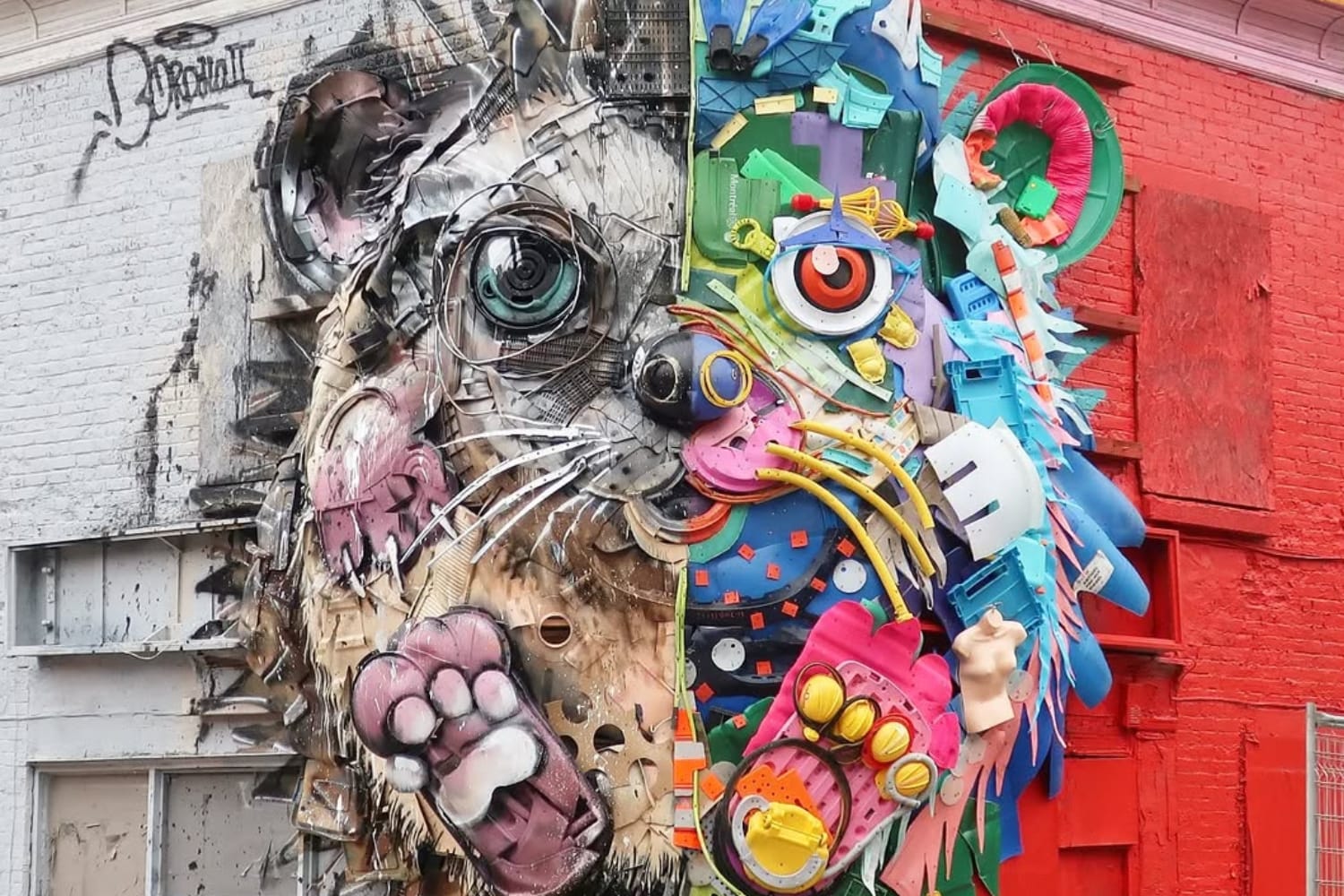
When you observe one of his monumental works, created with urban waste and abandoned materials, it is impossible to remain indifferent. Arthur Bordalo, known internationally as Bordalo II, is one of the most recognizable and influential urban artists on the contemporary scene. Born in Lisbon in 1987, Bordalo II transformed the very concept of waste into a powerful, direct and profoundly political artistic language, capable of describing the sick relationship between man, consumerism and the environment.
Who is Bordalo II
The name Bordalo II is not accidental. Arthur Bordalo chooses this pseudonym as a tribute to his grandfather Real Bordalo, a famous painter in Portugal, with the aim of carrying on a family artistic tradition by reinterpreting it in a radically contemporary key. Raised among canvases, colors and ateliers, Bordalo came into contact with art as a child and began experimenting with graffiti writing at a very young age, painting walls and urban spaces in Lisbon around the age of eleven.
View this post on Instagram
Parallel to his path as a street artist, Arthur Bordalo attended the Faculty of Fine Arts in Lisbon, where he studied painting and experimented with different materials and techniques, from sculpture to ceramics. He did not formally conclude his academic career, but it was during those years that his artistic vision matured: art not as a decorative object, but rather as a tool of social denunciation and collective reflection.
Big Trash Animals and sustainable urban art
The distinctive feature of Bordalo II is the exclusive use of waste materials: plastic, tyres, metal, broken household appliances, car carcasses and industrial waste become the raw material of his works. From this vision was born the artist’s most famous project, Big Trash Animals, a series of monumental sculptures depicting animals, often threatened species or symbols of biodiversity in danger.
View this post on Instagram
His works are neither casual nor purely aesthetic. Every animal built with waste represents a clear contradiction: nature wounded by man is rebuilt with the very thing that destroys it. It is a direct message, understandable to anyone, which does not require complex explanations. Bordalo II brings these installations into public spaces, on city walls, on abandoned industrial buildings, transforming the urban landscape into a permanent environmental manifesto.
Over the years, his works have appeared in Europe, the United States, Latin America and Asia, with installations in cities such as Lisbon, Paris, Brussels, Miami, Las Vegas and Sao Paulo. Overall, Bordalo II recovered and reused tens of tons of waste, demonstrating how urban art can also become a concrete act of sustainability.
An artist and an artivist
Arthur Bordalo likes to define himself as an “artivist”, a fusion between artist and activist. His production is not limited to the creation of iconic works, but aims to raise public awareness on the issue of pollution, excess consumption and individual responsibility. His sculptures, deliberately oversized, force the viewer to confront an often ignored reality: that of the waste we produce every day.
Alongside urban installations, Bordalo II participates in international exhibitions, educational projects and collaborations with local institutions and communities, using art as a means of dialogue. His language is direct, accessible and visual, designed to reach not only professionals, but a broad, transversal, global audience.
View this post on Instagram
Today Bordalo II is considered one of the reference names in contemporary street art with an environmental theme. His style is immediately recognisable, as is the message he consistently carries forward: there is no waste that doesn’t tell something about us. His works force us to look at what we normally discard, to recognize its weight, impact and consequences.
You might also be interested in:
