
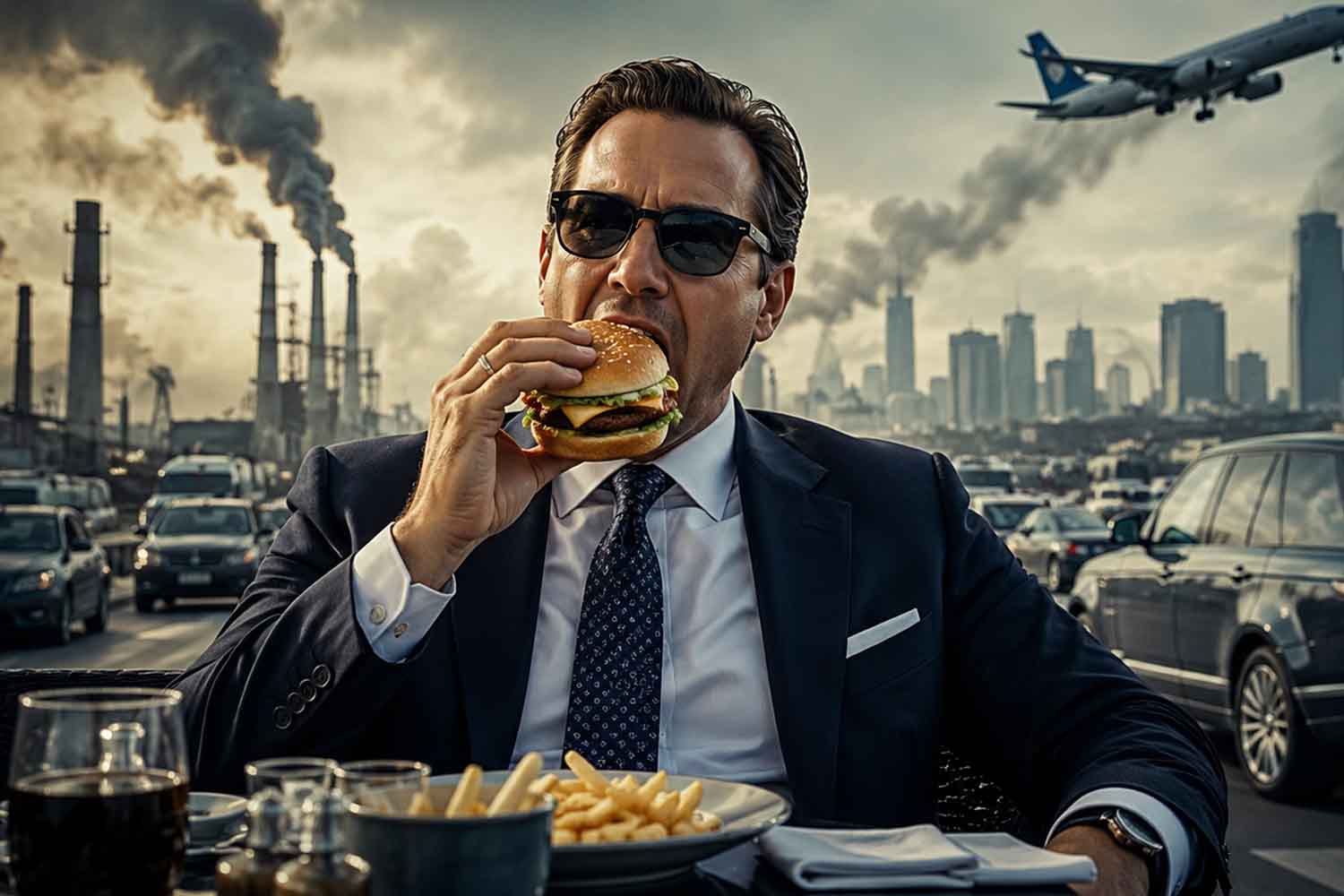
The climate crisis, it seems, also passes through the very sad scenario of normal things. The car taken to travel two blocks, why ever walking. The steak placed on the plate like a medal for valor. The long flight told with that “I deserve it” air, the SUV left crooked on the crosswalk and called personal freedom. All very everyday, all very innocent, all very “but what will happen”. And instead, surprise: someone got there, counted, compared, cross-referenced data and discovered that within certain habits there is also a gender issue.
Gender issues exist. And they often have a quite recognizable appearance: male, wealthy, white, raised in that part of the world where consuming a lot is still mistaken for success in life. A kind of complete package: big car, full plate, long trips, ostentatious security and the planet as a doormat.
A study has brought together research on the climate crisis, global warming and environmental damage by looking at them from a side door, the one that usually remains ajar because it is annoying to open: what men do, what consumption is still packaged as masculinity, which economic sectors remain firmly in their hands, which habits suddenly become “freedom” as soon as someone tries to question them.
The work was created by 22 researchers from 13 countries and crosses very different territories: climate denialism in Canadian oil pipeline policy, the environmental impact of Chinese choices in the Pacific Ocean, Finnish influencers who push meat consumption, up to men activists in Africa, Latin America, the United Kingdom and other contexts. Reading them like this they seem like pieces scattered on a table that is too large. Then you bring them closer and you can see the drawing: power, consumption, male identity, climate. Always them. Always there.
Meat, cars, flights
The easiest data to grasp comes from consumption. Men, in general, tend to have a higher carbon footprint than women, especially when it comes to travel, transportation, tourism and food. In France, research conducted on around 15,000 people showed that the difference comes above all from two very down-to-earth gestures: what ends up on your plate and how you move around.
According to the study, women emit 26% less than men from diet and transportation. Two areas which, combined, are worth around half of the average carbon footprint of a person in France. So no great mystery hidden in some incomprehensible graph: the climate also affects lunch and the daily commute. From “I’ll take the car” said as if it were a natural law. From “I won’t eat without meat” pronounced with the solemnity of a medieval edict.
Red meat and cars explain a large part of the waste, even taking into account the quantity of food consumed, the distances traveled and the work situation. Here the matter becomes less comfortable, because the discussion goes beyond income and comes to the tastes built into people from an early age. There are high-emitting products that continue to be sold as men’s stuff: strength, autonomy, control, performance, stage presence. The usual theater. Only with more petrol and more CO₂.
Even inside the house the pattern can be seen. In couples, eating habits tend to become closer, while in families with children the gap linked to transport grows more. Domestic life, therefore, does not erase these differences. He moves them from room to room. Sometimes he widens them. Like some ugly furniture inherited from relatives, which no one really wants and yet they remain there, taking up space.
At that point gender issues stop seeming like a conference curiosity and become a very real thing. Machismo, when it enters the plate and the garage, leaves exhaust, smoke, petrol, farms, kilometers. The refrigerator open, the car keys on the table, the steak sizzling. More than theory.
The manly trolley
Another piece of research looks at the cultural pressure that leads some men to avoid choices considered too “feminine”. In 2025, a study analyzed the relationship between masculinity and more sustainable food alternatives, because apparently even a veggie burger can become a threat to personal identity. Marvelous. We have reached the point where a legume can undermine the patriarchy.
The research cited shows that men tend to justify meat consumption more when they feel their gender identity is threatened. Traditional masculine norms can be accompanied by higher meat consumption and colder attitudes towards the environment. In the same study, when masculinity is perceived as threatened, willingness towards vegan alternatives decreases, precisely because that food is read as less virile.
It seems like a caricature, but instead it appears in shopping, in restaurants, in advertisements, in online videos, in dinner banter. The burger becomes more than a burger. The steak becomes belonging. Refusing plant-based food becomes a pose, one of those alpha male poses in the supermarket aisle, with his chest puffed out in front of the refrigerated counter. And every pose, repeated enough times, sooner or later disguises itself as nature.
Caution is needed, of course. Some male behaviors weigh more on the climate because they are linked to models, status, money, power, rewarded habits and social images. Watching a man in a jacket eating a hamburger means seeing something more than the usual easy photograph: consumption, ostentatious security, pleasures treated as rights, impact left out of frame like dirty dishes after a dinner where “then I’ll take care of it” and naturally someone disappears.
The researchers also point out another element. Men often show less concern about climate change, less willingness to change daily practices, less ambition in environmental policy and weaker support for forces committed to climate justice. Then comes the upper level, the one where decisions are really made: heavy industry, chemicals, industrialized agriculture, extractive sectors, carbon-based activities, militarism. Worlds with a high environmental impact where the male presence remains very strong. As it happens.
Who consumes and who decides
Social class weighs a lot. The authors insist on an important passage: the most harmful patterns are seen above all among the elite men of the Global North, i.e. in the rich part of the planet. The reference concerns in particular the white men of the Euro-Western elite. Those who had more access to resources, more space to consume, more possibilities to decide and also a certain habit of calling all this “normality”.
The comparison with low-income men in the global South completely changes the scale of the discussion. It’s one thing to talk about those who consume for status, fly often, drive heavy vehicles, eat meat frequently, own resources, influence markets and decisions. It’s another thing to talk about those who live in the poorest countries, often more exposed to the effects of the climate crisis and with very different historical responsibilities. Putting everything in the same bag would be convenient for many. It would also make a big mess.
Within this picture there is also a less dark part. Some men work with urgency and energy to change these trends: in climate movements, in local communities, in environmental battles, in activism networks, in more sober daily choices. Research recognizes this. Masculinity is not treated as a single block, carved in marble and condemned to the eternal barbecue. It is observed for what it is: a terrain full of contradictions, with destructive practices on one side and serious attempts to dismantle them on the other.
Those who study these phenomena have been repeating it for years: there is a lot of research on the negative effects of certain male behaviors on the environment and climate, yet this aspect still remains little present in debates and policies on sustainability. In other words: we already know enough. There is no desire to deal with it.
For years we called all this “lifestyle”. More elegant, of course. It makes less “waste” noise. But the climate is not fooled by words. Look at who consumes, who decides, who leaves the engine running.
You might also be interested in:
