
In recent times, a new generation of products is finding more and more space on supermarket shelves which aim to present themselves as more essential, with less sugar and simplified ingredient lists. An evolution that does not only concern yoghurts, but more generally the entire sector of so-called “free from” products, which range from versions without added sugars to those without lactose, without fat or anything else.
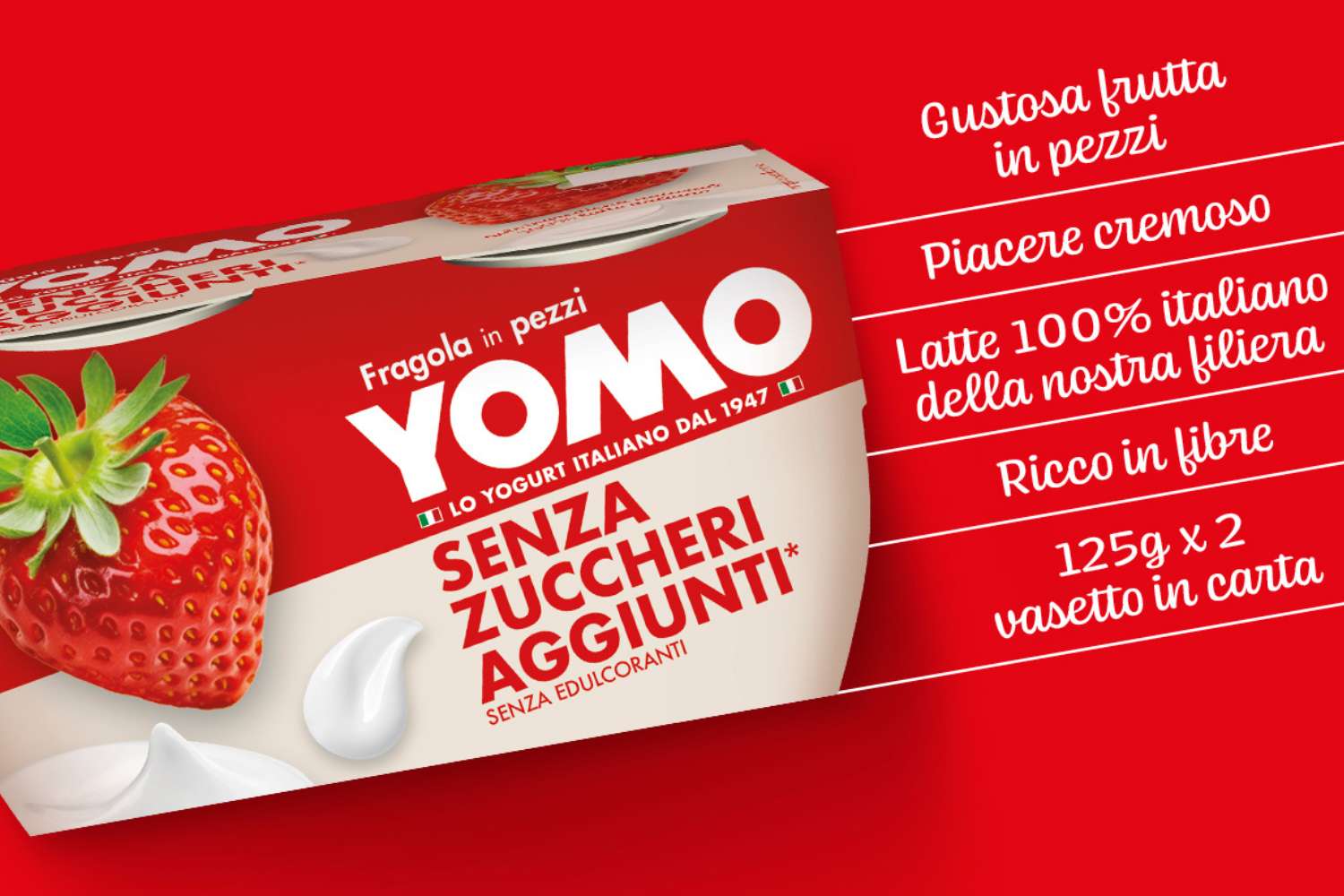
It is in this broader context that the new proposal from Granarolo also fits, which has expanded the range of the Yomo brand with a line of yoghurts without added sugars and without sweeteners, therefore no sweeteners such as stevia or sucralose. The novelty arrived in stores at the beginning of May 2026.
But what does this yogurt really contain? The composition of the new Yomo remains that typical of a fruit yogurt, built on a simple but not “minimalist” base in the absolute sense. At the base we find fermented Italian milk and live lactic ferments, to which is added the fruity part in the different variants: Strawberry, Peach, Cherry, Coconut and Berries.
This is the complete list of ingredients of the line’s strawberry yogurt:
yogurt (whole milk, specific live lactic ferments: Streptococcus thermophilus and Lactobacillus bulgaricus), fruit preparation 18% (strawberry 47%, fiber (oligofructose), corn starch, natural flavourings, black carrot juice, lemon juice, stabilizer: pectin)
View this post on Instagram
The comparison with classic yogurt
If you look at the nutritional values, the difference compared to traditional strawberry yogurt of the same brand is evident especially in terms of sugars. The version without added sugars is in fact around 4.4 g per 100 g, while the corresponding classic yogurt reaches 9.8 g.
In practice, this is a reduction of over 50% in the sugar content, equal to approximately 5.4 grams less per 100 grams of product. A significant gap which reflects the choice to eliminate added sugars, while maintaining those naturally present in the ingredients.
“Without added sugars” does not mean sugar-free
This is precisely where confusion often arises. The wording on the label may make you think of a sugar-free product, but in reality yogurt still contains sugars naturally present in the ingredients, namely those of milk and fruit.
In other words, it is not a “zero sugar” yogurt, but a product in which no external sugars are added during processing. An important distinction, especially for those trying to really reduce their overall sugar intake in their diet.
Is it really a better choice?
The answer is not unique. On the one hand, the new line eliminates added sugars and artificial sweeteners, a positive aspect for those who want to reduce or avoid these ingredients and, above all, for those who are used to sweeter tastes but are gradually looking for a product with a lower sugar content. On the other hand, it is still a yogurt that contains sugars naturally present in milk and fruit, as well as ingredients necessary for the consistency and stability of the product.
In this sense, it is more of a different formulation within the fruit yogurt segment than a true nutritional revolution. For those who wish to further reduce their sugar intake, or are in the habit of personalizing the taste, a simpler choice remains that of natural plain yogurt, to which fresh fruit is added.
