
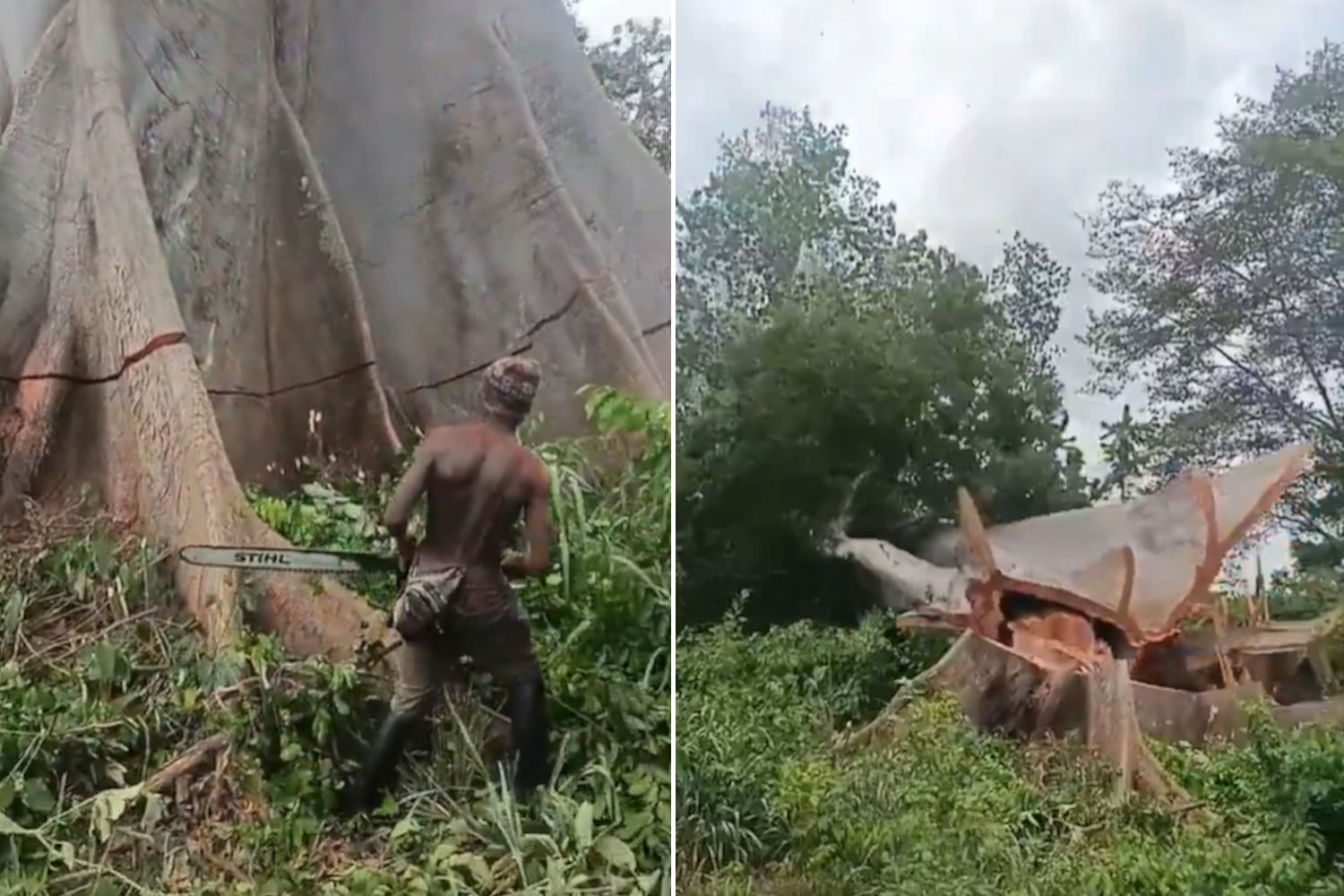
A video circulating on social media has sparked a wave of reactions around the world: a man in Africa is seen filming himself cutting down what is described as a centuries-old baobab tree, estimated to be up to 1,500 years old, presumably to obtain wood for the construction of a house. The scene, initially spread by an information account on
Afrika’da bir adam, evinin yapımında kullanacağı 1500 yıllık devasa baobab ağacını kestiği anları paylaştı pic.twitter.com/9j0LuHQHII
— Bulvar Medya (@Bulvarpress) May 10, 2026
Baobab: natural symbol between history, science and myth
Baobabs are among the most iconic trees on the African continent, often referred to as the “Trees of Life” for their ability to provide food, water and shelter. Some specimens are considered among the longest-lived living organisms in the world. Scientific studies have documented thousand-year-old trees: in Namibia, for example, a specimen was dated to approximately 1,275 years old via carbon-14 analysis. These plant giants are also the subject of growing scientific concern. Between 2005 and 2017, various studies recorded the death of a significant portion of the oldest specimens, a phenomenon also linked to climate change and environmental stress.
The social node: survival versus natural heritage
The affair has deeply divided public opinion. On the one hand there are those who see the gesture as an irreparable act, the loss of a natural heritage that has spanned centuries, surviving historical events such as the fall of the Roman Empire. On the other hand, many highlight the context: in some rural African areas, access to building materials is limited and the need for a house can prevail over environmental protection.
A man in Africa shared a video of himself cutting down a massive reportedly 1,500-year-old baobab tree so he could use the wood to build his house.
Baobabs are often called “the Tree of Life”, some are among the oldest living organisms on Earth.
It’s wild to think of a tree that’s… pic.twitter.com/buMRuClqAq
— Mario Nawfal (@MarioNawfal) May 11, 2026
Let’s not forget the deforestation of the meat industry
The case has rekindled a broader theme: the weight of social narrative in global environmental perception. While episodes – albeit condemnable – like this go viral in a few hours, on the other hand, industrial-scale deforestation linked to global supply chains, including sectors such as intensive farming and meat production in the Amazon, remains less visible.
You might also be interested in:
