
In some gardens the bees arrive before anyone even really thinks about them. They slip among lavender, rosemary, clover, flowers left to grow without too much discipline, and do what they have always done: they look for nectar, pollen, shelter, continuity. The problem is that around them, in the meantime, the landscape has changed. Fewer natural cavities, fewer old trees, more surfaces cleaned to the point of obsession, more pesticides, hotter, more predators, more obstacles.
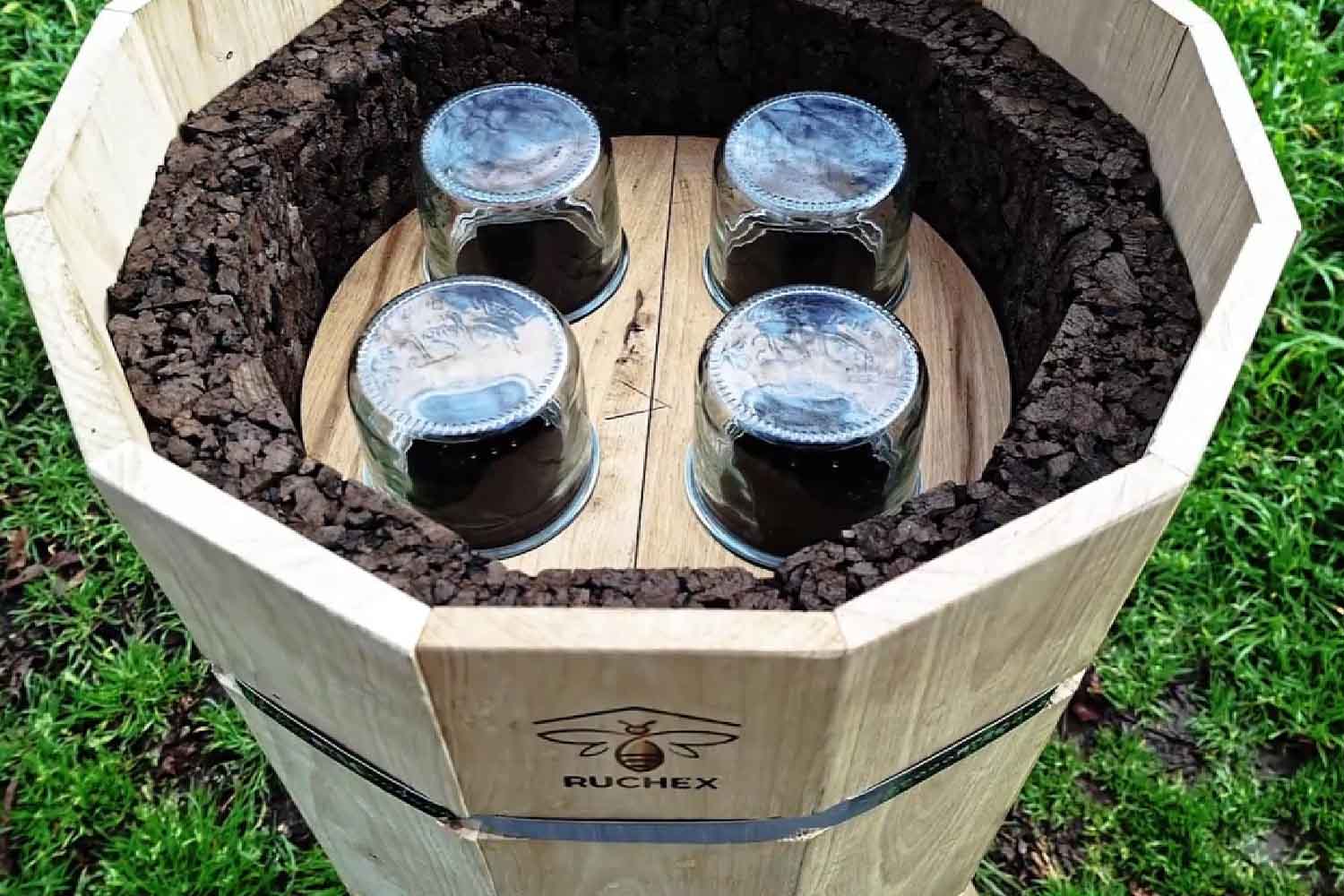
From this friction also arises the interest in a small French invention that has just received a gold medal at the Concours Lépine 2026historic competition dedicated to inventions. It’s called Ruchex and it’s one hive made of expanded cork and local wood designed to resemble, at least in idea, the tree cavities in which bees lived before modern beekeeping transformed their refuge into a more convenient structure to manage.
The promise is simple, and must be taken with the right caution: offer bees a space closer to their natural habitat, without focusing everything on honey production. A small reversal of perspective, in a time in which even biodiversity often ends up measured in yield, harvest, efficiency, numbers.
More shelter than production
The most obvious feature of the hive is its shape. Nothing classic parallelepiped from modern beekeeping: the structure is round, inspired by hollow trunks. Bees can freely build their honeycombs, without pre-set frames, inside a space that tries to imitate a natural cavity. The main material is the expanded corkchosen for its insulating properties, combined with wood and stainless steel straps.
According to the project, the insulation would be up to ten times higher than that of a traditional wooden hive. It is an interesting fact, because thermal regulation matters a lot for a colony: bees spend energy to keep the internal temperature stable and face increasingly hotter winters, summers and increasingly less gentle changes. However, the technical quality of the material is one thing, it is another to demonstrate concrete effects on the health of the colonies over time. Here we will need long observations, independent data and real seasons.
The most convincing point, net of the enthusiasm for the invention that has just been awarded, concerns the approach. The hive is made without plastic, without glue and without screws, with cork, wood and stainless steel. It exists in different configurations, even raised on feet or resting on a wall, and integrates a nutrition system with upside-down jars. Technical details, of course, but they tell a precise direction: reduce synthetic materials and build a less invasive shelter.
Bees already have too many enemies
The interest in objects of this type also arises from a broader concern. Bees and other pollinators live under constant pressure: pesticides, habitat loss, diseases, climate change, scarcity of flowering, spread of the Asian hornet in many European areas. No hive alone can correct all this. It would be comfortable to think so, just as it would be comfortable to put biodiversity in a nice round container and feel okay.
The reality is rougher. A hive can help, if it is placed in a suitable environment. You need flowers, water, the absence of aggressive chemical treatments, space, maintenance, minimum skills and respect for local rules. Installing bees in the garden means welcoming live animals, with precise needs and a direct relationship with the surrounding area. It’s not enough to buy a well-designed object and wait for nature to do everything else.
Precisely for this reason the most interesting side of the cork hive lies in its cultural function. Shift your gaze from honey to bees. From harvest to shelter. From management to coexistence. In a garden left a little freer, with honey plants and less anxiety about mowed lawns, a hive designed for biodiversity can become part of a small domestic ecosystem. Without turning into ecological decoration.
The project has already raised funds through a participatory financing campaign and has exceeded 7 thousand euros to start the first series. The success says something: many people are looking for concrete ways to help pollinators, even outside of professional beekeeping. It is an understandable desire, perhaps even a healthy one, as long as it remains anchored to reality. Bees are not a natural garden accessory, nor a symbolic gesture to photograph in spring.
First the rules, then the garden
Anyone thinking of installing a hive must first inform themselves about the regulations in their area. In Italy, beekeeping requires registrations, distances, health indications and specific obligations. Even a small domestic hive must be placed within the correct framework, because it concerns animals, neighbors, roads, borders and safety. Biodiversity works best when it is not improvised.
Ruchex therefore remains a good idea to observe, rather than a solution to be celebrated with our eyes closed. Expanded cork can offer good insulation, the shape inspired by hollow trunks has a natural logic, the absence of plastic is a plus. However, the real benefits for the colonies will have to be measured over time. Nature doesn’t hand out medals after a fair.
For now, a small but interesting sign remains: there are those who try to design hives starting from bees, instead of just honey. In times of overly tidy gardens and countryside increasingly lacking shelter, this too is a course correction. As long as there are real flowers around, not just good intentions.
